Fine ArtVintageFootageSubscriptionBoardsFree ResearchPricing
  • Fine Art
  • Vintage
  • Footage
  • Subscription
  • Boards
  • Free Research
  • Pricing

Apollo 11 Moon Mission

Historic images of the Apollo 11 moon landing, featuring astronauts conducting experiments and exploring the lunar surface.

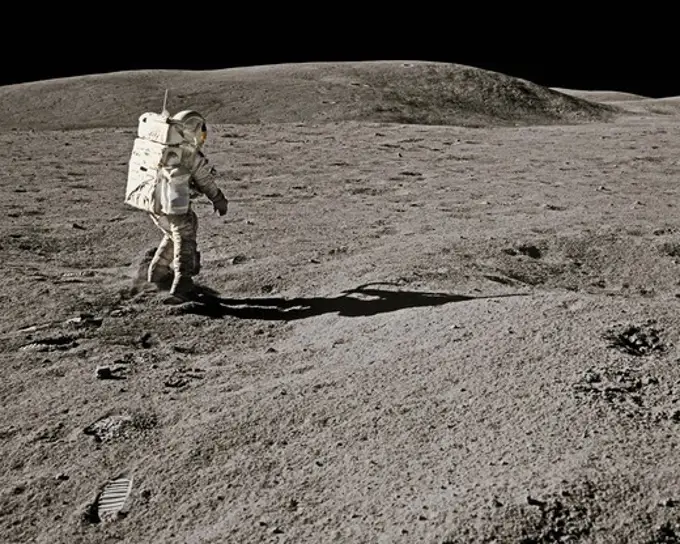
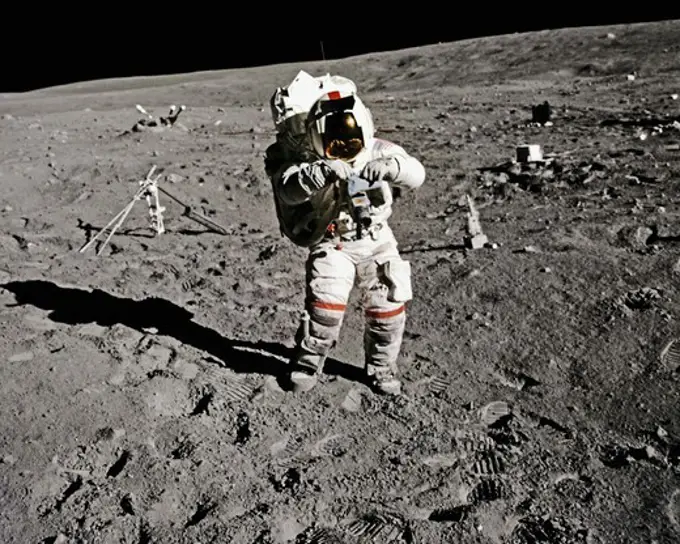
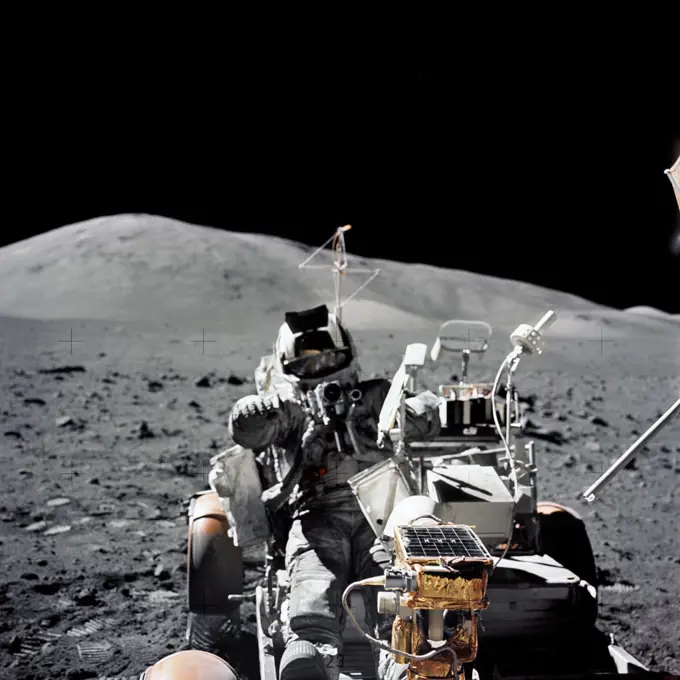
An Apollo 16 Astronaut Walks the Barren Moon
143 assets in this story
4093-20492
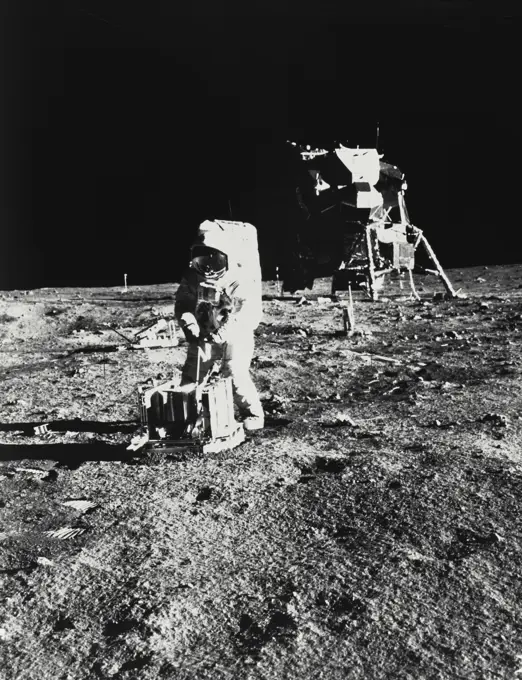
Astronaut Edwin E.Buzz Aldrin Jr.  Lunar Module pilot  is photographed during the Apollo 11 extravehicular activity on the Moon. He has just deployed the Early Apollo Scientific Experiments Package (EASEP).
1899-18984771
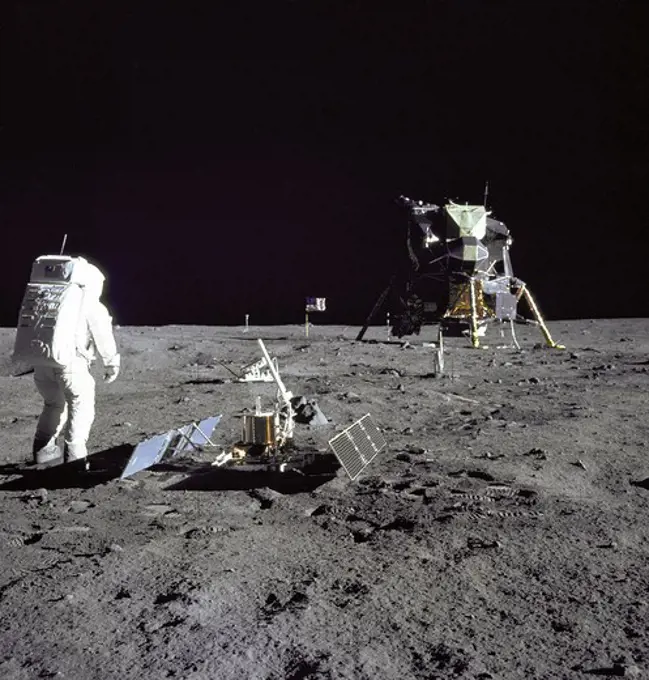
The deployment of the Early Apollo Scientific Experiments Package (EASEP) is photographed by astronaut Neil A. Armstrong, Apollo 11 commander, during the crew extravehicular activity (EVA)..
1838-51330407
American astronaut Edwin E. Aldrin Jr., lunar module pilot, after deploying Early Apollo Scientific Experiments Package during Apollo 11 extravehicular activity on moon surface. Foreground is Passive Seismic Experiment Package, with Laser Ranging Retro-Reflector, U.S. flag and Lunar Module in background, photograph taken by Astronaut Neil A. Armstrong, NASA, July 20, 1969
6145-45240040
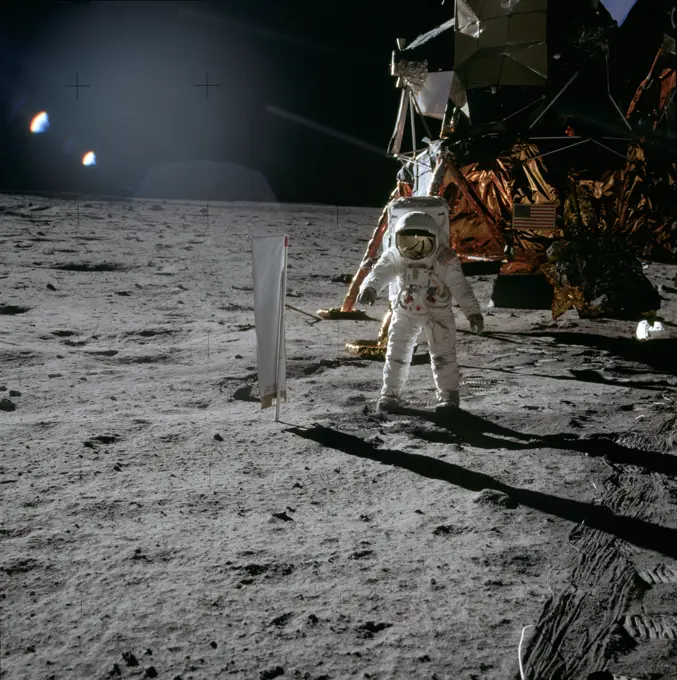
AS11-40-5964 (20 July 1969) --- Astronaut Edwin E. Aldrin Jr., lunar module pilot, is photographed during the Apollo 11 extravehicular activity (EVA) on the moon. He is driving one of two core tubes into the lunar soil. Astronaut Neil A. Armstrong, commander, took this picture with a 70mm lunar surface camera. Aldrin stands near the Solar Wind Composition (SWC) experiment, a component of the Early Apollo Scientific Experiments Package (EASEP, deployed earlier). The SWC is in the center background.
4389-263
An Apollo 16 Astronaut Walks the Barren Moon
4186-4407
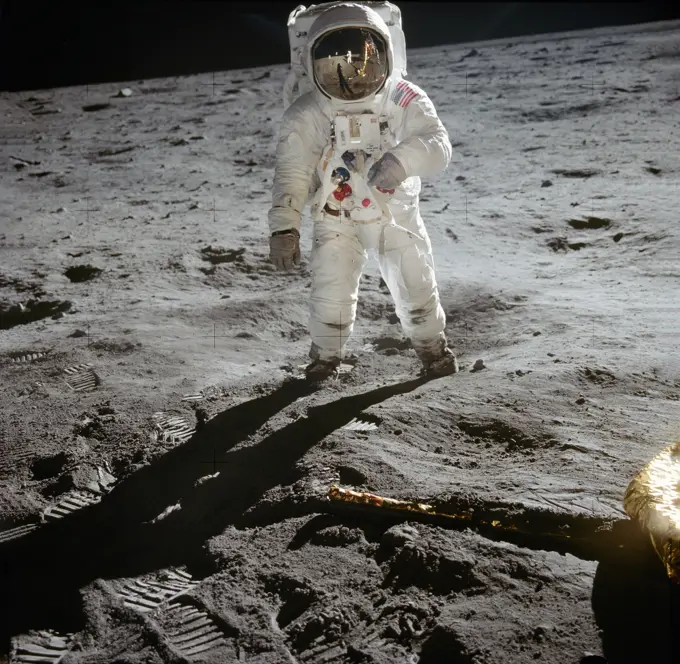
Apollo-11 - Aldrin Walking Near Lunar Module
4093-20493
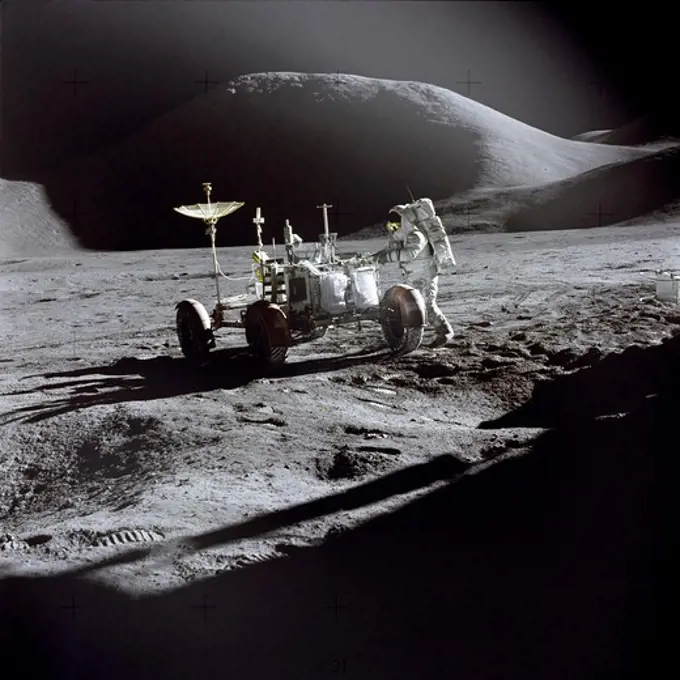
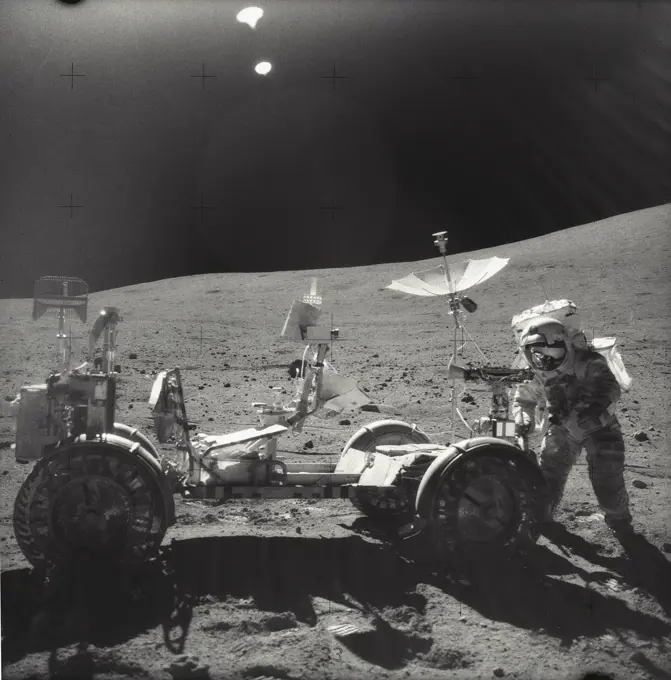
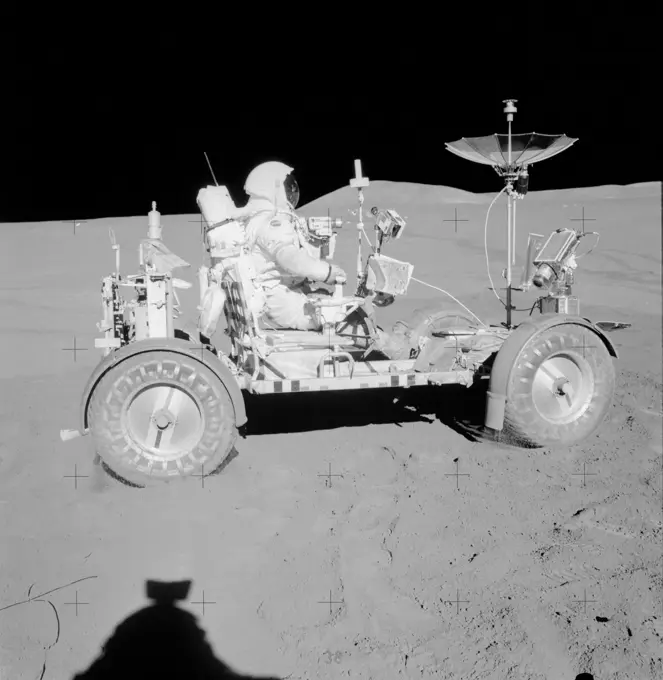
Astronaut James B. Irwin  Lunar Module pilot  works at the Lunar Roving Vehicle during the first Apollo 15 lunar surface extravehicular activity (EVA-1) at the Hadley-Apennine landing site. The shadow of the Lunar Module Falcon is in the foreground.
1899-19513115
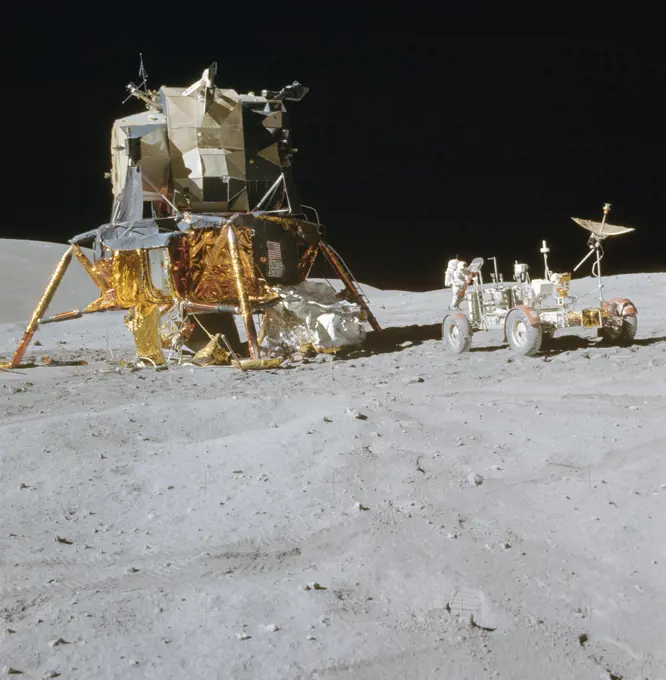
(21 April 1972) --- An excellent view of the Lunar Module (LM) 'Orion' and Lunar Roving Vehicle (LRV), as photographed by astronaut Charles M. Duke Jr., lunar module pilot, during the first Apollo 16 extravehicular activity (EVA) at the Descartes landing site. Astronaut John W. Young, commander, can be seen directly behind the LRV.
1746-29953534
Apollo 15 Astronauts Deploy First Lunar Roving Vehicle on the surface of the moon. July 31, 1971
1838-51330392
American astronaut Edwin E. Aldrin Jr., lunar module pilot, preparing to deploy Early Apollo Scientific experiments Package during Apollo 11 lunar surface extravehicular activity, photography by Neil A. Armstrong, Johnson Space Center, NASA, July 20, 1969
6145-44623029
The Lunar Roving Vehicle (LRV) was designed by Marshall Space Flight Center to transport astronauts and materials on the Moon. An LRV was used on each of the last three Apollo missions; Apollo 15, Apollo 16, and Apollo 17, in 1971 and 1972, to permit the crew to travel several miles from the lunar landing site. This photograph was taken during the Apollo 16 mission in 1972.
6145-45232932
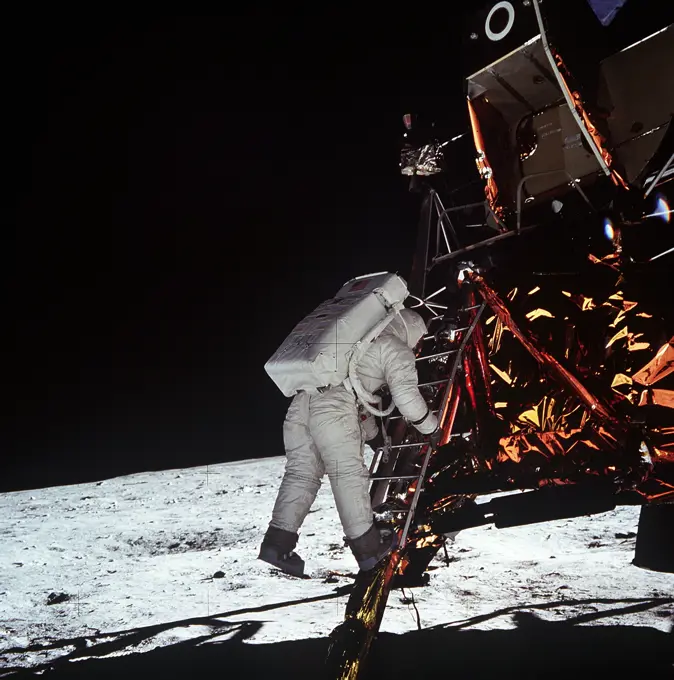
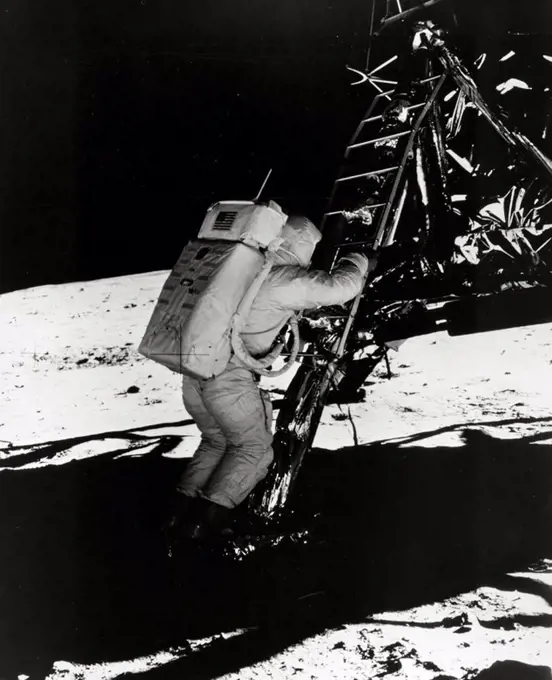
AS11-40-5868 (20 July 1969) --- Astronaut Edwin E. Aldrin Jr., lunar module pilot, descends the steps of the Lunar Module (LM) ladder as he prepares to walk on the moon. He had just egressed the LM. This photograph was taken by astronaut Neil A. Armstrong, commander, with a 70mm lunar surface camera during the Apollo 11 extravehicular activity (EVA). While Armstrong and Aldrin descended in the LM Eagle to explore the moon, astronaut Michael Collins, command module pilot, remained with the Command and Service Modules (CSM) in lunar orbit.
4389-262
Apollo 16 Astronaut John Young Walks Away From ALSEP
6145-45237865
AS15-86-11602 (31 July 1971) --- Astronaut James B. Irwin, lunar module pilot, works at the Lunar Roving Vehicle (LRV) during the first Apollo 15 lunar surface extravehicular activity (EVA) at the Hadley-Apennine landing site. A portion of the Lunar Module (LM) Falcon is on the left. The undeployed Laser Ranging Retro Reflector (LR-3) lies atop the LM's modular equipment stowage assembly (MESA). This view is looking slightly west of south. Hadley Delta and the Apennine Front are in the background to the left. St. George crater is approximately five kilometers (about three statute miles) in the distance behind Irwin's head. This photograph was taken by astronaut David R. Scott, commander. While astronauts Scott and Irwin descended in the LM to explore the moon, astronaut Alfred M. Worden, command module pilot, remained with the Command and Service Modules (CSM) in lunar orbit.
6145-58966097
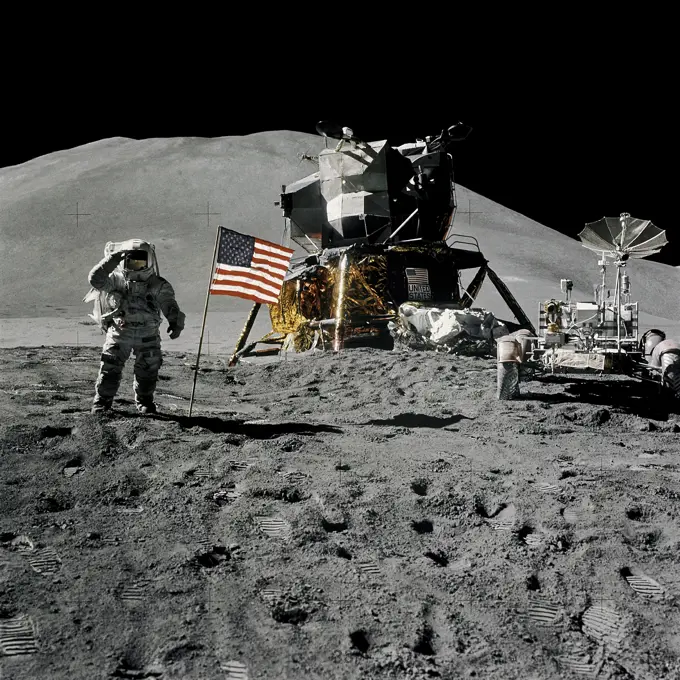
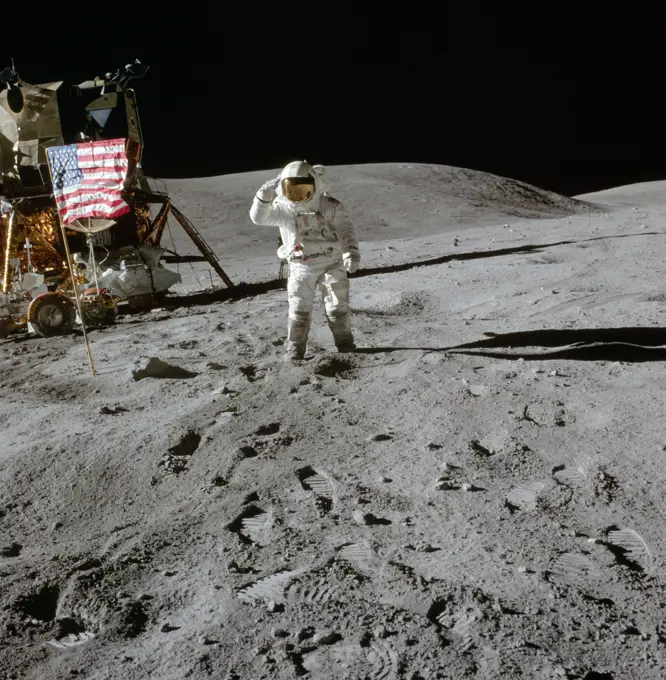
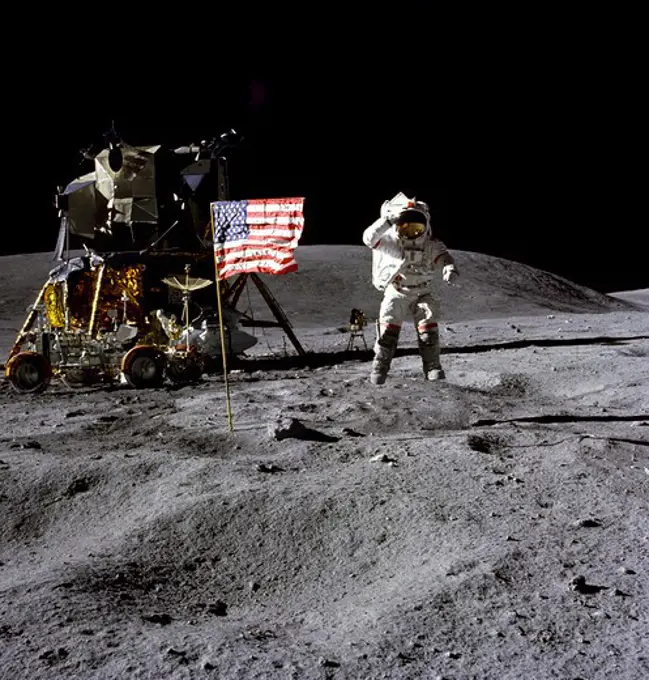
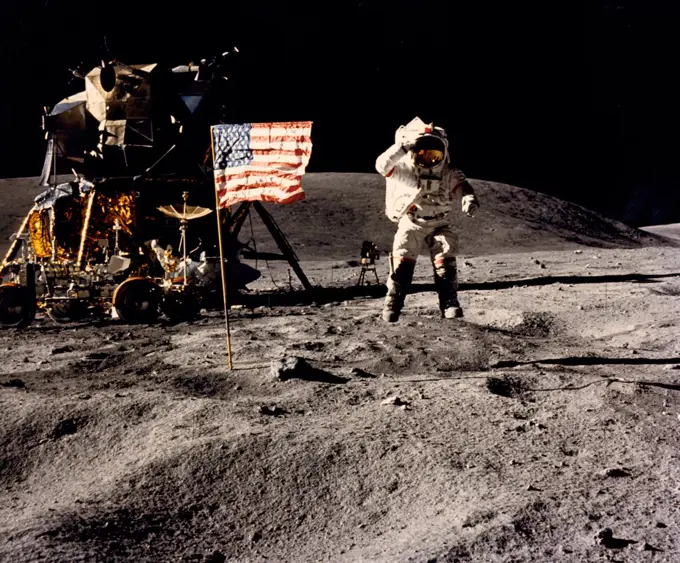
AS16-113-18342 (21 April 1972) --- Astronaut Charles M. Duke Jr., Apollo 16 lunar module pilot, salutes the United States flag during the mission's first extravehicular activity (EVA), on April 21, 1972. Stone Mountain reaches five-sixths across the photo in background. The Lunar Module (LM) and Lunar Roving Vehicle (LRV) are in the background. While John W. Young, commander and Duke descended in the LM to explore the Descartes region of the moon, Thomas K. Mattingly II, command module pilot, remained with the Command and Service Modules (CSM) in lunar orbit.
1899-19513215
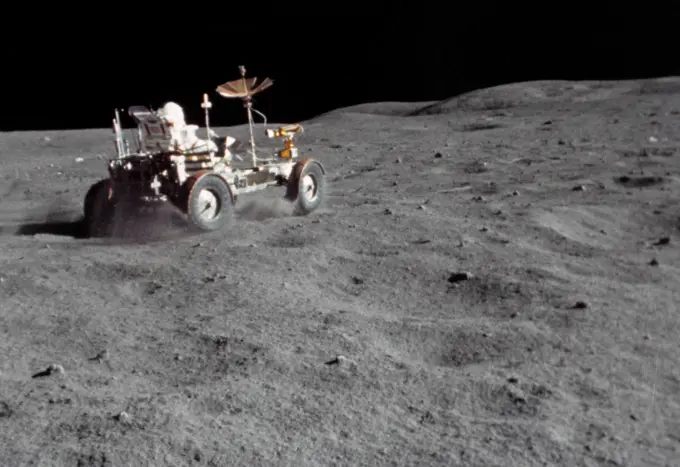
(21 April 1972) --- The Lunar Roving Vehicle (LRV) gets a speed workout by astronaut John W. Young in the 'Grand Prix' run during the first Apollo 16 extravehicular activity (EVA) at the Descartes landing site.
6145-44718280
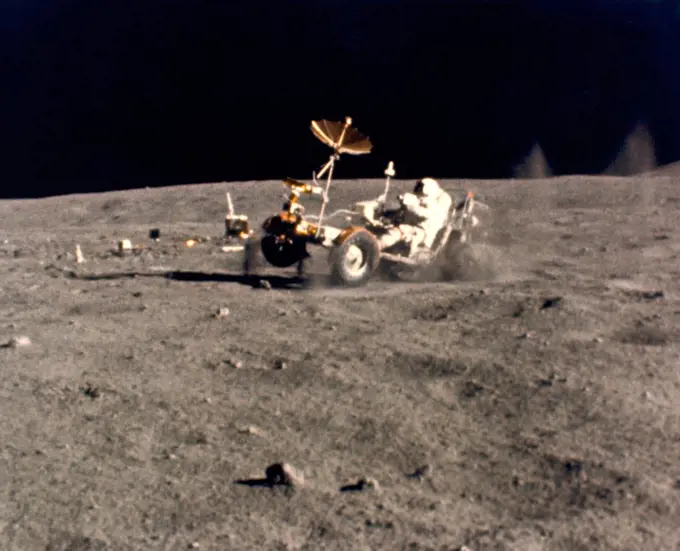
S72-37002 (21 April 1972) --- The Lunar Roving Vehicle (LRV) gets a speed workout by astronaut John W. Young in the Grand Prix run during the first Apollo 16 extravehicular activity (EVA) at the Descartes landing site. This view is a frame from motion picture film exposed by a 16mm Maurer camera held by astronaut Charles M. Duke Jr. While astronauts Young, commander, and Duke, lunar module pilot, descended in the Lunar Module (LM) Orion to explore the Descartes highlands region of the moon, astronaut Thomas K. Mattingly II, command module pilot, remained with the Command and Service Modules (CSM) Casper in lunar orbit.
6145-44749397
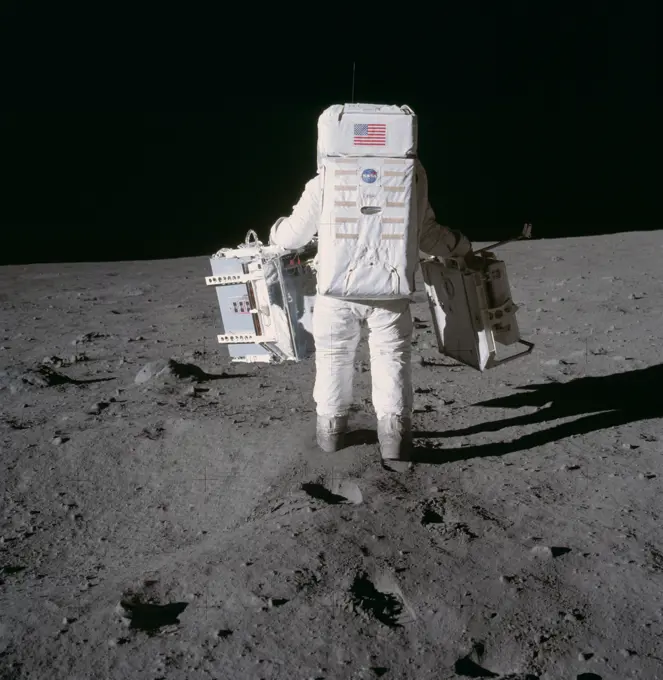
Astronaut Edwin E. Aldrin Jr., lunar module pilot, moves toward a position to deploy two components of the Early Apollo Scientific Experiments Package (EASEP) on the surface of the Moon during the Apollo 11 extravehicular activity. The Passive Seismic Experiments Package (PSEP) is in his left hand; and in his right hand is the Laser Ranging Retro-Reflector (LR3). Astronaut Neil A. Armstrong, commander, took this photograph with a 70mm lunar surface camera.
4239R-20480733
May 22, 1969 - The Apollo 10 Command and Service Modules (CSM) are photographed from the Lunar Module (LM) after CSM/LM separation in lunar orbit. The CSM was about 175 statute miles east of Smyth's Sea and was above the rough terrain which is typical of the lunar farside. The eastward oblique view of the lunar surface is centered near 105 degrees east longitude and 1 degree north latitude. The horizon is approximately 600 kilometers (374 statute miles) away. Numerous bright craters and the abse
1838-51330364
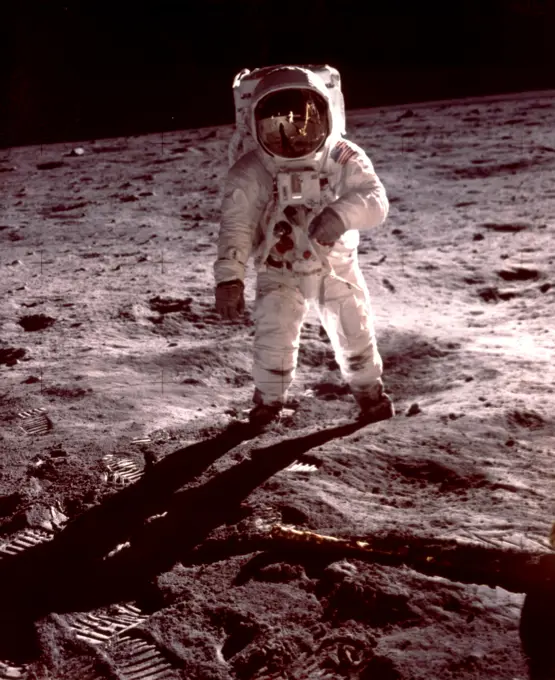
American Astronaut Edwin E. Aldrin Jr., lunar module pilot, walking on the moon surface near leg of Lunar Module  "Eagle" during Apollo 11 extravehicular activity, photo by Neil Armstrong, Johnson Space Center, NASA July 20, 1969
1035-20589379
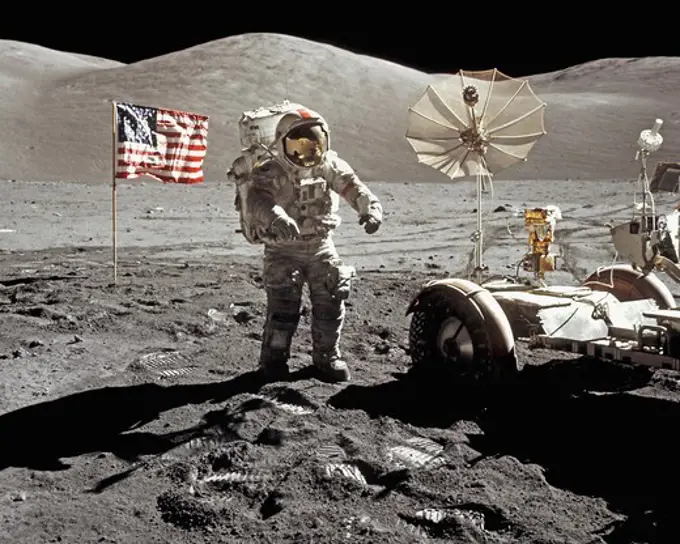
Moon:  April 21, 1972 Astronaut John Young,  commander of the Apollo 16 lunar landing mission, leaps from the lunar surface as he salutes the U.S. flag at the Descartes landing site during the mission's first extravehicular activity. The Lunar Module and the Lunar Roving Vehicle are at the left.
4389-283
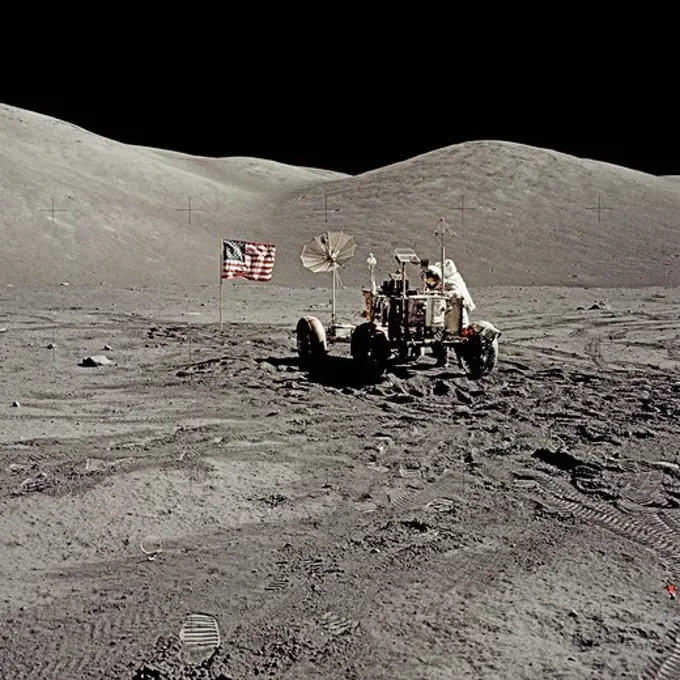
An Apollo 17 Astronaut and Lunar Rover in a Moon Valley
6145-45234907
This photograph of the Lunar Roving Vehicle (LRV) was taken during the Apollo 15 mission. Powered by battery, the lightweight electric car greatly increased the range of mobility and productivity on the scientific traverses for astronauts. It weighed 462 pounds (77 pounds on the Moon) and could carry two suited astronauts, their gear and cameras, and several hundred pounds of bagged samples. The LRV's mobility was quite high. It could climb and descend slopes of about 25 degrees. The LRV was designed and developed by the Marshall Space Flight Center and built by the Boeing Company.
4093-20517
Astronaut John W. Young  commander of the Apollo 16 lunar landing mission  jumps up from the lunar surface as he salutes the U.S. Flag at the Descartes landing site during the first Apollo 16 extravehicular activity (EVA-1). Astronaut Charles M. Duke Jr.  lunar module pilot  took this picture. The Lunar Module (LM) Orion is on the left. The Lunar Roving Vehicle is parked beside the LM. The object behind Young in the shade of the LM is the Far Ultraviolet Camera/Spectrograph. Stone Mountain domin
4409-2146
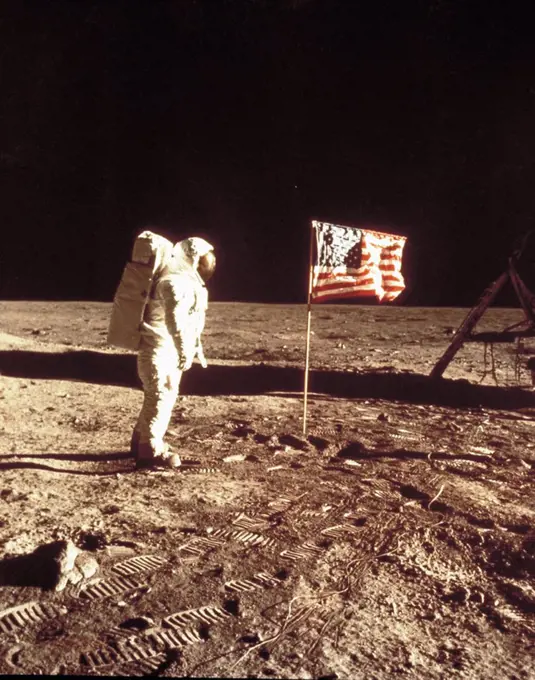
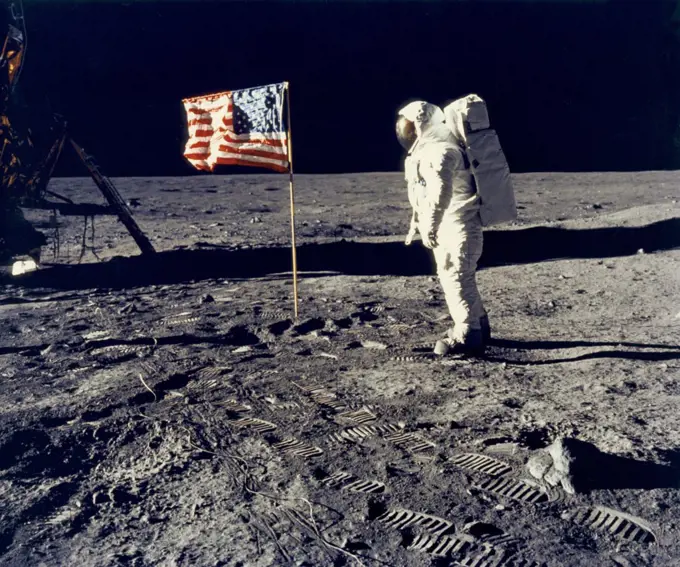
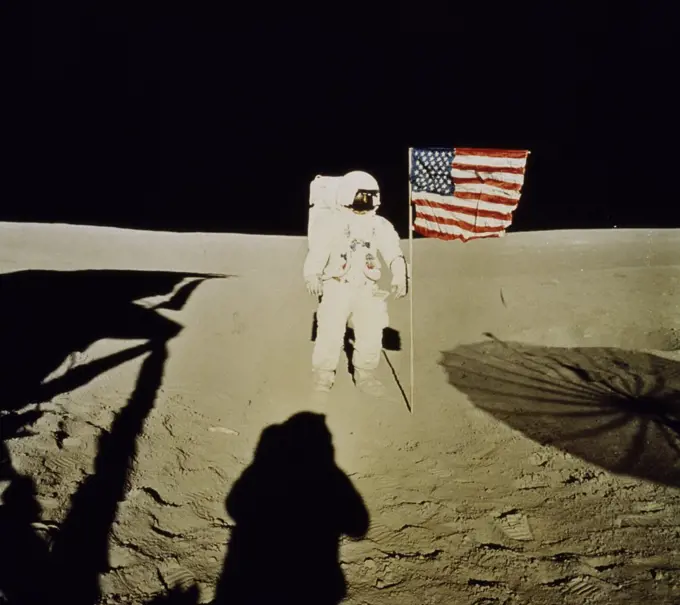
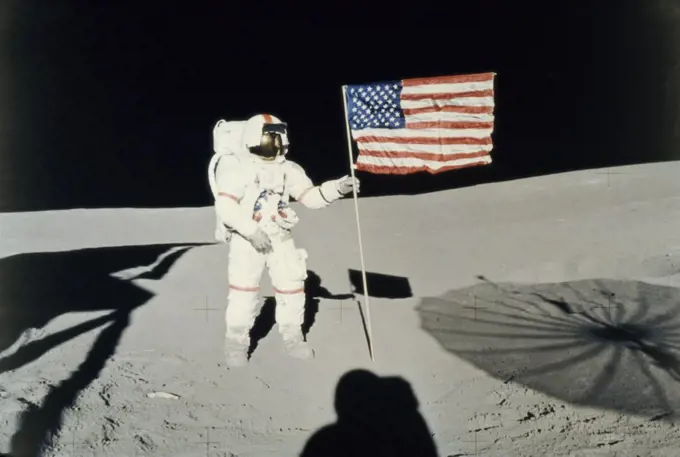
Astronaut Edward Aldrin poses beside deployed US flag. The lunar module is on the left. The astronaut's footprints are clearly visible in the foreground.
4048-8574
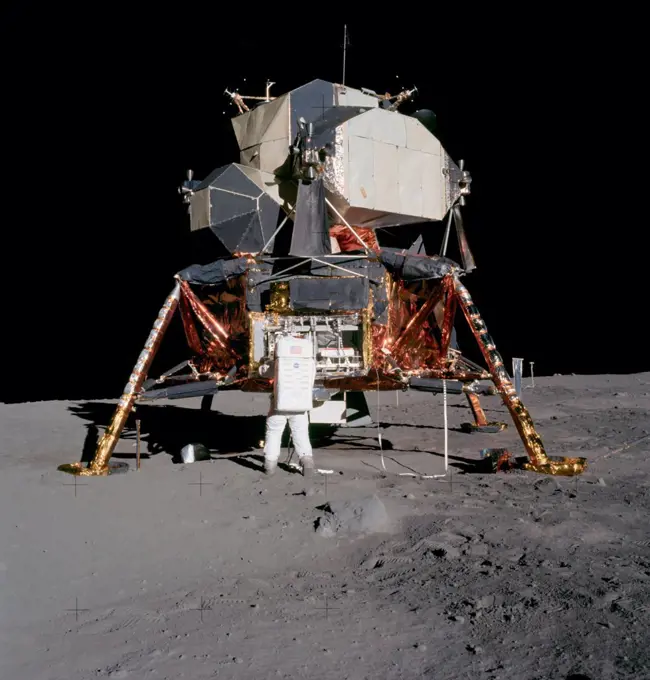
Apollo 11 Lunar Module on the Moon's surface. Astronaut Edwin Aldrin unpacks scientific experiments. July 20, 1969.
6145-45239776
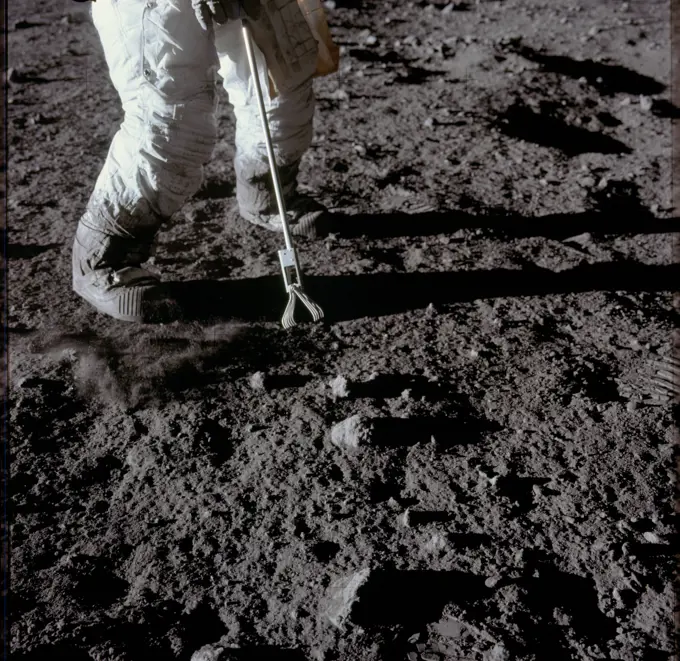
AS12-47-6932 (19 Nov. 1969) --- Close-up view of a set of tongs, an Apollo Lunar Hand Tool, being used by astronaut Charles Conrad Jr., commander, to pick up lunar samples during the Apollo 12 extravehicular activity. This photograph shows Conrad's legs and a good view of the lunar soil.
6145-44749398
Astronaut Alan L. Bean, lunar module pilot, deploys the Lunar Surface Magnetometer (LSM) during the first Apollo 12 extravehicular activity on the Moon. The LSM is a component of the Apollo Lunar Surface Experiments Package (ALSEP). The Lunar Module can be seen in the left background.
6145-44516382
Astronaut Edwin E. Aldrin, Lunar Module (LM) pilot, stands beside the Solar-Wind Composition (SWC) Experiment,facing the camera. The LM is visible behind Adrin.  Linear trails (lines) in the right foreground were formed by the cable of the surface television camera.  The cable is visible on the lunar surface.  Image taken at Tranquility Base during the Apollo 11 Mission. Original film magazine was labeled S.  Film Type: Ektachrome EF SO168 color film on a 2.7-mil Estar polyester base taken with a 60mm lens. Sun angle is Medium. Tilt direction is Southeast (SE).
1899-19513133
(23 April 1972) --- Astronaut John W. Young collects samples at the North Ray Crater geological site during the mission's third and final Apollo 16 extravehicular activity (EVA). He has a rake in his hand, and the gnomon is near his foot.
1899-19513134
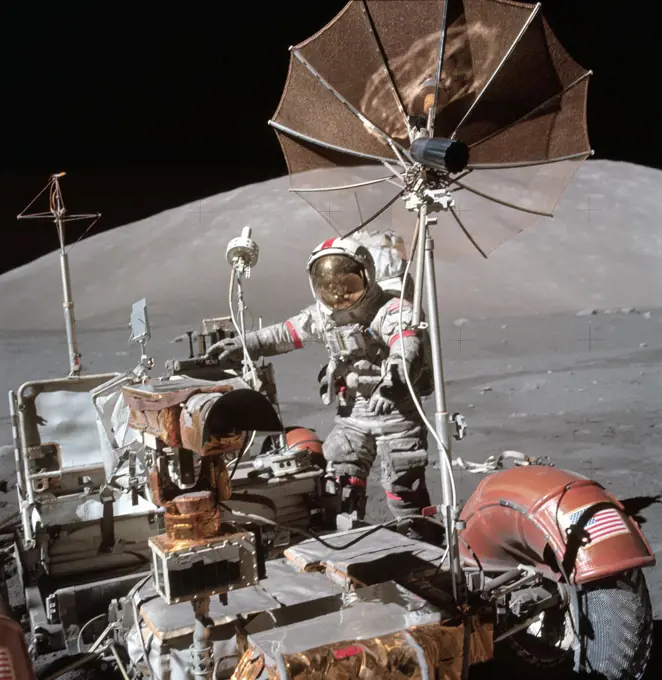
(13 Dec. 1972) --- Scientist-astronaut Harrison H. Schmitt is photographed seated in the Lunar Roving Vehicle (LRV) at Station 9 (Van Serg Crater) during the third Apollo 17 extravehicular activity (EVA) at the Taurus-Littrow landing site.
4239R-3395
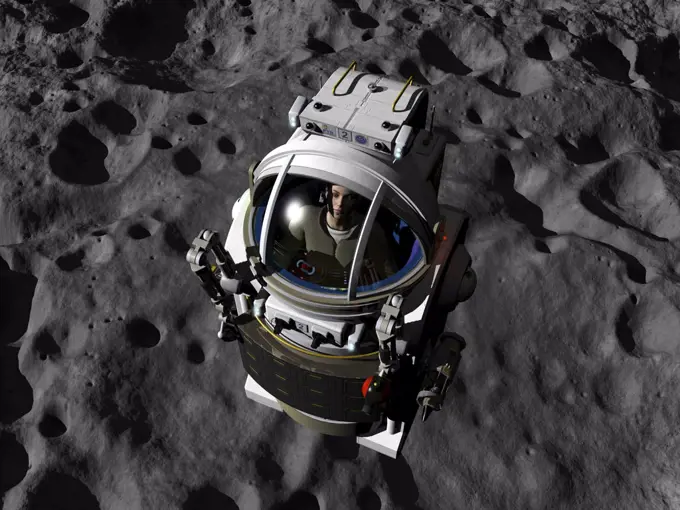
Portrait of an astronaut piloting a Manned Maneuvering Vehicle (MMV) above the lunar-like surface of a small asteroid. A hybrid between a space suit and a small spacecraft, the MMV provides a comfortable shirt-sleeve environment for exploring the airless, microgravity environment of a small asteroid.
255-5051
Astronaut Edwin Aldrin Jr. assembles Seismic Experiment, Apollo 11 Moon Landing, July 20, 1969
1838-51330365
Moon crater photographed by Apollo 11 crew near landing site during their lunar surface extravehicular activity, Johnson Space Center, NASA, July 20, 1969
1899-19513129
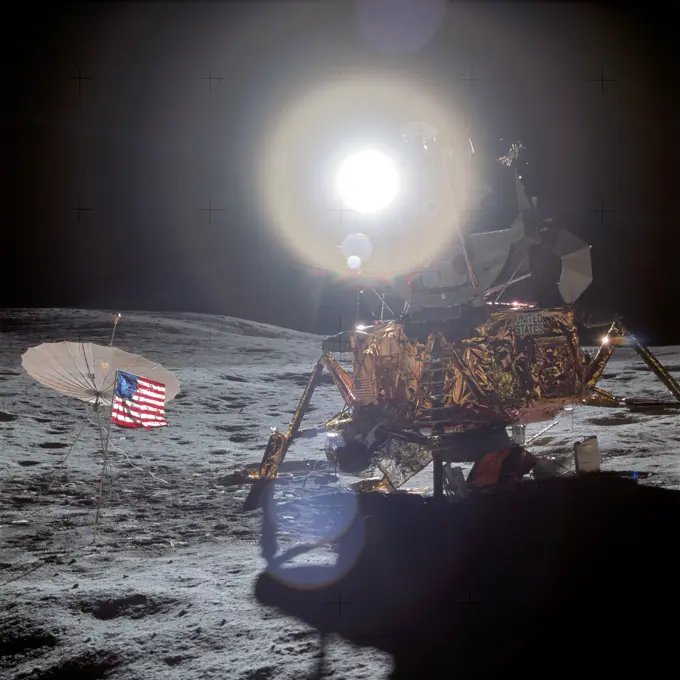
(5 Feb. 1971) --- An excellent view of the Apollo 14 Lunar Module (LM) on the moon, as photographed during the first Apollo 14 extravehicular activity (EVA) on the lunar surface.
1035-20589373
Moon:  July 20, 1969 Astronaut Edwin "Buzz" Aldrin, pilot of the lunar module, poses beside the United States flag during the Apollo 11 lunar landing. The Lunar Module "Eagle" is at the left. Commander Neil Armstrong took the photograph.
4389-284
An Apollo 17 Astronaut and Lunar Rover in a Moon Valley
1746-19670937
Image of the far side of the lunar surface, with Earth in the background, taken by NASA's MoonKAM system onboard the Ebb spacecraft.
4389-1447
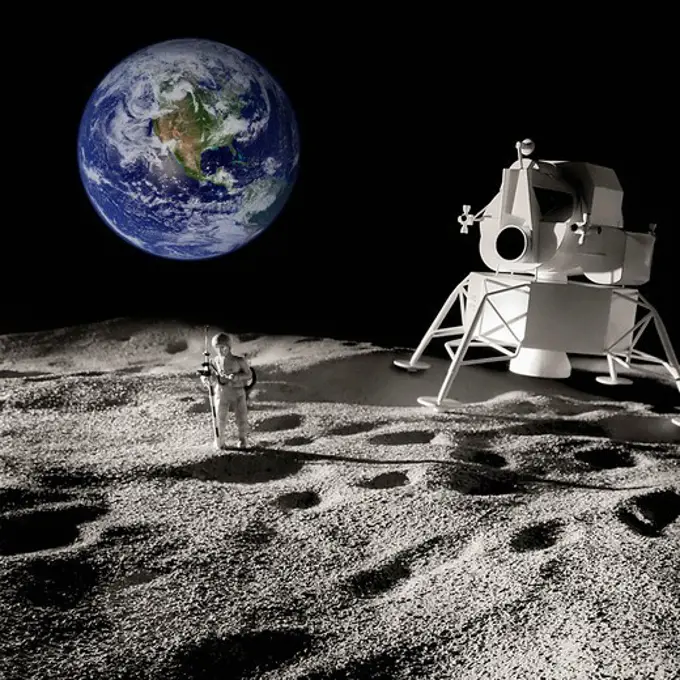
Model of Moon Landing
1899-19513110
AS12-46-6790 (19 Nov. 1969) --- Astronaut Alan L. Bean, lunar module pilot, is photographed at quadrant II of the Lunar Module (LM) during the first Apollo 12 extravehicular activity (EVA) on the moon. This picture was taken by astronaut Charles Conrad Jr., commander. Here, Bean is using a fuel transfer tool to remove the fuel element from the fuel cask mounted on the LM's descent stage.
4239R-20480281
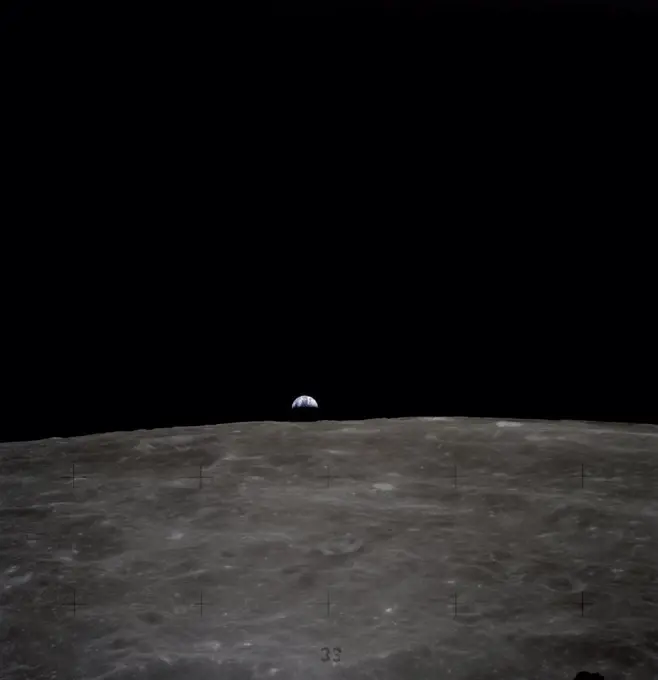
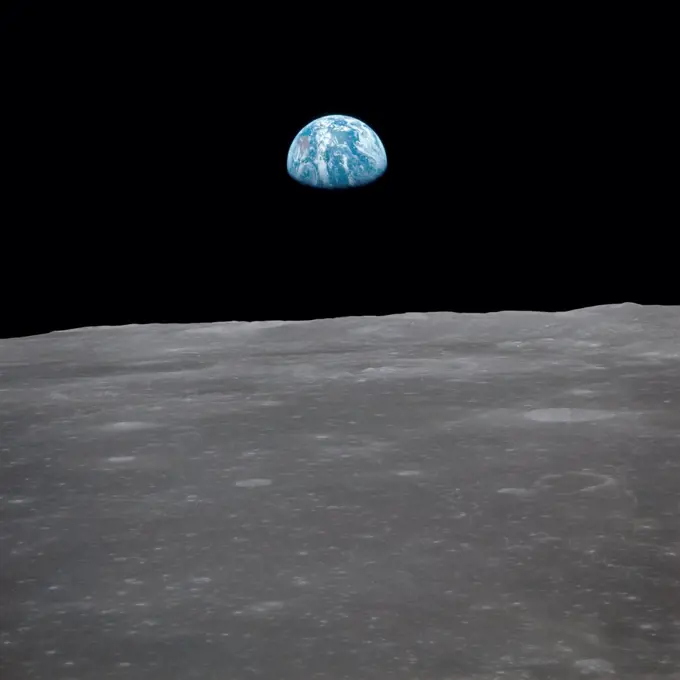
April 16-27, 1972 - Earth rises over the lunar horizon.
1838-51330409
American astronaut Charles Conrad Jr., commander of Apollo 12 lunar landing mission, standing at Module Equipment Stowage Assembly on Lunar Module  following first Apollo 12 extravehicular activity on lunar surface, NASA, November 19, 1969
6145-44755770
AS16-116-18678 (23 April 1972) --- A view from the moving Apollo 16 Lunar Roving Vehicle (LRV) as the crew men headed home at the end of the mission's third and final extravehicular activity (EVA). Astronaut John W. Young called attention to the series of block fields between the Lunar Module (LM) and LRV. Young also noted that, The LM was obviously sitting in the only flat place around. Stone Mountain stretches about half way across the background. The high gain antenna and the RCA television camera on the LRV are in the foreground. While astronauts Young, commander; and Charles M. Duke Jr., lunar module pilot; descended in the Apollo 16 LM Orion to explore the Descartes highlands landing site on the moon, astronaut Thomas K. Mattingly II, command module pilot, remained with the Command and Service Modules (CSM) Casper in lunar orbit.
6145-44755979
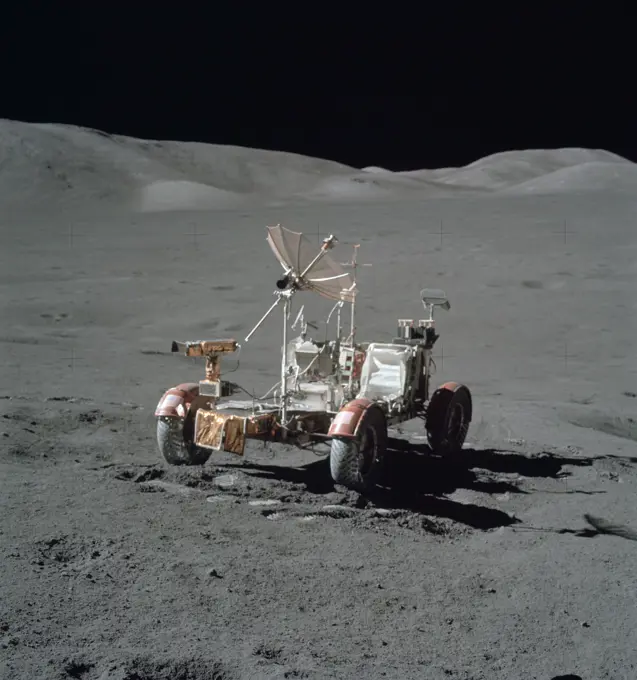
AS17-146-22367 (7-19 Dec. 1972) --- This is an excellent view of the Lunar Roving Vehicle (LRV) which was used extensively by astronauts Eugene A. Cernan and Harrison H. Schmitt at the Taurus-Littrow landing site.
6145-44618642
The second manned lunar landing mission, Apollo 12 launched from launch pad 39-A at Kennedy Space Center in Florida on November 14, 1969 via a Saturn Five launch vehicle. The Saturn V vehicle was developed by the Marshall Space Flight Center (MSFC) under the direction of Dr. Wernher von Braun. Aboard Apollo 12 was a crew of three astronauts Alan L. Bean, pilot of the Lunar Module (LM), Intrepid; Richard Gordon, pilot of the Command Module (CM), Yankee Clipper; and Spacecraft Commander Charles Conrad. The LM, Intrepid, landed astronauts Conrad and Bean on the lunar surface in whats known as the Ocean of Storms while astronaut Richard Gordon piloted the CM, Yankee Clipper, in a parking orbit around the Moon. Their lunar soil activities included the deployment of the Apollo Lunar Surface Experiments Package (ALSEP), finding the unmanned Surveyor 3 that landed on the Moon on April 19, 1967, and collecting 75 pounds (34 kilograms) of rock samples. In this photograph, one of the astronauts
1746-29014389
Photograph of Buzz Aldrin (1930-) an American engineer and former astronaut. As the Lunar Module Pilot on Apollo 11, he was one of the first two humans to land on the moon. Dated 20th century
6145-45240041
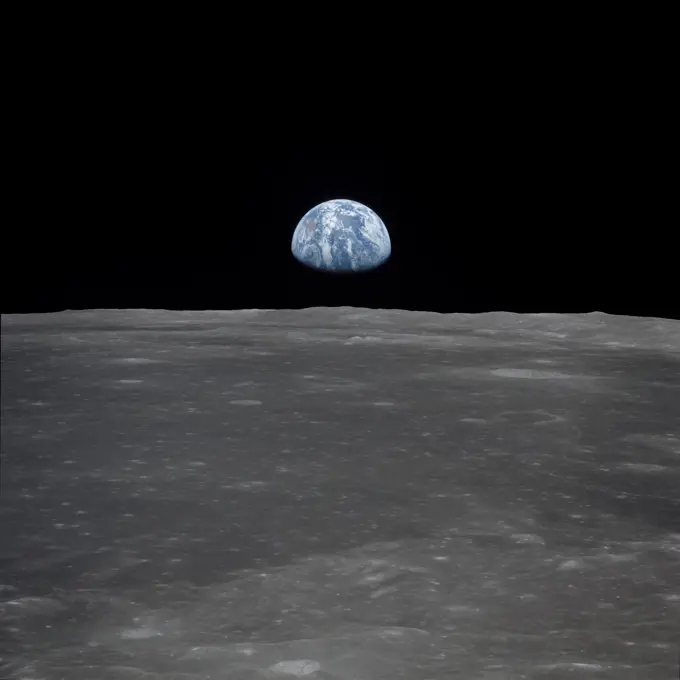
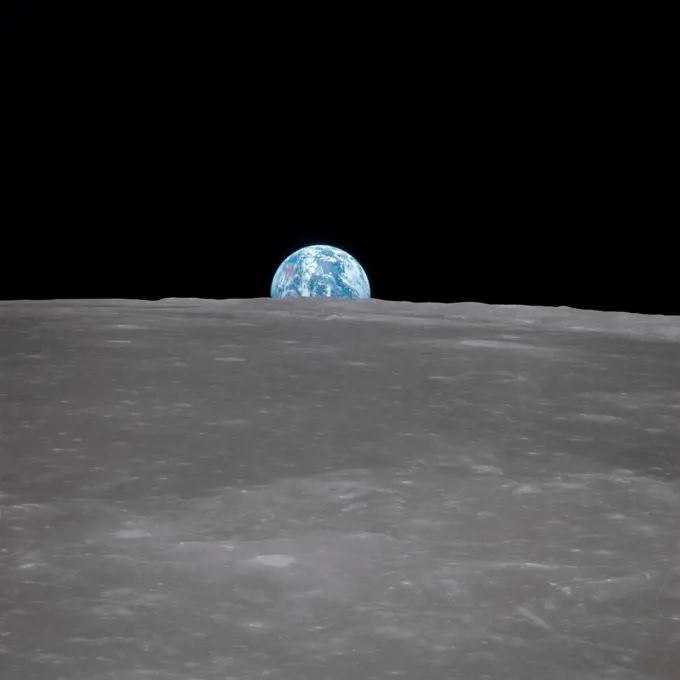
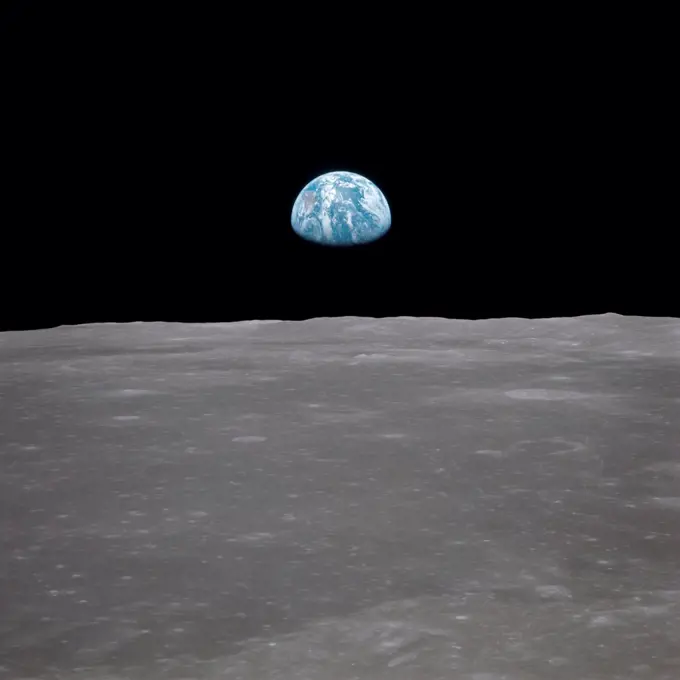
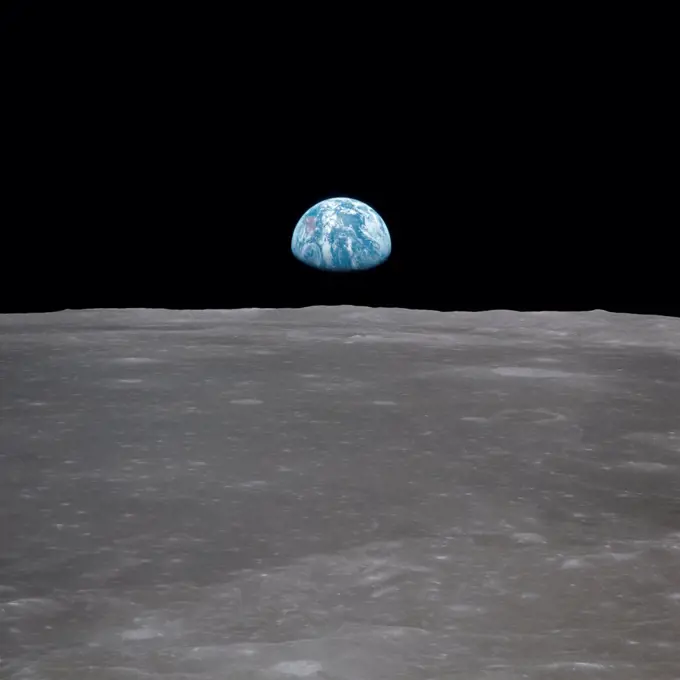
AS11-44-6552 (16-24 July 1969) --- This view of Earth rising over the moon's horizon was taken from the Apollo spacecraft. The lunar terrain pictured is in the area of Smyth's Sea on the nearside. Coordinates of the center of the terrain are 85 degrees east longitude and 3 degrees north latitude. While astronaut Neil A. Armstrong, commander; and Edwin E. Aldrin Jr., lunar module pilot, descended in the Lunar Module (LM) Eagle to explore the Sea of Tranquility region of the moon, astronaut Michael Collins remained with the Command and Service Modules (CSM) Columbia in lunar orbit.
6145-44935983
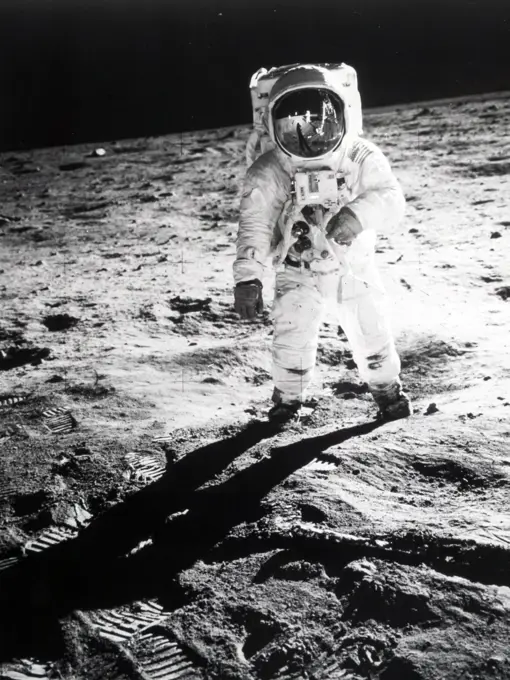
AS11-40-5903 (20 July 1969) --- Astronaut Edwin E. Aldrin Jr., lunar module pilot, walks on the surface of the moon near the leg of the Lunar Module (LM) Eagle during the Apollo 11 extravehicular activity (EVA). Astronaut Neil A. Armstrong, commander, took this photograph with a 70mm lunar surface camera. While astronauts Armstrong and Aldrin descended in the Lunar Module (LM) Eagle to explore the Sea of Tranquility region of the moon, astronaut Michael Collins, command module pilot, remained with the Command and Service Modules (CSM) Columbia in lunar orbit.
4389-326
Scientific Equipment at Apollo 14 Base Camp
6145-44684056
The first manned lunar landing mission, Apollo 11, launched from the Kennedy Space Center (KSC) in Florida via the Marshall Space Flight Center (MSFC) developed Saturn V launch vehicle on July 16, 1969 and safely returned to Earth on July 24, 1969. Aboard the space craft were astronauts Neil A. Armstrong, commander; Michael Collins, Command Module (CM) pilot; and Edwin E. (Buzz) Aldrin Jr., Lunar Module (LM) pilot. The CM, piloted by Michael Collins, remained in a parking orbit around the Moon, while the LM, named Eagle’’, carrying astronauts Armstrong and Aldrin, landed on the Moon in the Sea of Tranquility. During 2½ hours of surface exploration, the crew set up experiments, collected 47 pounds of lunar surface material for analysis back on Earth, planted the U.S Flag, and left a message for all mankind. In this photograph, Aldrin is deploying the Passive Seismic Experiment Package (PSEP).
1035-20589377
Moon:  April 23, 1972 Astronaut John Young gives the Lunar Roving Vehicle a speed workout in the "Grand Prix" run during the third Apollo 16 extravehicular activity at the Descartes landing site.
6145-45235461
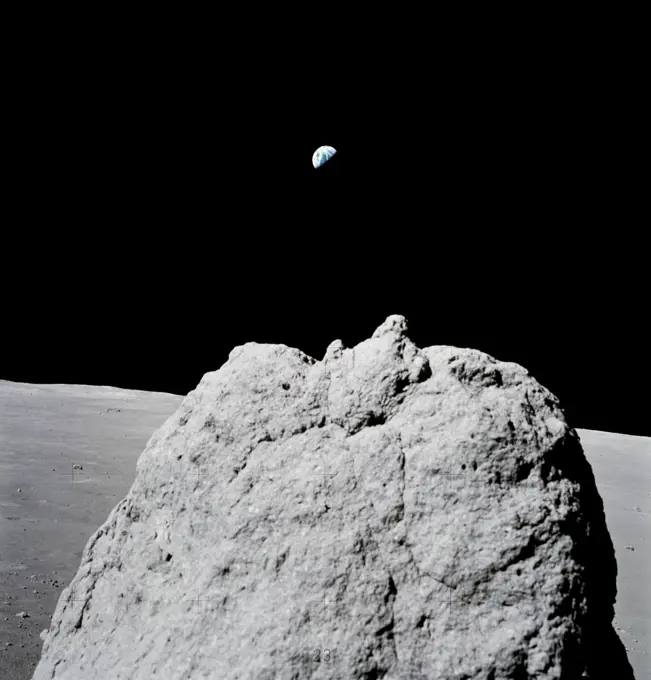
AS17-137-20910 (7-19 Dec. 1972) --- Earth (far distant background) is seen above a large lunar boulder (foreground) on the moon. The photo was taken with a handheld Hasselblad camera by the last two moon walkers in the Apollo Program. While astronauts Eugene A. Cernan, commander; and Harrison H. Schmitt, lunar module pilot, descended in the Lunar Module (LM) Challenger to explore the Taurus-Littrow region of the moon, astronaut Ronald E. Evans, command module pilot, remained with the Command and Service Modules (CSM) America in lunar orbit.
6145-45234420
AS16-120-19187 (19 April 1972) --- Apollo 16 astronauts captured this Earth rise scene with a handheld Hasselblad camera during the second revolution of the moon. Identifiable craters seen on the moon include Saha, Wyld, and Saenger. Much of the terrain seen here is never visible from Earth, as the Command Module (CM) was just passing onto what is known as the dark side or far side of the moon. Crewmen aboard the CM at the time the photo was made were astronauts John W. Young, Thomas K. Mattingly II and Charles M. Duke Jr. Mattingly remained later with the CM in lunar orbit while Young and Duke descended in the lunar module (LM) to explore the surface of the moon.
1899-19513132
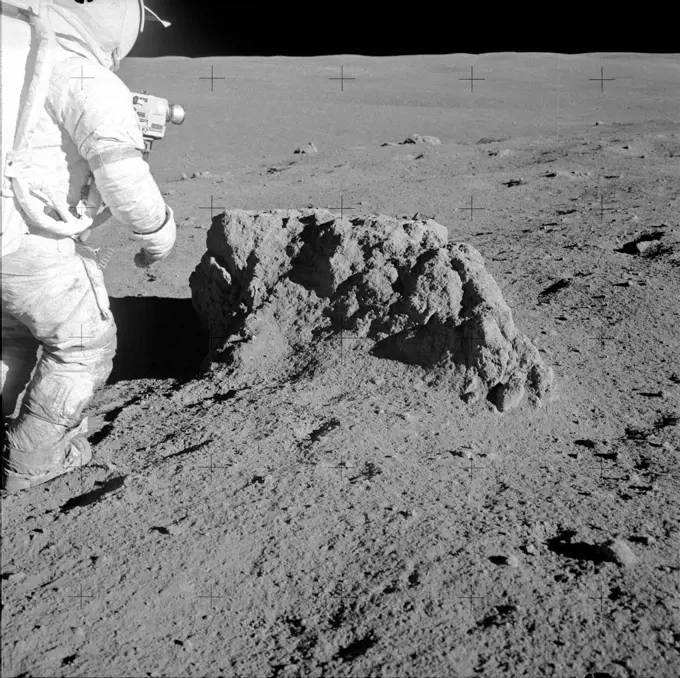
Astronaut Alan Shepard stands beside large boulder found by Apollo 14 crew
7050-70037052
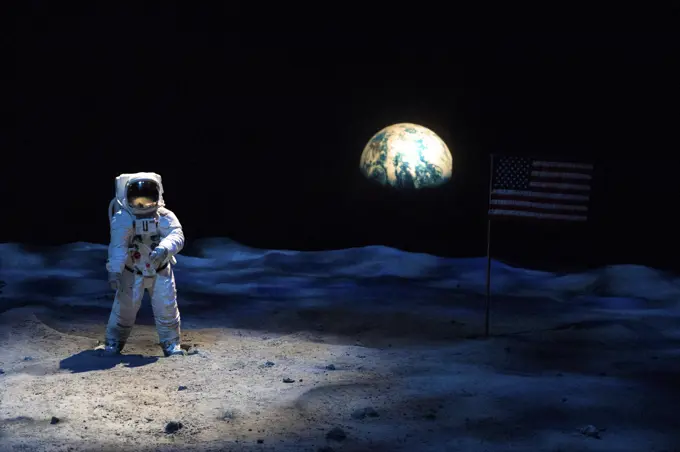
USA, Florida, Titusville, Kennedy Space Center, Apollo/Saturn V center, NASA, astronaut on moon display.
227-569
Harrison Schmitt, Apollo 17, Taurus-Littrow Landing Site, December 1972
6145-44516925
Astronaut Edwin E. Aldrin,Lunar Module (LM) pilot, poses for a photo beside the U.S. flag that has been placed on the moon. The LM is visible in the left  field of view. Numerous footprints and the cable of the surface television camera are visible on the lunar surface in the foreground.  Image taken at Tranquility Base during the Apollo 11 Mission. Original film magazine was labeled S.  Film Type: Ektachrome EF SO168 color film on a 2.7-mil Estar polyester base taken with a 60mm lens. Sun angle is Medium. Tilt direction is South (S).
4048-8623
Apollo 17 Geologist-Astronaut Harrison H. Schmitt at the Taurus-Littrow landing site. Shorty Crater is to the right. The peak in the center background is Family Mountain. A portion of South Massif is on the horizon at the left edge. Nov. 11-14, 1972.
4048-8592
Apollo 11 Earth rise over the Moon. Earth on the horizon in the Mare Smythii Region of the Moon. Image 11 of a NASA sequence of 18. July 20, 1969.
6176-67062272
Alan Shepard (1923-1998) assembling lunar hand tools during the Apollo 14 mission, 1971. Artist: Unknown
6145-44522967
AS14-66-9305 (5 Feb. 1971) --- A front view of the Apollo 14 Lunar Module (LM), which reflects a circular flare caused by the brilliant sun, as seen by the two moon-exploring crew men (out of frame) of the Apollo 14 lunar landing mission during their first extravehicular activity (EVA). The unusual ball of light was said by the astronauts to have a jewel-like appearance. In the left background Cone Crater can be seen. In the left foreground are the erectable S-Band antenna and the United States flag. Astronauts Alan B. Shepard Jr., commander, and Edgar D. Mitchell, lunar module pilot, descended in the LM, while astronaut Stuart A. Roosa, command module pilot, remained with the Command and Service Modules (CSM) in lunar orbit.
1899-19513210
(13 Dec. 1972) --- Astronaut Eugene A. Cernan, Apollo 17 commander, approaches the parked Lunar Roving Vehicle (LRV) on the lunar surface during the flight's third period of extravehicular activity (EVA). South Massif can be seen in the background.
6145-45236722
AS17-134-20425 (11 Dec. 1972) --- Scientist-astronaut Harrison H. Schmitt, lunar module pilot, collects lunar rake samples at Station 1 during the first Apollo 17 extravehicular activity (EVA) at the Taurus-Littrow landing site. This picture was taken by astronaut Eugene Cernan, commander. The lunar rake, an Apollo lunar geology hand tool, is used to collect discrete samples of rocks and rock chips ranging in size from one-half inch (1.3 centimeter) to one inch (2.5 centimeter).
1838-51330386
American flag after it was unfurled on lunar surface during  extravehicular activity during Apollo 12 manned lunar landing mission, Johnson Space Center, NASA , November 19, 1969
4409-20783291
2001: A SPACE ODYSSEY (1968), directed by STANLEY KUBRICK.
6145-45235454
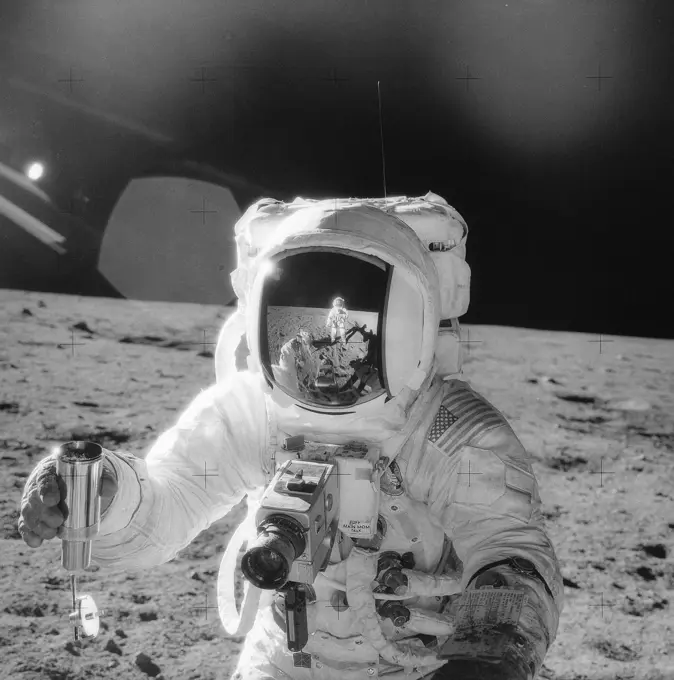
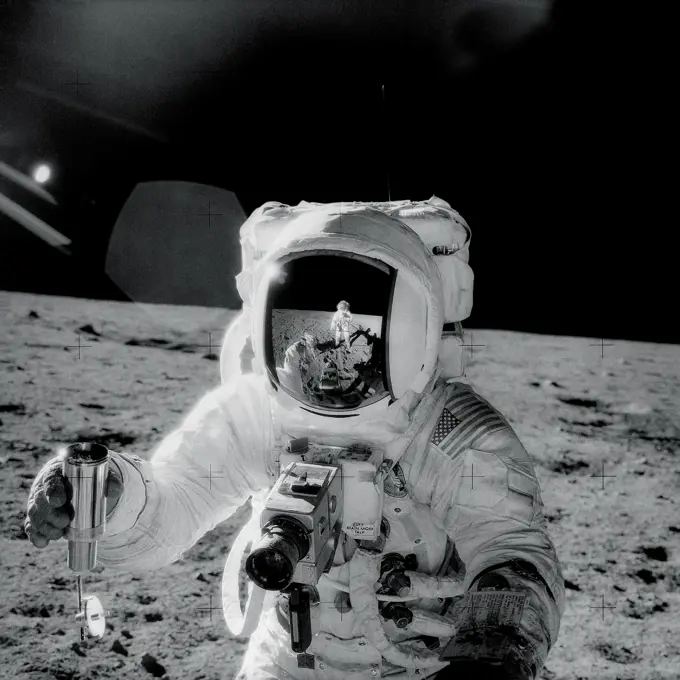
AS12-49-7278 (19-20 Nov. 1969) --- Astronaut Alan L. Bean holds a Special Environmental Sample Container filled with lunar soil collected during the extravehicular activity (EVA) in which astronauts Charles Conrad Jr., commander, and Bean, lunar module pilot, participated. Conrad, who took this picture, is reflected in Bean's helmet visor. Conrad and Bean descended in the Apollo 12 Lunar Module (LM) to explore the lunar surface while astronaut Richard F. Gordon Jr., command module pilot, remained with the Command and Service Modules (CSM) in lunar orbit.
6145-45236709
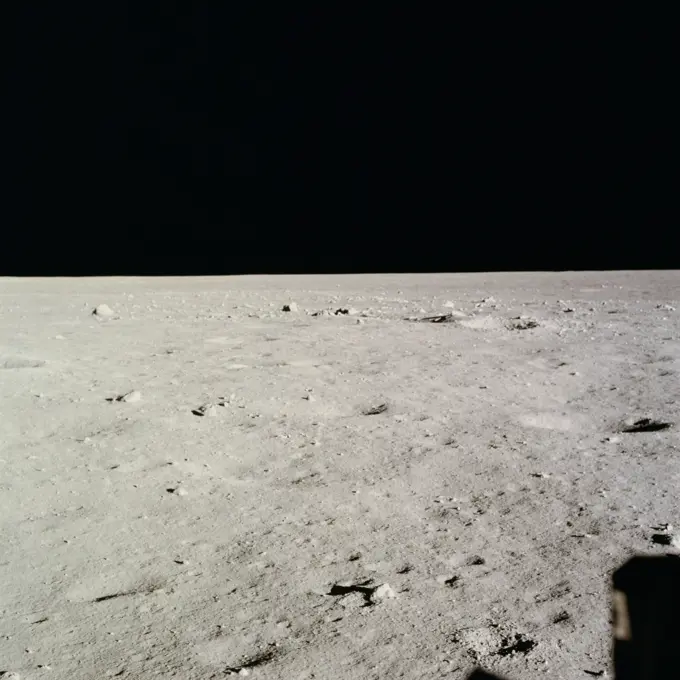
AS11-37-5458 (20 July 1969) --- This excellent view from the right-hand window of the Apollo 11 Lunar Module (LM) shows the surface of the moon in the vicinity of where the LM touched down. Numerous small rocks and craters can be seen between the LM and the lunar horizon. Astronaut Michael Collins, command module pilot, remained with the Command and Service Modules (CSM) in lunar orbit while astronauts Neil A. Armstrong, commander; and Edwin E. Aldrin Jr., lunar module pilot, descended in the LM to the lunar surface.
6145-44618643
The second manned lunar landing mission, Apollo 12, launched from launch pad 39-A at Kennedy Space Center in Florida on November 14, 1969 via a Saturn V launch vehicle. The Saturn V vehicle was developed by the Marshall Space Flight Center (MSFC) under the direction of Dr. Wernher von Braun. Aboard Apollo 12 was a crew of three astronauts Alan L. Bean, pilot of the Lunar Module (LM), Intrepid; Richard Gordon, pilot of the Command Module (CM), Yankee Clipper; and Spacecraft Commander Charles Conrad. The LM, Intrepid, landed astronauts Conrad and Bean on the lunar surface in whats known as the Ocean of Storms while astronaut Richard Gordon piloted the CM, Yankee Clipper, in a parking orbit around the Moon. Lunar soil activities included the deployment of the Apollo Lunar Surface Experiments Package (ALSEP), finding the unmanned Surveyor 3 that landed on the Moon on April 19, 1967, and collecting 75 pounds (34 kilograms) of rock samples. This is the twenty-third of 25 images captured by
6177-V53836387
4389-303
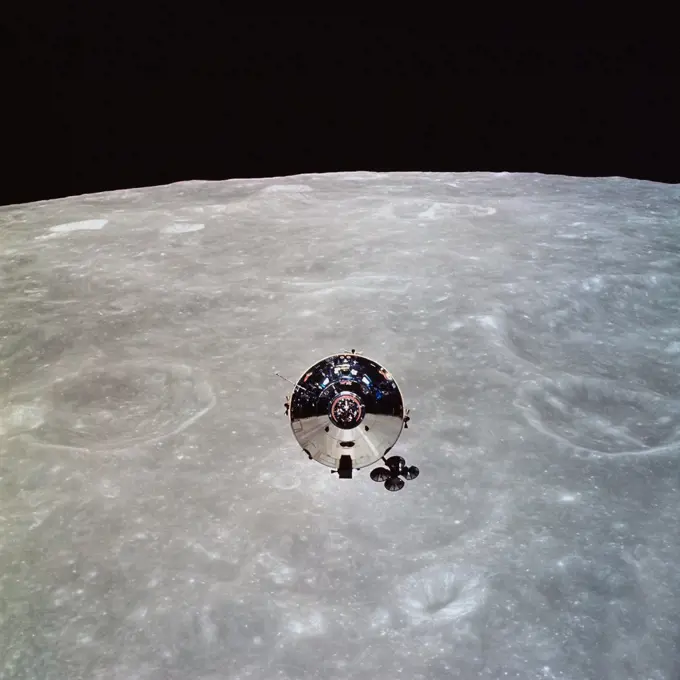
Apollo 17 Command Module America Above the Moon
6145-44755772
AS16-117-18754 (23 April 1972) --- A view of the smooth terrain in the general area of the North Ray Crater geological site, photographed by the Apollo 16 crew from the Lunar Roving Vehicle (LRV) shortly after leaving the immediate area of the geology site. The RCA color television camera is mounted on the front of the LRV and can be seen in the foreground, along with a small part of the high gain antenna, upper left. The tracks were made on the earlier trip to the North Ray Crater site. Astronaut Charles M. Duke Jr., lunar module pilot, exposed this view with his 70mm Hasselblad camera. Astronaut John W. Young, commander, said that this area was much smoother than the region around South Ray Crater. While astronauts Young and Duke descended in the Apollo 16 Lunar Module (LM) Orion to explore the Descartes highlands landing site on the moon, astronaut Thomas K. Mattingly II, command module pilot, remained with the Command and Service Modules (CSM) Casper in lunar orbit.
6145-44516404
View of Moon limb with Earth on the horizon,Mare Smythii Region. Earth rise. This image was taken before separation of the LM and the Command Module during Apollo 11 Mission. Original film magazine was labeled V. Film Type: S0-368 Color taken with a 250mm lens.  Approximate photo scale 1:1,300,000. Principal Point Latitude was 3 North by Longitude 85 East. Foward overlap is 90%. Sun angle is High. Approximate Tilt minimum is 65 degrees,maximum is 69. Tilt direction is West (W).
4048-8587
Apollo 11 Earth rise over the Moon. Earth on the horizon in the Mare Smythii Region of the Moon. Image 2 of a NASA sequence of 18. July 20, 1969.
6145-44719293
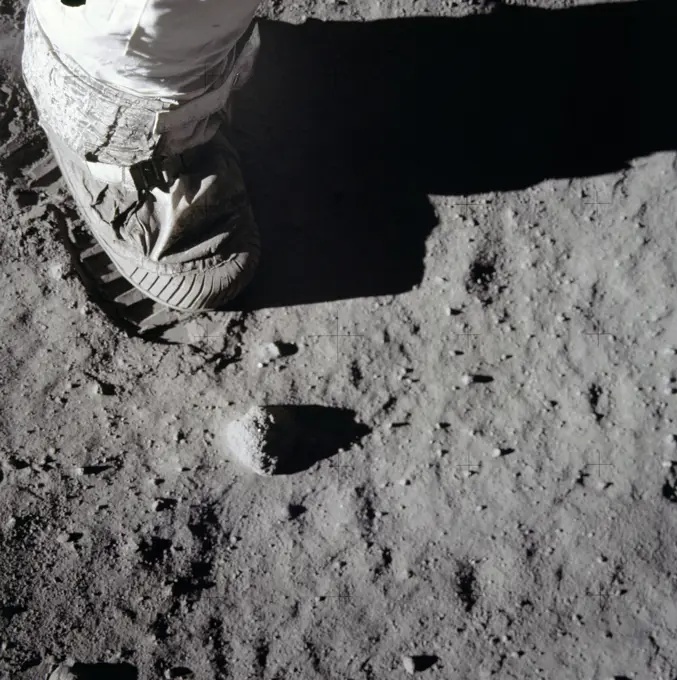
AS11-40-5880 (20 July 1969) --- A close-up view of an astronaut's boot and bootprint in the lunar soil, photographed with a 70mm lunar surface camera during the Apollo 11 lunar surface extravehicular activity (EVA). While astronauts Neil A. Armstrong, commander, and Edwin A. Aldrin Jr., lunar module pilot, descended in the Lunar Module (LM) Eagle to explore the Sea of Tranquility region of the moon, astronaut Michael Collins, command module pilot, remained with the Command and Service Modules (CSM) Columbia in lunar orbit.
6145-45235453
AS12-47-6891 (14-24 Nov. 1969) --- A partially illuminated Earth rises above the lunar horizon in this photograph taken from the Apollo 12 spacecraft in lunar orbit.
4409-2424
Expedicion del Apollo 11 a la Luna, 1969. Imagen extraida del reportaje de la 20th Century-Fox "Footprints on the Moon-Apollo 11".
1899-19513245
(7-19 Dec. 1972) --- Earth (far distant background) is seen above a large lunar boulder (foreground) on the moon. The photo was taken with a handheld Hasselblad camera by the last two moon walkers in the Apollo Program.
6145-45297369
AS17-147-22548 (11 Dec. 1972) --- This is a photograph of the LSP geosphere flag on the lunar surface. The gnomon is in the foreground, while Apollo Lunar Scientific Experiments Package (ALSEP) and north Massif is in the background. The Lunar Roving Vehicle (LRV) is also seen in the right background. While astronauts Eugene A. Cernan, commander, and Harrison H. Schmitt, lunar module pilot, descended in the Lunar Module (LM) Challenger to explore the Taurus-Littrow region of the moon, astronaut Ronald E. Evans, command module pilot, remained with the Command and Service Modules (CSM) America in lunar orbit.
6188-65592393
meteor An illustration of a nice deep space planet background Copyright: xZoonar.com/magannx 1265023
6145-44743330
Apollo Crew landing site showing deployment of ALSEP (Apollo Lunar Surface expeiments package)
4048-8591
Apollo 11 Earth rise over the Moon. Earth on the horizon in the Mare Smythii Region of the Moon. Image 7 of a NASA sequence of 18. July 20, 1969.
4239R-20480250
July 1969 - An oblique view of the Crater Daedalus on the lunar farside as seen from the Apollo 11 spacecraft in lunar orbit. The view looks southwest. Daedalus (formerly referred to as I.A.U. Crater No. 308) is located at 179 degrees east longitude and 5.5 degrees south latitude. Daedalus has a diameter of about 50 statute miles. This is a typical scene showing the rugged terrain on the farside of the Moon.
4239R-20480738
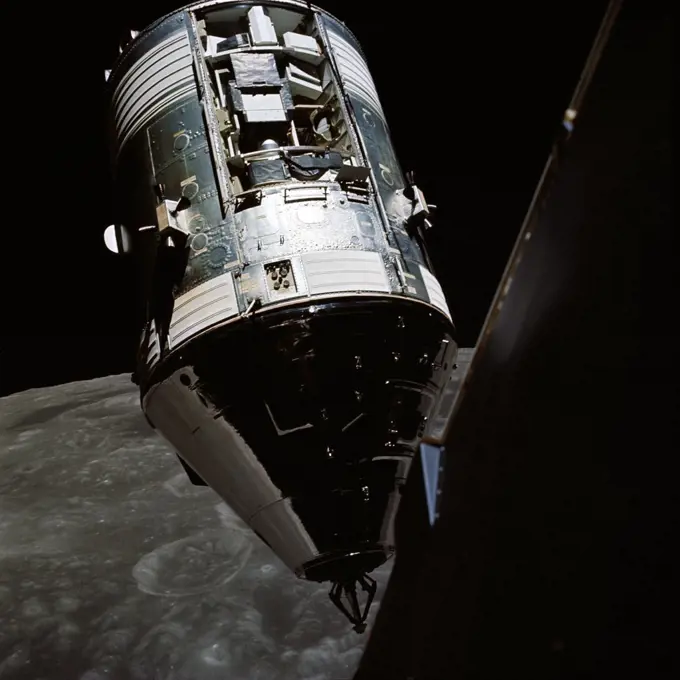
December 14, 1972 - View of the Apollo 17 Command and Service Modules (CSM) photographed from the Lunar Module (LM) Challenger during rendezvous and docking maneuvers in lunar orbit. Note the exposed Scientific Instrument Module (SIM) Bay in Sector 1 of the Service Module (SM). Three experiments are carried in the SIM bay: S-209 lunar sounder, S-171 infrared scanning spectrometer, and the S-169 far-ultraviolet spectrometer. Also mounted in the SIM bay are the panoramic camera, mapping camera and
1899-61005
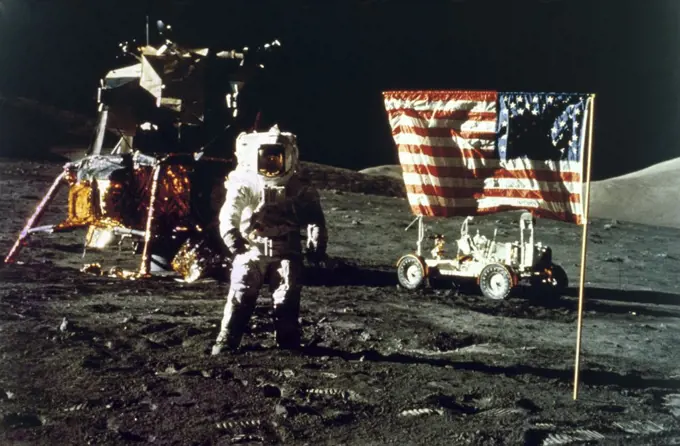
Apollo 17 Astronauts On Moon, Taurus-Littrow Landing Site, 12-72. Schmitt Beside Flag.
6145-44684051
The first manned lunar landing mission, Apollo 11, launched from the Kennedy Space Center (KSC) in Florida via the Marshall Space Flight Center (MSFC) developed Saturn V launch vehicle on July 16, 1969 and safely returned to Earth on July 24, 1969. Aboard the space craft were astronauts Neil A. Armstrong, commander; Michael Collins, Command Module (CM) pilot; and Edwin E. (Buzz) Aldrin Jr., Lunar Module (LM) pilot. The CM, piloted by Michael Collins, remained in a parking orbit around the Moon while the LM, named Eagle’’, carrying astronauts Armstrong and Aldrin, landed on the Moon in the Sea of Tranquility. The LM was a two part spacecraft. Its lower or descent stage had the landing gear, engines, and fuel needed for the landing. When the LM blasted off the Moon, the descent stage served as the launching pad for its companion ascent stage, which was also home for the two astronauts on the surface of the Moon. The LM was full of gear with which to communicate, navigate, and rendezvous
4048-8589
Apollo 11 Earth rise over the Moon. Earth on the horizon in the Mare Smythii Region of the Moon. Image 5 of a NASA sequence of 18. July 20, 1969.
4239-57495572
An astronaut on a barren planet with moon rising over the horizon.
227-520
Astronaut Mitchell, Apollo 14 Mission, 1971
6145-45236711
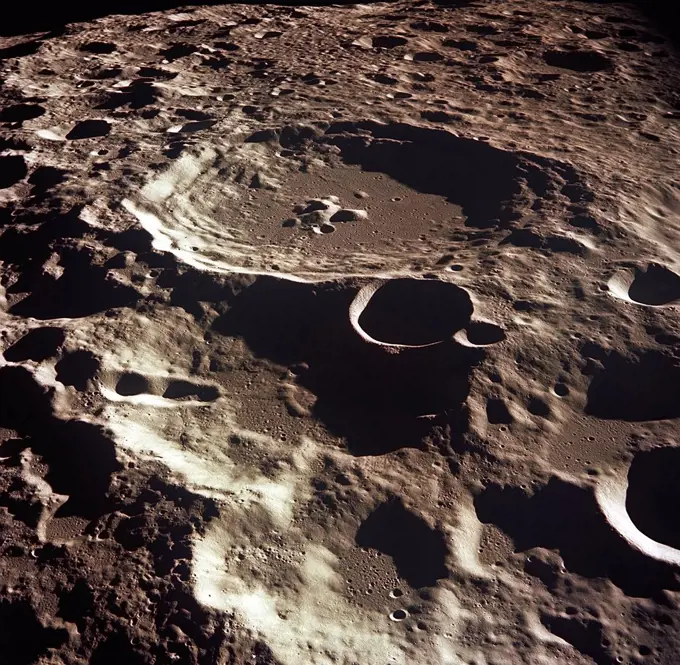
AS11-44-6609 (16-24 July 1969) --- An oblique of the Crater Daedalus on the lunar farside as seen from the Apollo 11 spacecraft in lunar orbit. The view looks southwest. Daedalus (formerly referred to as I.A.U. Crater No. 308) is located at 179 degrees east longitude and 5.5 degrees south latitude. Daedalus has a diameter of about 50 statute miles. This is a typical scene showing the rugged terrain on the farside of the moon. While astronauts Neil A. Armstrong, commander, and Edwin E. Aldrin Jr., lunar module pilot, descended in the Lunar Module (LM) Eagle to explore the Sea of Tranquility region of the moon, astronaut Michael Collins, command module pilot, remained with the Command and Service Modules (CSM) Columbia in lunar orbit.
4239R-20480732
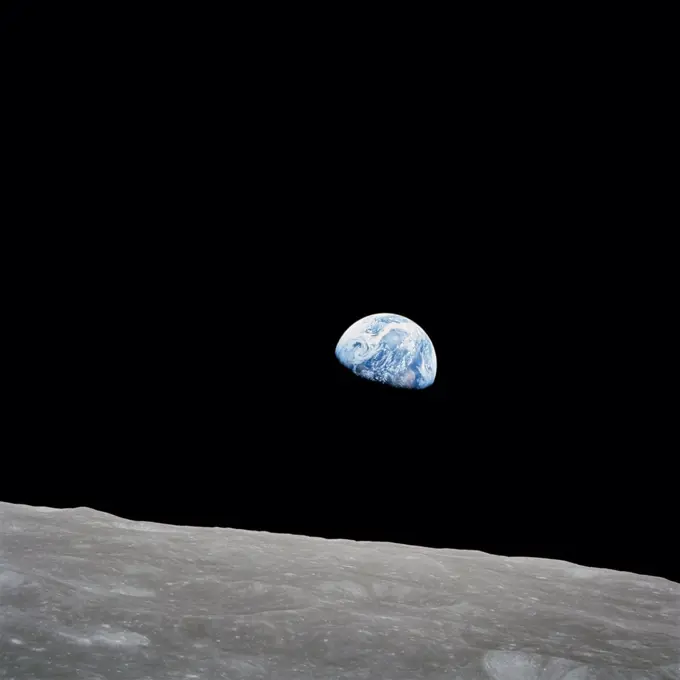
December 24, 1968 - The rising Earth is about five degrees above the lunar horizon in this telephoto view taken from the Apollo 8 spacecraft near 110 degrees east longitude. The horizon, about 570 kilometers (350 statute miles) from the spacecraft, is near the eastern limb of the moon as viewed from Earth. Width of the view at the horizon is about 150 kilometers (95 statute miles). On Earth 240,000 statute miles away the sunset terminator crosses Africa. The South Pole is in the white area near
1899-19513124
(22 April 1972) --- Apollo 16 Astronaut stands in the shadow of the Lunar Module (LM) behind the ultraviolet (UV) camera which is in operation.
227-445B
Astronaut Alan Shepard Jr., Apollo 14 Mission, 1971
1899-19513130
(30 July 1971) --- A view of the Apollo 15 Command and Service Modules (CSM) in lunar orbit as photographed from the Lunar Module (LM) just after rendezvous. The lunar nearside is in the background. This view is looking southeast into the Sea of Fertility. The crater Taruntius is at the right center edge of the picture.
6145-44524463
AS15-85-11471 (31 July 1971) --- Astronaut David R. Scott, commander, is seated in the Lunar Roving Vehicle (LRV) during the first Apollo 15 lunar surface extravehicular activity (EVA) at the Hadley-Apennine landing site. This photograph was taken by astronaut James B. Irwin, lunar module pilot. While astronauts Scott and Irwin descended in the Lunar Module (LM) Falcon to explore the Hadley-Apennine area of the moon, astronaut Alfred M. Worden, command module pilot, remained with the Command and Service Modules (CSM) in lunar orbit.
6145-44715212
S69-39562 (20 July 1969) --- Astronauts Neil A. Armstrong (center), commander; and Edwin E. Aldrin Jr. (right), lunar module pilot, are seen standing near their Lunar Module (LM) in this black and white reproduction taken from a telecast by the Apollo 11 lunar surface camera during the Apollo 11 extravehicular activity (EVA). This picture was made from a televised image received at the Deep Space Network (DSN) tracking station at Goldstone, California. United States President Richard M. Nixon had just spoken to the two astronauts by radio. Aldrin, a Colonel in the United States Air Force, is saluting the Commander-in-Chief. While astronauts Armstrong and Aldrin descended in the LM Eagle to explore the Sea of Tranquility region of the moon, astronaut Michael Collins, command module pilot, remained with the Command and Service Modules (CSM) Columbia in lunar orbit.
1815-76040081
3d cartoon astronaut exploring portal on asteroid in outer space
6145-44620977
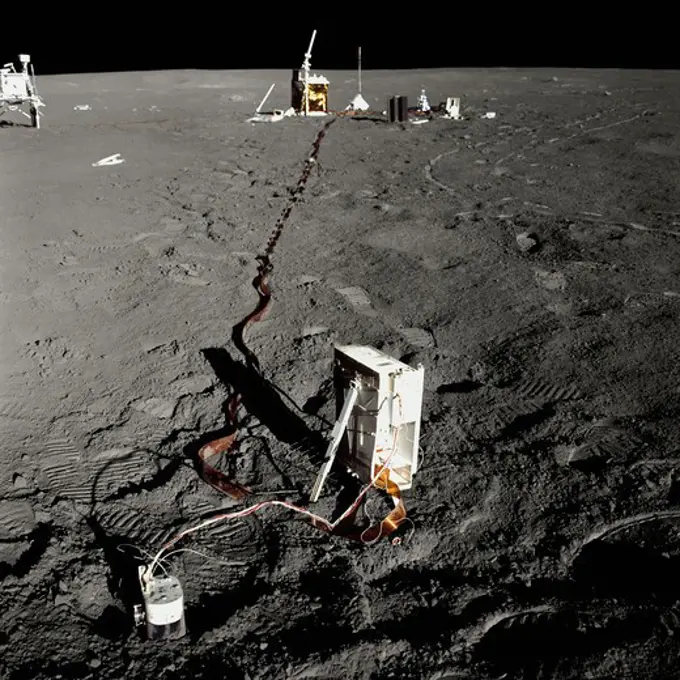
The moon bound Apollo 14, carrying a crew of three astronauts Mission commander Alan B. Shepard Jr., Command Module pilot Stuart A. Roosa, and Lunar Module pilot Edgar D. Mitchell, lifted off from launch complex 39A at the Kennedy Space Center on January 31, 1971, and safely returned to Earth on February 9, 1971. It was the third manned lunar landing, the first manned landing in exploration of the lunar highlands, and it demonstrated pinpoint landing capability. The major goal of Apollo 14 was the scientific exploration of the Moon in the foothills of the rugged Fra Mauro region. The extravehicular activity (EVA) of astronauts Shepard and Mitchell included setting up an automated scientific laboratory called Apollo Lunar Scientific Experiments Package (ALSEP), shown here fully deployed. In addition, they collected a total of about 95 pounds (43 kilograms) of Moon rock and soil for a geological investigation back on the Earth.
1457-962
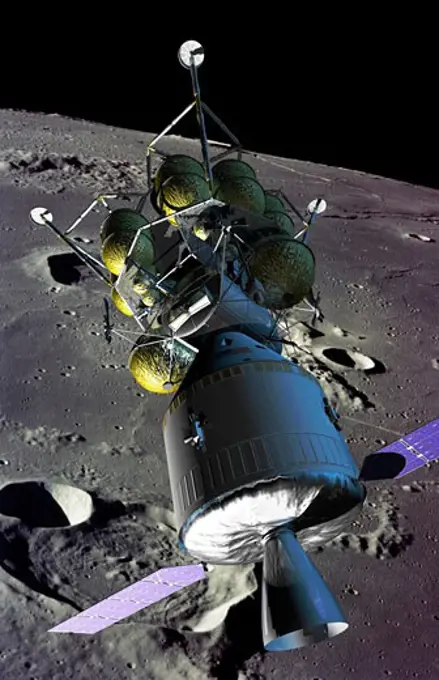
Spaceship orbiting the moon
495-1136
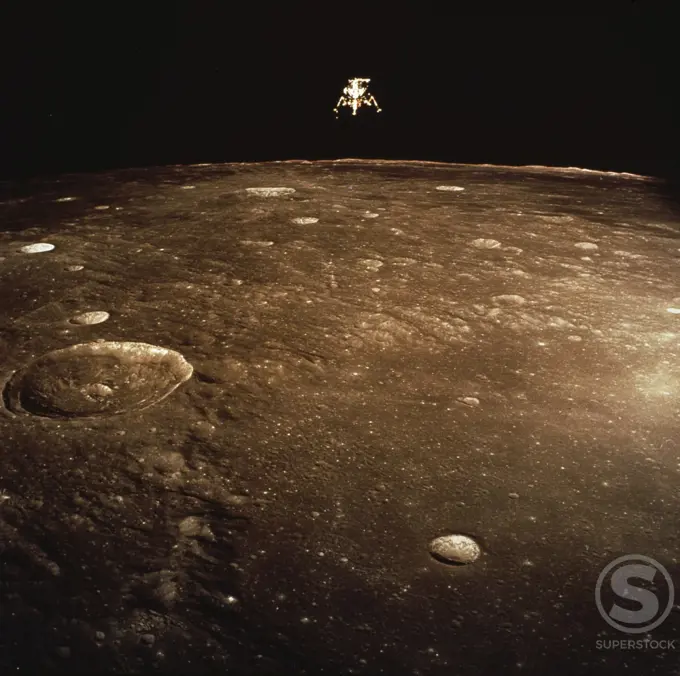
Satellite landing on the moon surface, Apollo 11 Lunar Module
6145-45238872
AS12-48-7133 (20 Nov. 1969) --- This unusual photograph, taken during the second Apollo 12 extravehicular activity (EVA), shows two U.S. spacecraft on the surface of the moon. The Apollo 12 Lunar Module (LM) is in the background. The unmanned Surveyor 3 spacecraft is in the foreground. The Apollo 12 LM, with astronauts Charles Conrad Jr. and Alan L. Bean aboard, landed about 600 feet from Surveyor 3 in the Ocean of Storms. The television camera and several other pieces were taken from Surveyor 3 and brought back to Earth for scientific examination. Here, Conrad examines the Surveyor's TV camera prior to detaching it. Astronaut Richard F. Gordon Jr. remained with the Apollo 12 Command and Service Modules (CSM) in lunar orbit while Conrad and Bean descended in the LM to explore the moon. Surveyor 3 soft-landed on the moon on April 19, 1967.
PREVIOUS
of 2
NEXT
2401 S. Ervay, Suite 206
Dallas, Texas 75215
United States
Browse
CategoriesGalleriesFree Research
For Creators
License Your ContentSuperStock For StudentsFrame of Mind BlogContributor PortalNew Image SpotlightLicense AI Imagery
Resources
About UsLicensingTerms & ConditionsAPI AccessPrivacyPricing
Contact
+1 866 236 0087help@superstock.com Contact form
©2026 SuperStock. All Rights Reserved. -A
This site is protected by reCAPTCHA and Google Privacy Policy and Terms of Service apply.