Chinese Landscape Art

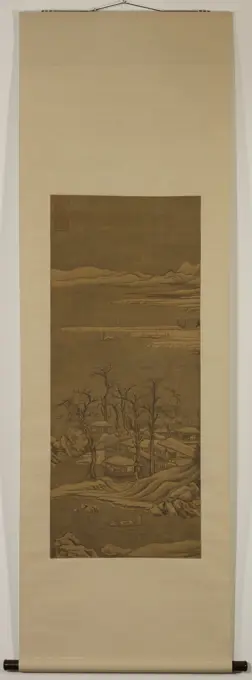
Delicate winter landscapes intricately painted on silk, using subtle tones and textures to convey tranquility and solitude.

Scholar in Landscape, c. 1500, Jiang Song, Chinese, Zhe school, late 15th -16th century, 55 x 34 1/2 in. (139.7 x 87.63 cm) (image), Ink on silk, China, 15th-16th century, Chiang Sung was a professional artist working in Nanking at the end of the fifteenth and beginning of the sixteenth centuries. A late proponent of the Che School, he was an important follower of Wu Wei, who popularized swift, sketchy, cursive brushwork in large scale paintings. Chiang enjoyed using sooty, deep black ink called 'burnt' or 'roasted.' He applied his inkwash with great nuance and subtlety, creating strong compositions of varied ink tonalities and brush movements. Unfortunately, few of his rapidly executed large vertical landscapes have survived.