Fine ArtVintageFootageSubscriptionBoardsFree ResearchPricing
  • Fine Art
  • Vintage
  • Footage
  • Subscription
  • Boards
  • Free Research
  • Pricing

Global Environmental Data Visualization

Colorful maps showing atmospheric carbon dioxide concentrations and ocean winds, derived from NASA satellites, illustrating climate patterns.

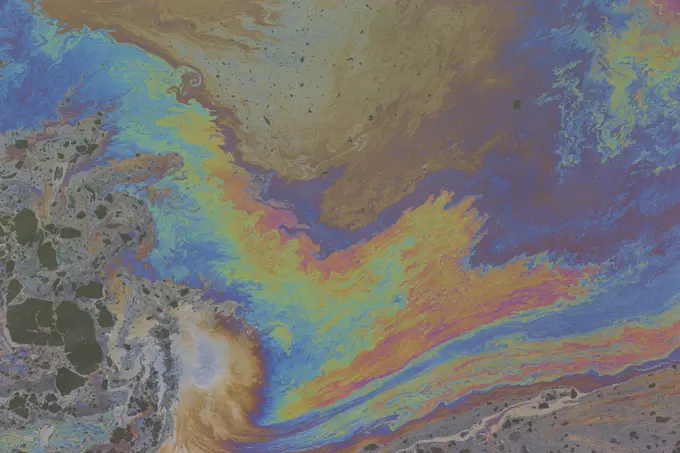
Close-up of oil stains in the basin of a fishing port.
90 assets in this story
1746-19663814
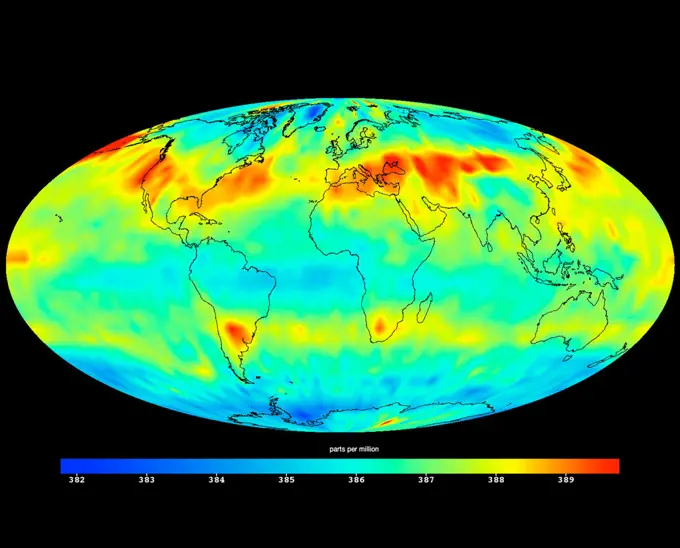
image created with data acquired by the Atmospheric Infrared Sounder instrument (AIRS) on NASAs Aqua satellite during July 2009. shows large-scale patterns of carbon dioxide concentrations that are transported around Earth by the general circulation of the atmosphere. Dark blue corresponds to a concentration of 382 parts per million and dark red corresponds to a concentration of almost 390 parts per million. The northern hemisphere mid-latitude jet stream effectively sets the northern limit of enhanced carbon dioxide. A belt of enhanced carbon dioxide girdles the globe in the southern hemisphere, following the Zonal flow of the southern hemisphere mid-latitude jet stream. This belt of carbon dioxide is fed by biogenesis activity in South America (carbon dioxide is released into the atmosphere through the respiration and decomposition of vegetation), forest fires in both South America and Central Africa, and clusters of gasification plants in South Africa and power generation plants in
6145-44589715
One of NASA's newest Earth-observing instruments, the SeaWinds scatterometer aboard Japan's Advanced Earth Observing Satellite (Adeos) 2--now renamed Midori 2--has successfully transmitted its first radar data to our home planet.
6145-45258108
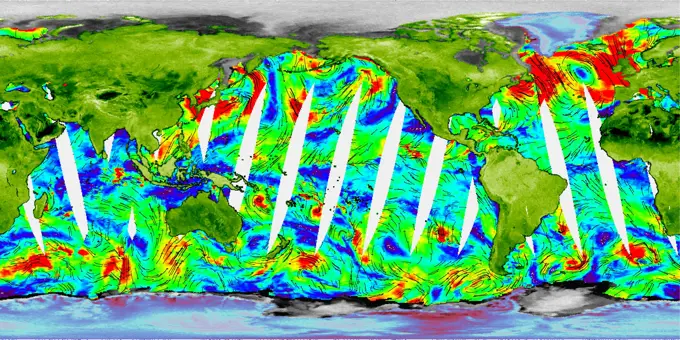
These images show ocean winds near the surface as observed by NASA's ISS-RapidScat on the International Space Station.
6145-44700930
Water vapor is the dominant greenhouse gas in our atmosphere. Mean clear air precipitable water, 500mb to top of atmosphere from the Atmospheric Infrared Sounder (AIRS) on NASA's Aqua satellite.
6145-45232155
NASA image  taken 8/31/2000The tongue of the Malaspina Glacier, the largest glacier in Alaska, fills most of this image. The Malaspina lies west of Yakutat Bay and covers 1,500 sq. MI (3,880 sq. km).
6145-44505300
The SeaWinds scatterometer on NASA's QuikScat satellite makes global radar measurements day and night, in clear sky and through clouds. Greenland and the polar ice cap are shown here on September 20, 1999.
1606-30449727
Close-up of oil stains in the basin of a fishing port.
1899-35654
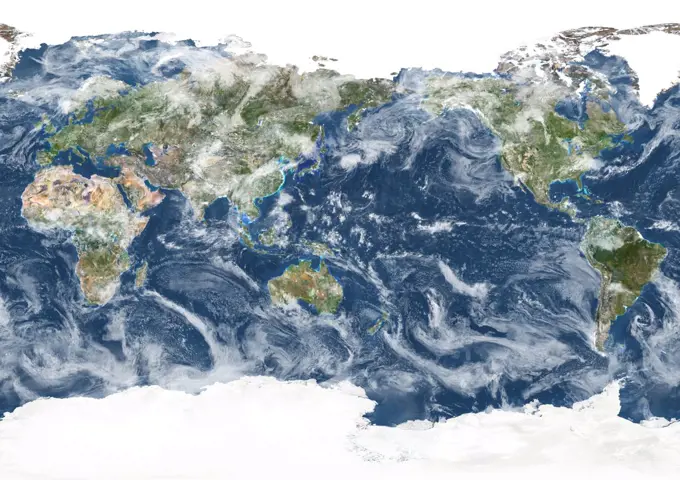
Whole Earth Centred On Pacific Ocean, True Colour Satellite Image. True colour satellite image of the whole Earth centred on the Pacific Ocean, with cloud coverage. This image in Miller projection was compiled from data acquired by LANDSAT 5 & 7 satellites.
6145-45046674
Beaufort Sea surface temperatures where Canada's Mackenzie River discharges into the Arctic Ocean, measured by NASA's MODIS instrument; warm river waters had broken through a shoreline sea ice barrier to enhance sea ice melt.
6145-45260421
Two key climate change indicators -- global surface temperatures and Arctic sea ice extent -- have broken numerous records through the first half of 2016, according to NASA analyses of ground-based observations and satellite data. Each of the first six months of 2016 set a record as the warmest respective month globally in the modern temperature record, which dates to 1880, according to scientists at NASA's Goddard Institute for Space Studies (GISS) in New York. The six-month period from January to June was also the planet's warmest half-year on record, with an average temperature 1.3 degrees Celsius (2.4 degrees Fahrenheit) warmer than the late nineteenth century. Read more a href= http //go.nasa.gov/29SQngq rel= nofollow go.nasa.gov/29SQngq /a
6177-V54005336
6177-V53547235
6145-44933579
The latest image of sea surface heights in the Pacific Ocean from NASA's Jason-2 satellite shows that the equatorial Pacific Ocean is now in its 10th month of being locked in what some call a neutral, or 'La Nada' state.
6145-45259696
This image shows ocean surface currents around the world during the period from June 2005 through Decmeber 2007. NASA/Goddard Space Flight Center Scientific Visualization StudioNASA image use policy.NASA Goddard Space Flight Center enables NASAs mission through four scientific endeavors: Earth Science, Heliophysics, Solar System Exploration, and Astrophysics. Goddard plays a leading role in NASAs accomplishments by contributing compelling scientific knowledge to advance the Agencys mission.Follow us on TwitterLike us on FacebookFind us on <a href="http://instagrid.me/nasagoddard/?vm=grid" rel="no
6145-44769651
NASA and Japan's Ministry of Economy, Trade and Industry (METI) released the Advanced Spaceborne Thermal Emission and Reflection Radiometer (ASTER) Global Digital Elevation Model (GDEM) to the worldwide public on June 29, 2009.
6145-44794262
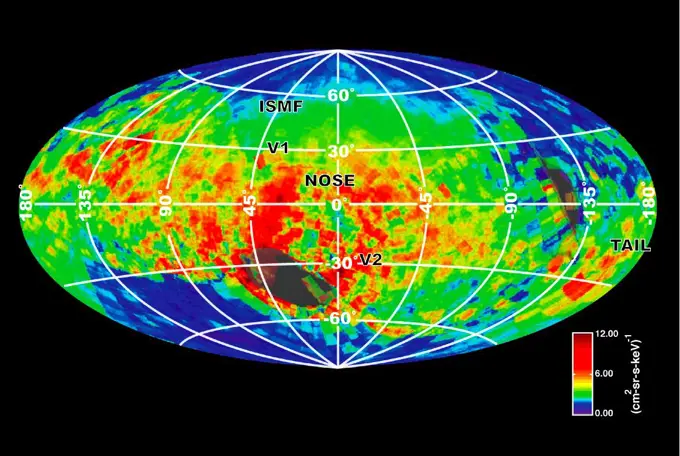
NASA's Cassini spacecraft created this image of the bubble around our solar system based on emissions of particles known as energetic neutral atoms.
6145-44769737
This image represents the total precipitable water vapor for May, 2009 as observed by JPL's Atmospheric Infrared Sounder on NASA's Aqua satellite.
6145-44792178
ElNio is experiencing a late-fall resurgence. Sea-level height data from the NASA/European Ocean Surface Topography Mission/Jason-2 oceanography satellite show the equatorial Pacific has triggered a wave of warm water, known as a Kelvin wave.
6145-45083854
This frame from an animation simulates a flyover of a portion of a Martian canyon detailed in a geological map produced by the U.S. Geological Survey and based on observations by the HiRISE camera on NASA's Mars Reconnaissance Orbiter.
6177-V53647811
6145-44773008
This visualization of a gravity model was created with data from NASA's Gravity Recovery and Climate Experiment and shows variations in the gravity field across the Asia and Australia.
6145-44972853
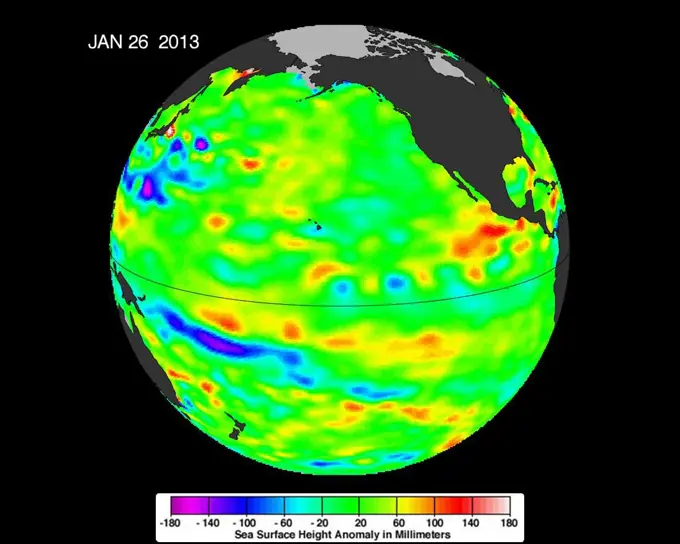
New data from NASA's Jason-2 satellite show near-normal sea surface heights in the equatorial Pacific Ocean persisting for a 16th straight month.
6145-44815736
On April 15, 2010, NASA's Terra spacecraft captured these images of the ongoing eruption of Iceland's Eyjafjallajkull Volcano, which continues to spew ash into the atmosphere and impact air travel worldwide.
6145-52961098
. SWOT Monitors Warming Waters Off California Coast. This data visualization image above shows sea surface heights off the northern California coast in August 2023 as measured by the Surface Water and Ocean Topography (SWOT) satellite. Red indicates higher-than-average ocean heights, while blue represents lower-than-average heights. Warm ocean waters from the developing El Niño are shifting north along coastlines in the eastern Pacific Ocean. Along the coast of California, these warm waters are interacting with a persistent marine heat wave that recently influenced the development of Hurricane Hilary. SWOT is able to spot the movement of these warm ocean waters in unprecedented detail. The SWOT science team made the measurements with the Ka-band Radar Interferometer (KaRIn) instrument. With two antennas spread 33 feet (10 meters) apart on a boom, KaRIn produces a pair of data swaths as it circles the globe, bouncing radar pulses off the water's surface to collect water-height measureme
4128R-11309925
Planet earth with fault lines and tectonic plates, computer artwork.
6145-45099530
Scientists poring over data from NASA's Orbiting Carbon Observatory-2 mission are seeing patterns emerge as they seek answers to questions about atmospheric carbon dioxide.
6145-44496733
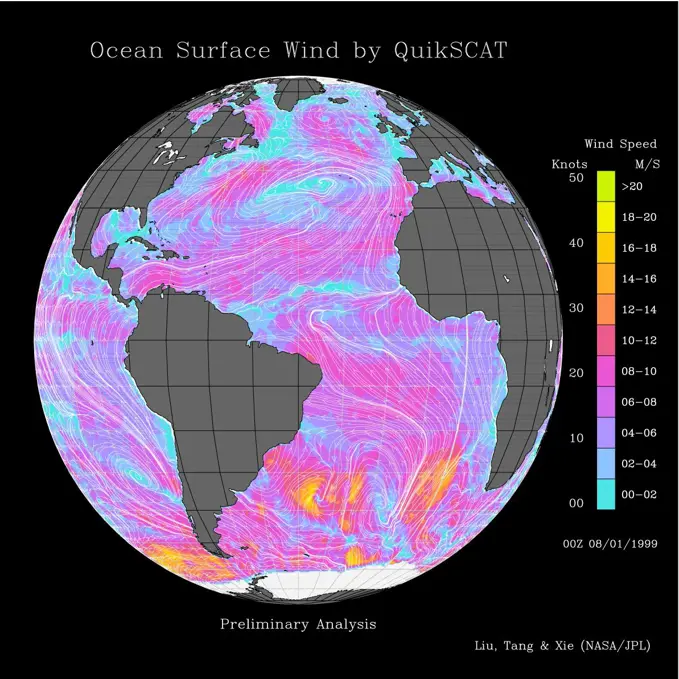
This image shows wind speeds and direction in the Atlantic Ocean on August 1, 1999, gathered by NASA's Seawinds radar instrument flying onboard NASA's QuikScat satellite.
6145-44971567
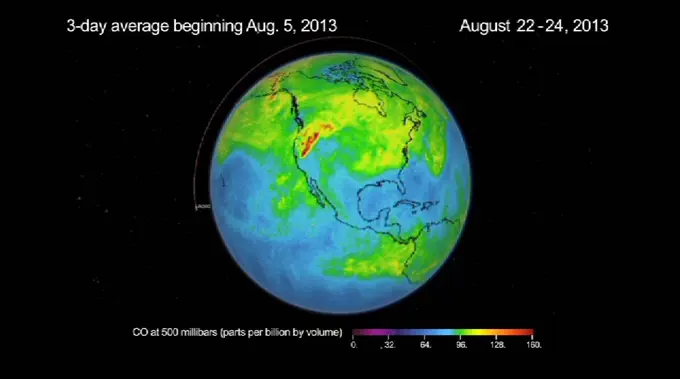
This frame from a movie was produced with data from NASA's Aqua spacecraft showing the spread of carbon monoxide pollution across North America from fires in the Western U.S., including the Beaver Creek Fire in Idaho and the Rim Fire in California.
6145-44790647
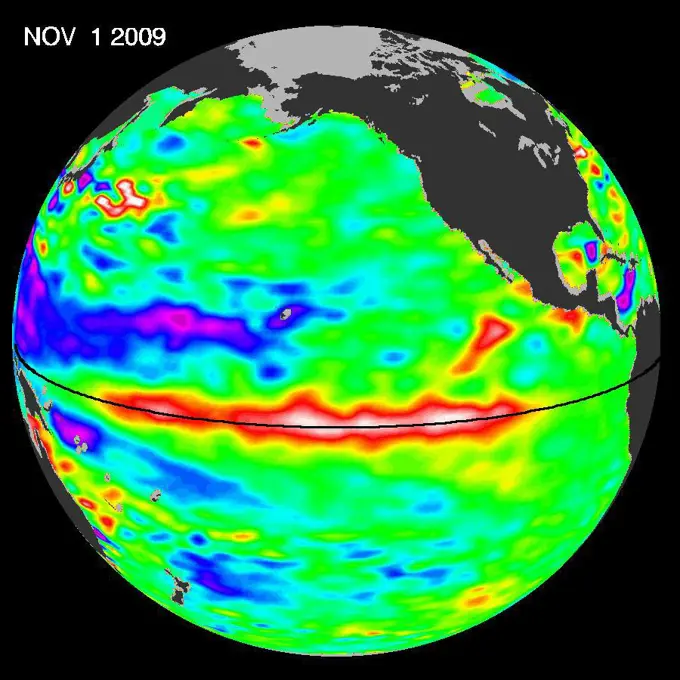
Pools of warm water known as Kelvin waves can be seen traveling eastward along the equator (black line) in this image from the NASA/French Space Agency Ocean Surface Topography Mission/Jason-2 satellite.
6145-44501666
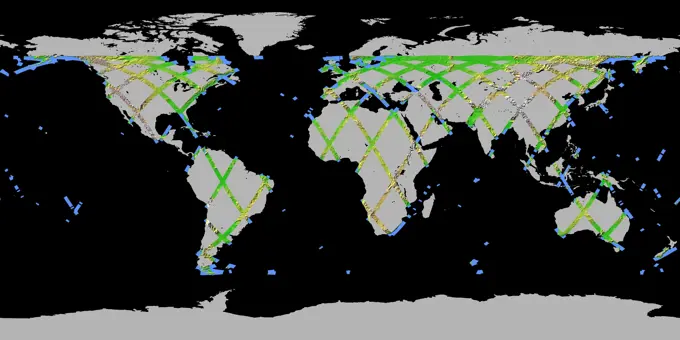
JSC2000E01555 (January 2000) --- A one-dimensional representation of Earthindicates only a portion of the total anticipated coverage area for the Shuttle Radar Topography Mission(SRTM). The primary objective of SRTM is to acquire a high-resolution topographic map of the Earth's land mass (between 60 degrees north and 56 degrees south latitude) and to test new technologies for deployment of large rigid structures and measurement of their distortions to extremely high precision.
1899-35469
North America With Cloud Coverage, True Colour Satellite Image. True colour satellite image of North America with cloud coverage. This image in Lambert Conformal Conic projection was compiled from data acquired by LANDSAT 5 & 7 satellites.
6145-44962653
This map created with data from the AIRS on NASA's Aqua satellite shows the concentration of carbon dioxide in Earth's mid-troposphere, located roughly between 3 to 6 miles (5 to 9 kilometers) in altitude.
1525-56351801
Weather Hurricane On Radar And Satellite Weather Hurricane On Radar And Satellite
6145-45264622
Images from the U.S./European Jason-3 satellite show sea surface height with respect to the seasonal cycle and the long-term trend. Blue/magenta colors indicate lower-than-normal sea levels, while yellow/red colors indicate higher-than-normal sea levels. The April 9, 2018 image (left panel) shows most of the ocean at neutral heights (green). A month later (right panel), a red patch is visible along the equator in the Central Pacific. The red area is a downwelling Kelvin wave, traveling eastward along the equator.
6145-44681557
Global tropospheric methane for August 2005 retrieved from the Atmospheric Infrared Sounder (AIRS) on NASA's Aqua satellite.
6177-V53546314
6177-V53547182
6145-45124981
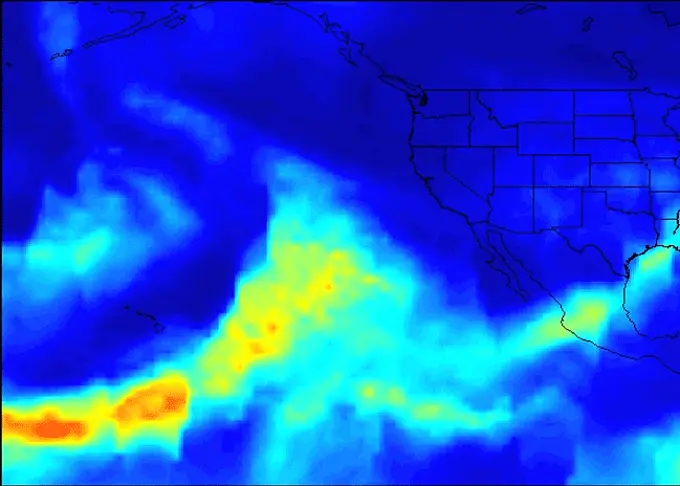
A series of atmospheric rivers that brought drought-relieving rains, heavy snowfall and flooding to California this week is highlighted in this movie frame created with satellite data from the AIRS instrument on NASA's Aqua satellite.
6145-44603844
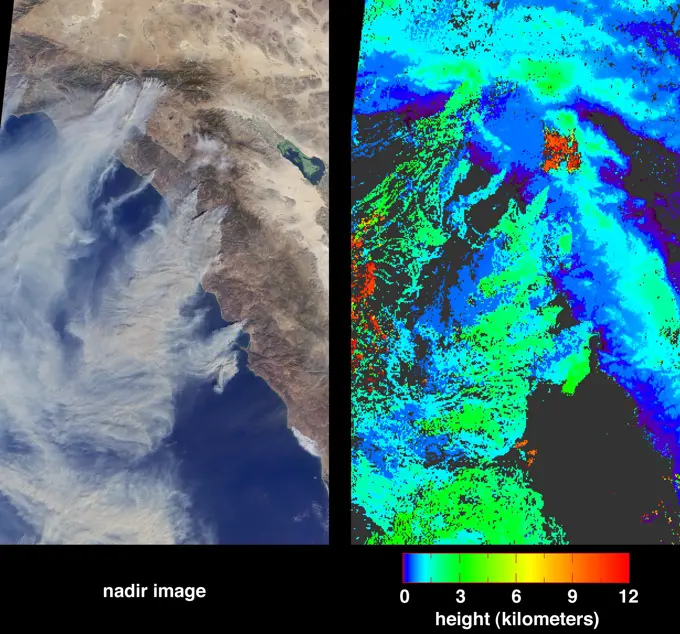
Large plumes of smoke rising from devastating wildfires burning near Los Angeles and San Diego on Sunday, October 26, 2003, are highlighted in this set of images from NASA's Terra spacecraft.
4409-17230984
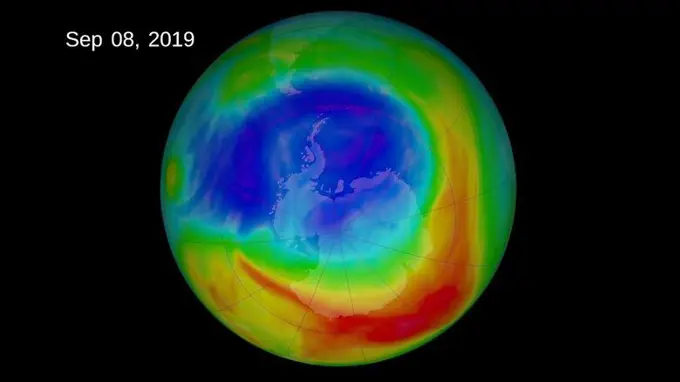
Scientists from NASA and NOAA work together to track the ozone layer throughout the year and determine when the hole reaches its annual maximum extent. in 2019 was unusually strong weather patterns caused warm temperatures in the upper atmosphere above the South Pole region of Antarctic, which resulted in a small ozone hole. Credits: NASA.
6145-44971565
This image from the MISR instrument onboard NASA's Terra spacecraft shows a 121-by-165-mile (194-by-266 kilometer) portion of California's Rim fire where the smoke is the thickest.
6145-45235794
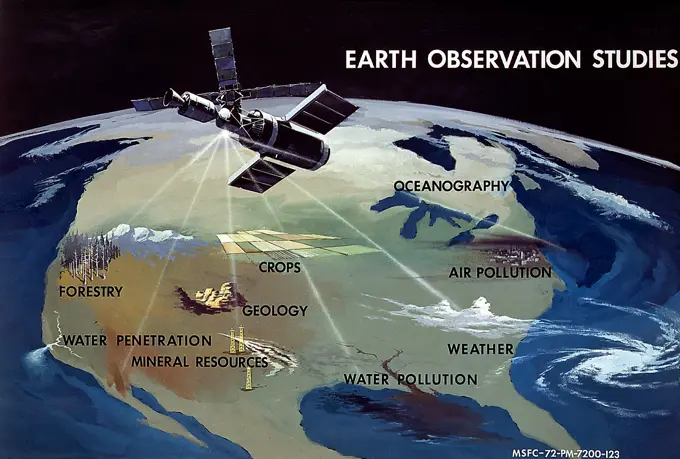
This concept illustrates Skylab Earth observation studies, an Earth Resources Experiment Package (EREP). EREP was designed to explore the use of the widest possible portion of the electromagnetic spectrum for Earth resource investigations with sensors that recorded data in the visible, infrared, and microwave spectral regions. Resources subject to this study included a capability of mapping Earth resources and land uses, crop and forestry cover, health of vegetation, types of soil, water storage in snow pack, surface or near-surface mineral deposits, sea surface temperature, and the location of likely feeding areas for fish, etc. A significant feature of EREP was the ability of man to operate the sensors in a laboratory fashion.
6188-58498865
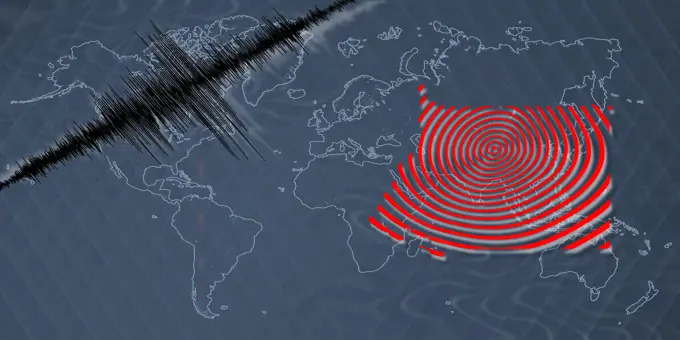
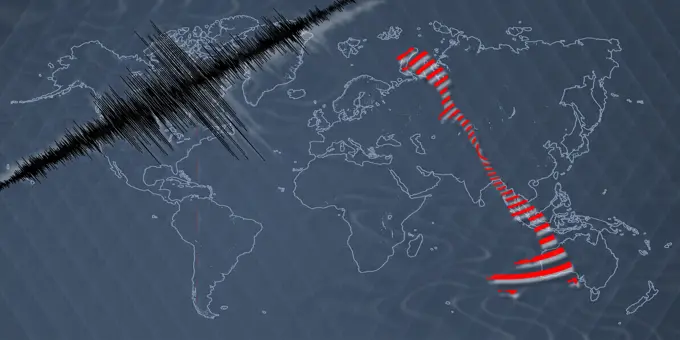
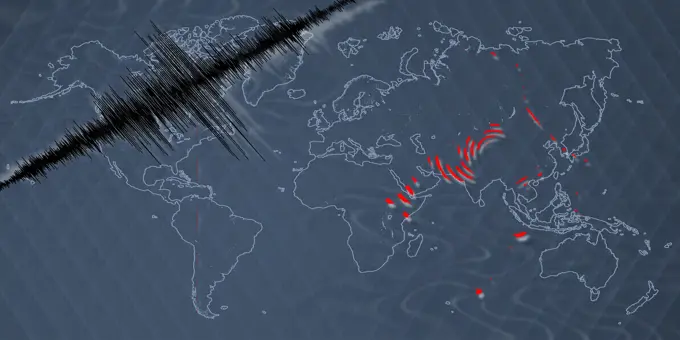
Seismic activity earthquake Equatorial Guinea map Seismic activity earthquake Equatorial Guinea map Richter scale Copyright: xZoonar.com/AleksandarxVukicevicx 21520836
6145-45257882
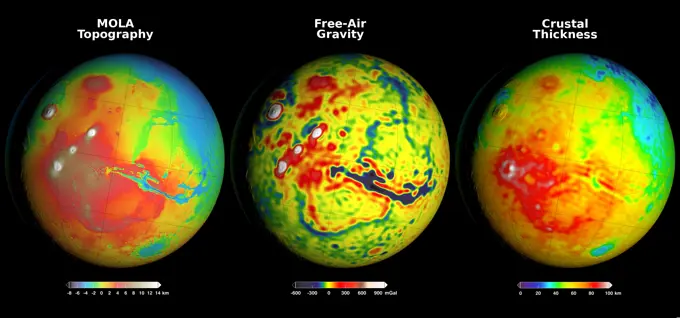
Newly detailed mapping of local variations in Mars' gravitational pull on orbiters (center), combined with topographical mapping of the planet's mountains and valleys (left) yields the best-yet mapping of Mars' crustal thickness (right). These three views of global mapping are centered at 90 degrees west longitude, showing portions of the planet that include tall volcanoes on the left and the deep Valles Marineris canyon system just right of center. Additional views of these global maps are available at http //svs.gsfc.nasa.gov/goto 4436. The new map of Mars' gravity (center) results from analysis of the planet's gravitational effects on orbiters passing over each location on the globe. The data come from many years of using NASA's Deep Space Network to track positions and velocities of NASA's Mars Global Surveyor, Mars Odyssey and Mars Reconnaissance Orbiter. If Mars were a perfectly smooth sphere of uniform density, the gravity experienced by the spacecraft would be exactly the same
6145-30253317
NASA's Hyperwall shows the sea surface temperature at the U.S. Center at the 19th Session of the Conference of the Parties to the UN Framework Convention on Climate Change (COP19) in Warsaw, Poland, on November 19, 2013.
6145-44575392
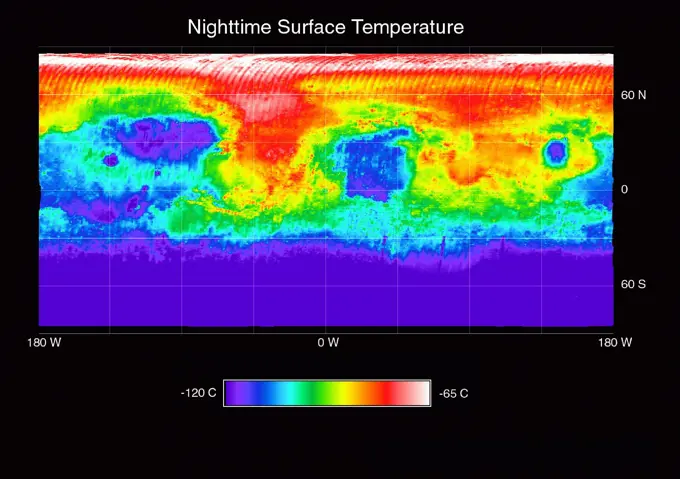
Temperature of the Martian Surface
6145-45298513
On Sept. 6, NASA's ECOsystem Spaceborne Thermal Radiometer Experiment on Space Station (ECOSTRESS) imaged active fires across California, including the El Dorado fire near Yucaipa and the Valley fire in Japatul Valley in the southern part of the state. As of Sept. 8, there were 25 major wildfires burning in California. Both images, taken at 12 13 a.m. PDT (3 13 a.m. EDT), show multiple concentrated areas of surface temperatures (in red) higher than 375 degrees Fahrenheit (191 degrees Celsius). These high temperature regions were likely where the active fires were occurring. The surrounding areas show abnormally warm middle-of-the-night background surface temperatures (orange) due to the ongoing heat wave.
1746-19663320
We can measure how fast tectonic plates are moving today with the Global Positioning System (GPS) method. The three most commonly used space-geodetic techniques. very long baseline interferometry (VLBI), satellite laser ranging (SLR), and the Global Positioning System (GPS)are based on technologies developed for military and aerospace research, notably radio astronomy and satellite tracking.
6145-44845528
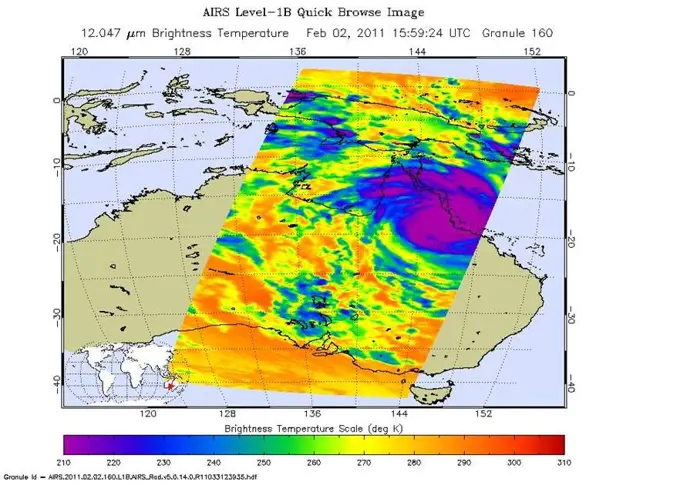
Powerful Tropical Cyclone Yasi's fury rakes Northeastern Australia in February, 2011, as seen by the Atmospheric Infrared Sounder (AIRS) on NASA's Aqua satellite.
6145-44903171
NASA's Terra spacecraft recorded low-level wind speeds of up to 75 miles per hour (65 knots) from cloud motion observed outside Tropical Storm Isaac's eye. The spacecraft flew over Isaac a few hours before Isaac was upgraded to a Category 1 hurricane.
6145-44497705
Mars Polar Lander Landing Site Noon-time Temperatures
6145-44574064
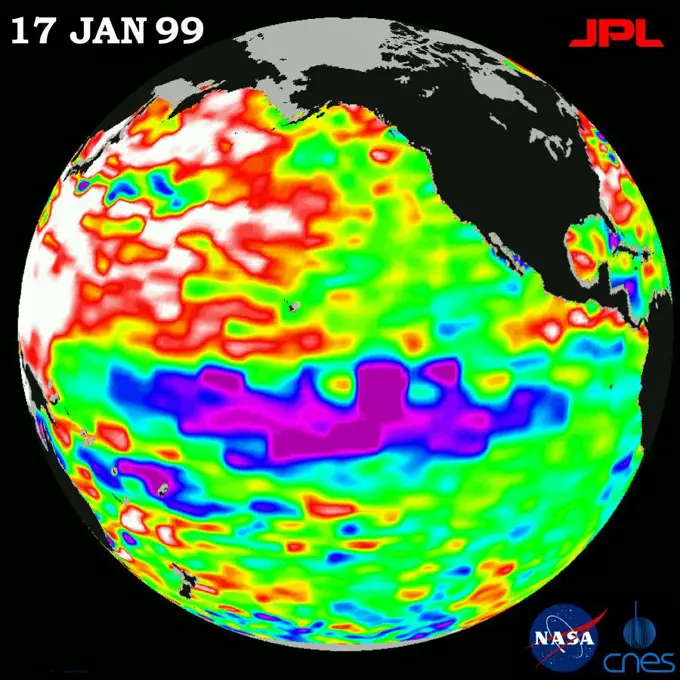
This image of the Pacific Ocean was produced using sea-surface height measurements taken by NASA's U.S.-French TOPEX/Poseidon satellite.
6188-58499490
Seismic activity earthquake Bahamas map Seismic activity earthquake Bahamas map Richter scale Copyright: xZoonar.com/AleksandarxVukicevicx 21521604
6145-45260977
City lights shine brighter during the holidays in the United States when compared with the rest of the year, as shown using a new analysis of daily data from the NASA-NOAA Suomi NPP satellite. Dark green pixels are areas where lights are 50 percent brighter, or more, during December. Because snow reflects so much light, the researchers could only analyze snow-free cities. They focused on the U.S. West Coast from San Francisco and Los Angeles, and cities south of a rough imaginary line from St. Louis to Washington, D.C.
6145-44494883
Growth of a Dust Storm (TES)
6188-58499413
Seismic activity earthquake French Guiana map Seismic activity earthquake French Guiana map Richter scale Copyright: xZoonar.com/AleksandarxVukicevicx 21521537
6145-44484951
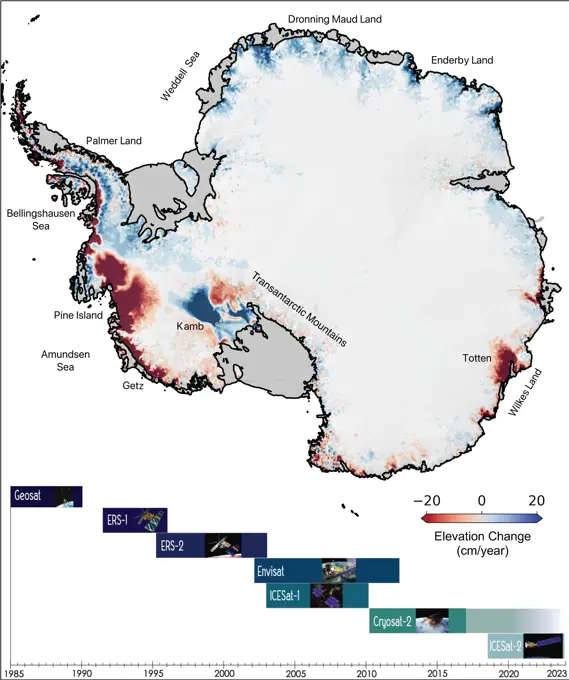
This map of Antarctica shows the changes in the elevation of the Antarctic ice sheet from 1985 through 2021. The map is part of a study, published in Earth System Science Data, conducted by researchers at NASA's Jet Propulsion Laboratory in Southern California. Ice height diminishes (shown in red) as the ice sheet melts by contact with ocean water; ice height rises (shown in blue) where accumulation exceeds ice loss. Ice shelves are shown in gray. The Pine Island and Thwaites glaciers in West Antarctica (the dark red spots on the left side of the map) are the largest areas of rapid ice loss. The stagnant Kamb Ice Stream (the dark blue area at middle-left) is the only major site of rapid accumulation as ice continues to push in from the interior but no longer flows out to an ice shelf. The image summarizes a new data set of monthly high-resolution snapshots of ice change. The satellite altimetry missions that supplied data for the study are listed in the timeline at the bottom of the im
6145-44676990
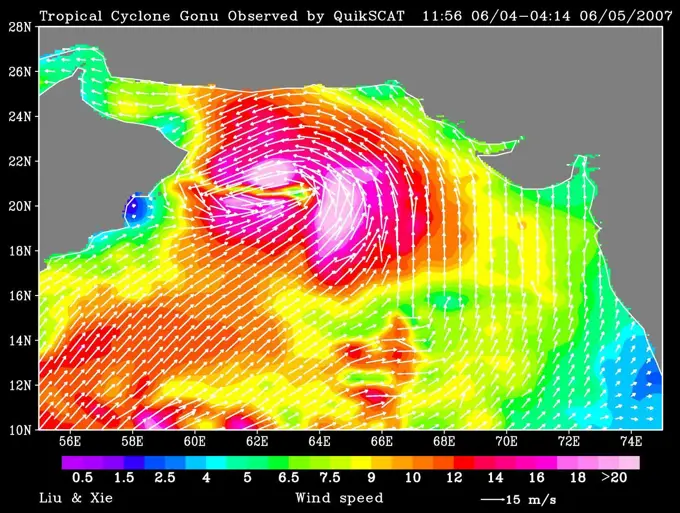
NASA's QuikScat observed a rare tropical cyclone in the northern part of the Arabian Sea, threatening the petroleum shipping lanes and the Gulf States (e.g. Oman) that are unprepared for such an event.
6145-44532046
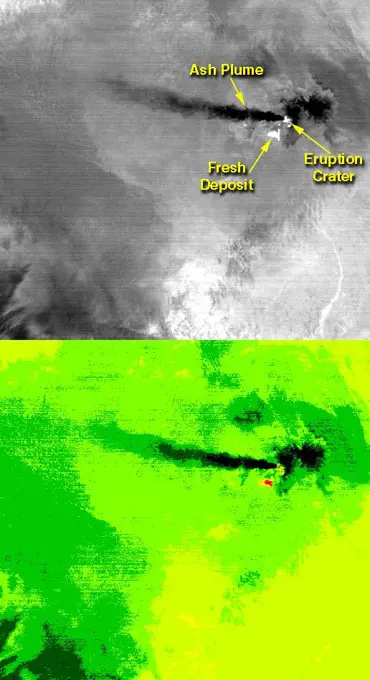
On the night of June 4, 2001, NASA's Terra spacecraft captured this thermal image of the erupting Shiveluch volcano, located on Russia's Kamchatka Peninsula.
6188-58499562
Seismic activity earthquake French Polynesia map Seismic activity earthquake French Polynesia map Richter scale Copyright: xZoonar.com/AleksandarxVukicevicx 21521705
6145-45043052
NASA 'Sees' Tohoku-Oki Earthquake and Tsunami in Earth's Upper Atmosphere
6145-44564379
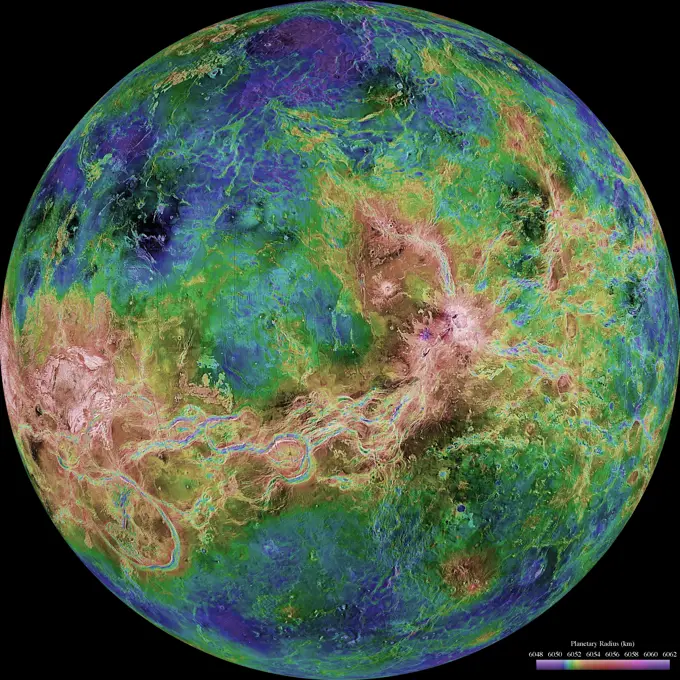
The view of Venus, after more than a decade of radar investigations culminating in the 1990-1994 NASA Magellan mission, is centered at 180 degrees east longitude.
1746-28998661
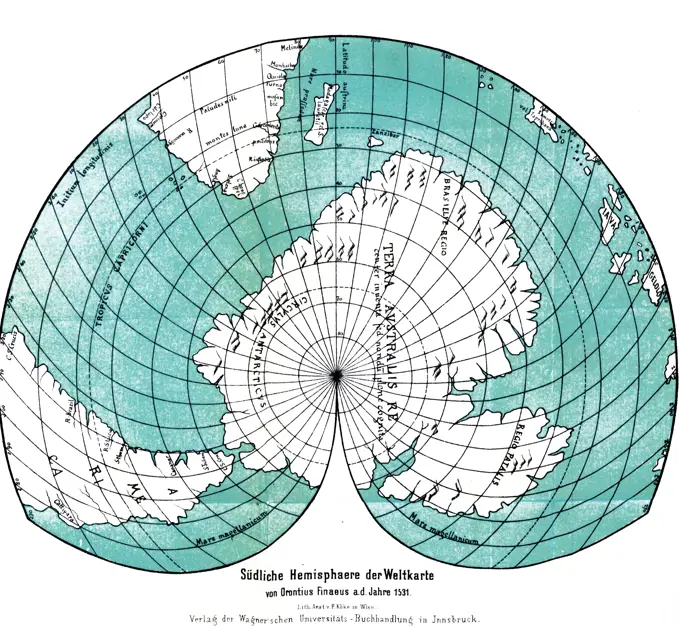
1881 German version of the World Map 1531, by Oronce Finé (Orontius Finnaeus). Fine (1494  1555) was a French mathematician and cartographer.
6145-44681556
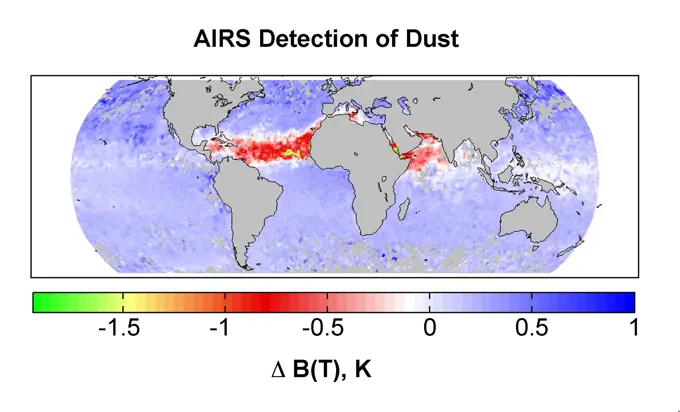
Detection of dust: global map for July 2003 from the Atmospheric Infrared Sounder (AIRS) on NASA's Aqua satellite.
6145-45258907
This pair of images shows ocean surface wind speeds for Hurricane Irma as observed at 5 26 a.m. EDT on Sept. 4, 2017 (top) and 24.5 hours later at 6 02 a.m. EDT on September 5th (bottom) by the radiometer instrument on NASA's Soil Moisture Active Passive (SMAP) satellite. Color indicates wind speed, with red being highest and blue lowest. Irma intensified from a Category 2 hurricane on Sept. 4 with observed wind speed of 106 miles per hour (47.5 meters per second) to a Category 5 hurricane on Sept. 5 with a maximum observed wind speed of 160 miles per hour (71.4 meters per second).
6145-44977392
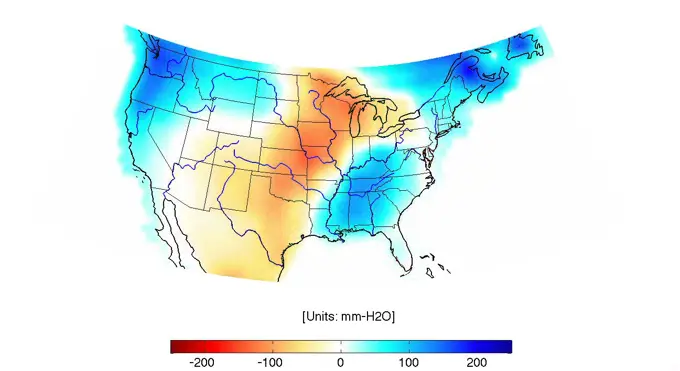
This frame from NASA's Grace animation illustrates the highs and lows of combined land water storage (includes snow, soil moisture, and surface water) over the continental United States.
6145-44712673
Carbon monoxide from California's wildfire, a visualization created using data from the Atmospheric Infrared Sounder (AIRS) on NASA's Aqua satellite, June-July, 2008.
6145-45092562
With its antenna now spinning at full speed, NASA's new Soil Moisture Active Passive (SMAP) observatory has successfully re-tested its science instruments and generated its first global maps, a key step to beginning routine science operations in May, 2015
6145-44878373
This image is the first complete map of the speed and direction of ice flow in Antartica. The thick black lines delineate major ice divides. Subglacial lakes in Antarctica's interior are also outlined in black.
6176-55294042
Aquatic System Beneath Antarctic Ice Sheet, Illustration
6145-44856374
This radar image from ESA's Envisat depicts ground displacements resulting from the March 11, 2011, magnitude 9.0 Tohoku earthquake in Japan.
6145-45097991
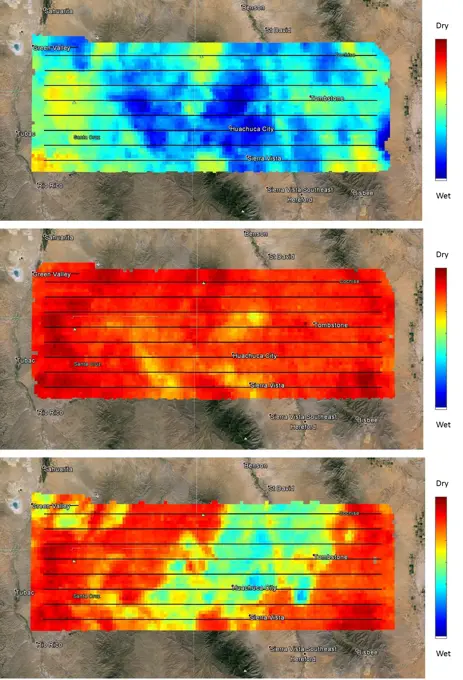
NASA's SMAP (Soil Moisture Active Passive) satellite observatory conducted a field experiment as part of its soil moisture data product validation program in southern Arizona on Aug. 2-18, 2015.
6145-44903449
Strong tropical storm Isaac continues to create havoc across the Gulf Coast, from eastern Texas to Florida. This infrared image from NASA's Aqua spacecraft, was acquired at 2:41 p.m. CDT on Aug. 29, 2012.
1927-1613
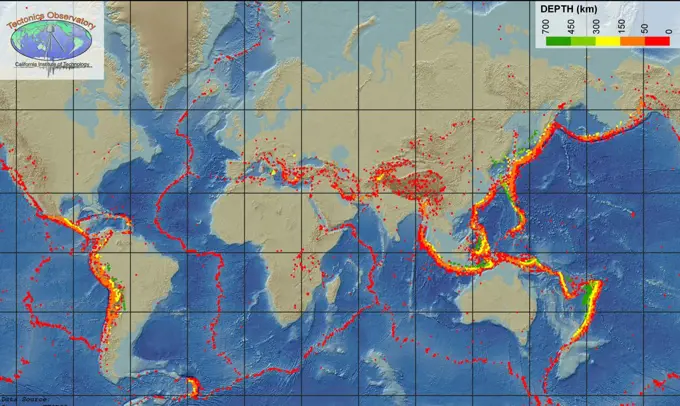
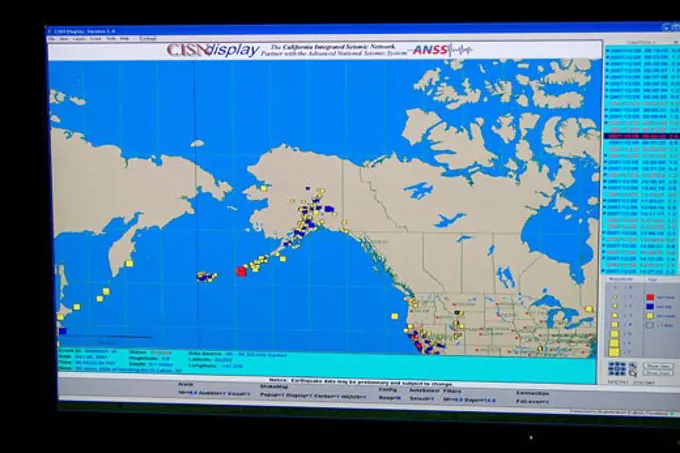
Computor screen shoiwng location and strength of earthquakes Seismic Labratory at California Institute of Technology Pasadena  California
6145-45264632
This image, taken at 1 35 pm local time on Tuesday, September 11, 2018 by the Atmospheric Infrared Sounder (AIRS) onboard NASA's Aqua satellite shows Hurricane Florence whose strong winds are expected to reach the Carolina coast late Thursday. Florence intensified from a Category 2 to a Category 4 storm in a matter of hours. As of Tuesday evening, Florence had maximum sustained winds of 140 mph (225 kph). Figure 1 shows Hurricane Florence in visible light, much as our eyes would see it. This is a classic image of a strong hurricane, with a well-defined eye near the center of a large, thick cloud shield containing bands of very thick clouds, and high, thin clouds far from the storm where air flows away from the thick rain clouds. AIRS has more than 2,000 channels that capture various hues of infrared, and this image represents the temperature of the cloud tops and the ocean surface (called brightness temperature in the image). Purple shows very cold clouds high in the atmosphere, blue a
6145-44821013
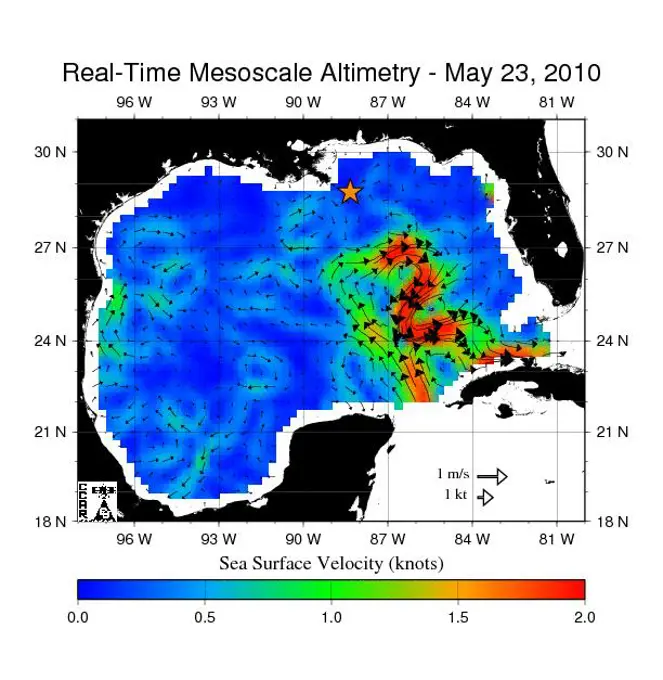
The northern portion of the Gulf of Mexico's Loop Current, shown in red, appears about to detach a large ring of current, creating a separate eddy. An eddy is a large, warm, clockwise-spinning vortex of water -- the ocean's version of a cyclone.
6145-45297023
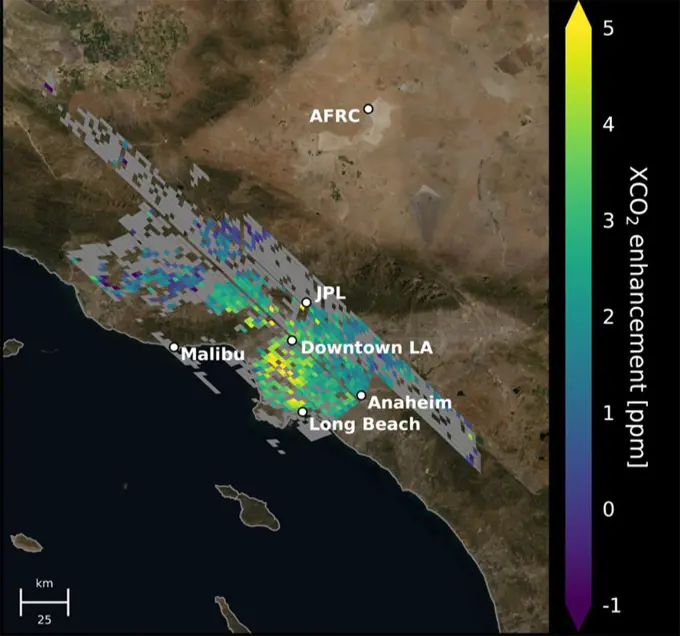
This animation shows the accumulation of five adjoining swaths of data over the Los Angeles metropolitan area that when combined, create a map of carbon dioxide (CO2) concentrations that covers about 50 square miles (80 square kilometers). Researchers have used the data, collected by NASA's Orbiting Carbon Observatory 3 (OCO-3) instrument aboard the space station, to create one of the most accurate maps ever made from space of the human influence on CO2 abundances in the L.A. Basin Each pixel is about 1.3 miles (2.2 kilometers); the color indicates how much higher the concentration of CO2 is in that spot than in clean desert air north of the city (measured at NASA's Armstrong Research Center, upper right). The highest CO2 readings, in yellow on the map, are on the west side of downtown L.A. - a densely populated area with congested freeways and CO2-emitting industries. Yellow indicates atmospheric CO2 elevated by five or more molecules out of every million molecules of air, or five par
4128-28681059
Earth's internal structure, illustration
6145-44631898
These data maps from the Microwave Limb Sounder on NASA's Aura spacecraft depict levels of hydrogen chloride, chlorine monoxide, and ozone at an altitude of approximately 19 km (490,000 ft) on selected days during the 2004-05 Arctic winter.
6145-44483644
A relentless heat wave has blanketed India and Pakistan since mid-March 2022, causing dozens of deaths, fires, increased air pollution, and reduced crop yields. NASA's Ecosystem Spaceborne Thermal Radiometer Experiment on Space Station instrument (ECOSTRESS) has been measuring these temperatures from space, at the highest spatial resolution of any satellite instrument. This image, taken shortly before local midnight on May 5, shows urban areas and agricultural lands northwest of Delhi that are home to about 28 million people. The image covers about 4,800 square miles (12,350 square kilometers). Cities are usually markedly warmer than the surrounding countryside due to human activities and the materials used in the built environment. The image clearly delineates these urban heat islands. Nighttime temperatures in Delhi and several smaller villages were above 95 degrees Fahrenheit (35 degrees Celsius), peaking at about 102 degrees F (39 degrees C), while the rural fields nearby had coole
6145-52930602
COWVR, TEMPEST Track Tropical Cyclone Mandous. Data from two weather instruments developed at NASA's Jet Propulsion Laboratory in Southern California to provide forecasters data on weather over the open ocean were used to create this image of Tropical Cyclone Mandous on Dec. 9, 2022, as the storm approached the southeastern coast of India. Forecasters at the U.S. Joint Typhoon Warning Center in Pearl Harbor, Hawaii, used the image and others like it to understand the storm's intensity and track its path. The instruments, Compact Ocean Wind Vector Radiometer (COWVR) and Temporal Experiment for Storms and Tropical Systems (TEMPEST), observe the planet's atmosphere and surface from aboard the International Space Station. The image above uses 33.9 gigahertz microwave emissions measured from COWVR to detect structural features of Mandous, including its center, which is about 160 miles (250 kilometers) northeast of the northern tip of Sri Lanka. The colored portions over water indicate the p
6145-45155117
NASA and Roscosmos team members, along with Russian Search and Recovery Forces, meet to discuss the readiness for the landing of Expedition 54 crew members Joe Acaba and Mark Vande Hei of NASA and cosmonaut Alexander Misurkin Sunday, Feb. 25, 2018. Acaba, Vande Hei, and Misurkin are returning after 168 days in space where they served as members of the Expedition 53 and 54 crews onboard the International Space Station.
6145-45266661
Image shows OCO-3's first preliminary solar-induced fluorescence (SIF) measurements over western Asia. Solar-induced fluorescence is the glow plants emit from photosynthesis  the process of plant growth that includes the capture of carbon from the atmosphere. Areas with lower photosynthesis activity are in shown in light green; areas with higher photosynthesis activity are shown in dark green. As expected, there is significant contrast in plant activity from areas of low vegetation near the Caspian Sea to areas of more dense vegetation like the forests and farms north and east of the Mingachevir Reservoir (near the center of the image). The mission team expects to complete OCO-3's In-orbit checkout phase  the period where they ensure all instruments and components are working and calibrated correctly  in August 2019. They are scheduled to release official CO2 and solar-induced fluorescence data to the science community a year later; however, the data will likely be available sooner
1525-28067853
Isodynames or lines of equal magnetic intensity, vintage engraved illustration. From the Universe and Humanity, 1910.
6145-52930407
Sea Level Visualization of Gulf Stream. This visualization shows sea surface height measurements of the Gulf Stream off the coast of North Carolina and Virginia. The data was collected on Jan. 21, 2023, by seven satellites currently in operation. The information, provided by the Copernicus Marine Service of ESA (European Space Agency), comes from radar instruments called Earth-facing altimeters. In the visualization, red and orange areas represent sea levels that are higher than the global average, while shades of blue represent sea levels that are lower than average. An altimeter - widely used to measure sea level from space - works by bouncing radar signals off the ocean's surface directly beneath the instrument. It records both the time the signal takes to travel from a satellite to Earth and back, as well as the strength of the return signal. The spatial resolution offered by these instruments - shown in the composite image that's been modified so that different sea levels appear a
6145-44514780
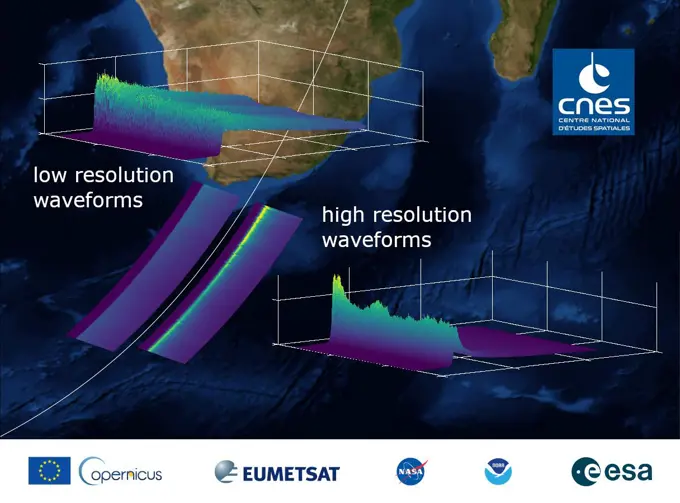
This graphic, released on Dec. 10, 2020, shows the basic radar measurements, called waveforms, collected by the instrument that monitors sea level on the Sentinel-6 Michael Freilich satellite, which launched Nov. 21, 2020. The instrument, called an altimeter, works by bouncing a radar signal off the ocean surface and measuring how long it takes to go out and return. The higher-resolution waveforms focus on a smaller area of the ocean than the lower-resolution waveforms, allowing researchers to resolve smaller ocean features such as currents closer to the coast. The waveform provides information not only on sea level, but also on wave height and wind speed.
6145-54684447
. NASA's AIRS Instrument Tracks Volcanic Sulfur Dioxide Plume from Mauna Loa Eruption. The Atmospheric Infrared Sounder (AIRS) instrument aboard NASA's Aqua satellite detected volcanic sulfur dioxide (SO) plumes emanating from Hawaii's Mauna Loa volcano, which started erupting late Sunday, Nov. 27, 2022, at 11 30 p.m. Hawaiian Standard Time (9 30 a.m. UTC, Nov. 28). The AIRS images shown here were taken from seven overpasses, capturing the SO volcanic plumes and its pathways since the eruption. Starting from the upper left frame  captured at 2 41 a.m. HST (12 41 UTC) on Nov. 28, around three hours after the eruption began  a red patch that represents an SO plume can be seen east of the volcano, which is shown as a blue triangle, then moving east and diffusing through subsequent frames. By 71 hours after the eruption, the eastern part of the plume is over the southeastern United States. SO can be harmful to the human respiratory system when inhaled. In the atmosphere, it can also lead t
6145-45258367
The radiometer instrument on NASA's Soil Moisture Active Passive (SMAP) spacecraft captured this image of Hurricane Maria at 6 27 a.m. EDT on Sept. 19, 2017 (10 27 UTC), showing an estimated maximum surface wind speed of 126.6 miles per hour (56.6 meters per second). While Maria was already a Category 5 hurricane at the time of this observation, it is an extremely tightly organized hurricane and SMAP cannot fully resolve its highest winds due to the 25-mile (40-kilometer) resolution of SMAP.
6145-44705961
Polygon Patterned Ground on Mars and on Earth
6145-51995097
USGS Map of 3.6 Germantown Earthquake.. Photographs Relating to Disasters and Emergency Management Programs, Activities, and Officials
PREVIOUS
of 1
NEXT
2401 S. Ervay, Suite 206
Dallas, Texas 75215
United States
Browse
CategoriesGalleriesFree Research
For Creators
License Your ContentSuperStock For StudentsFrame of Mind BlogContributor PortalNew Image SpotlightLicense AI Imagery
Resources
About UsLicensingTerms & ConditionsAPI AccessPrivacyPricing
Contact
+1 866 236 0087help@superstock.com Contact form
©2026 SuperStock. All Rights Reserved. -B
This site is protected by reCAPTCHA and Google Privacy Policy and Terms of Service apply.