Fine ArtVintageFootageSubscriptionBoardsFree ResearchPricing
  • Fine Art
  • Vintage
  • Footage
  • Subscription
  • Boards
  • Free Research
  • Pricing

Persian Miniature Art

Vivid Persian miniatures depicting historical narratives with intricate details, vibrant colors, and stylized figures, showcasing warriors, gardens, and emotional scenes.

Stage in the garden pavilion; Ali Karimi (Fl. Ca 1896); 1896/1897 () (1898-00-00-1898-00-00);
85 assets in this story
4409-17428713
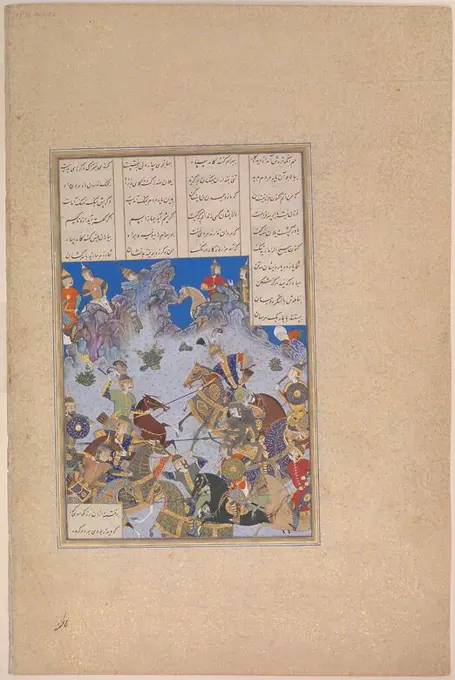
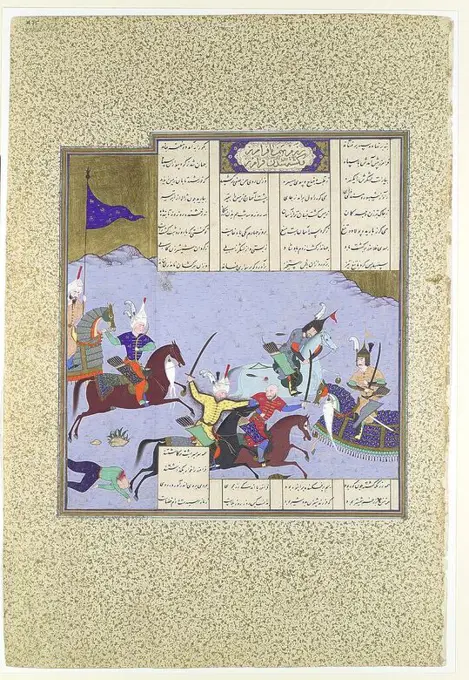
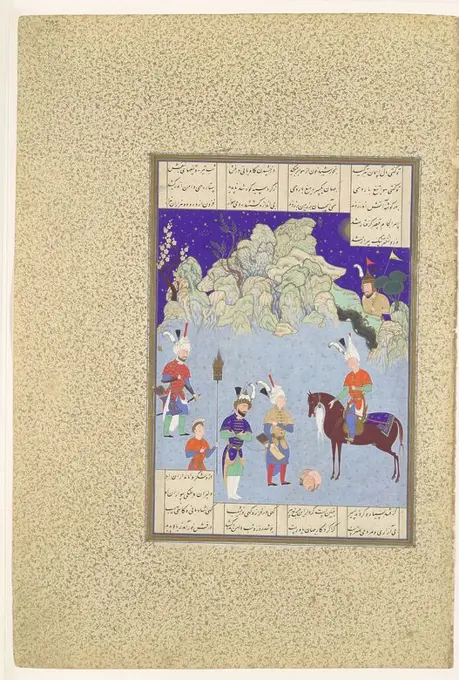
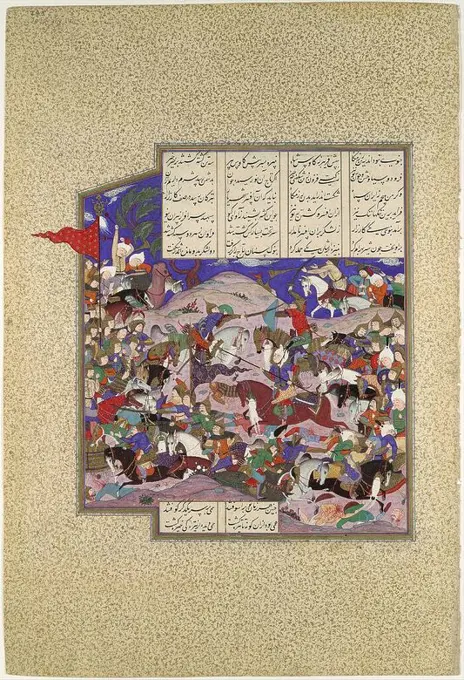
"Khusrau Parviz's Charge against Bahram Chubina", Folio 707v from the Shahnama (Book of Kings) of Shah Tahmasp. Artist: Painting attributed to Bashdan Qara (active ca. 1525-35). Author: Abu'l Qasim Firdausi (935-1020). Dimensions: Painting: H. 7 3/4 x W. 6 1/2 in. (H. 19.7 x W. 16.5 cm)Entire Page: H. 18 9/16 x W. 12 3/8 in. (H. 47.1 x W. 31.4 cm). Date: ca. 1530-35.Eventually a large army from Rum joins Khusrau Parviz and his Iranians and marches toward Azarbaijan. After a Rumi hero dies on the first day of battle, Khusrau decides to take a small band of Iranians with him the next day. Although Bahram Chubina enters the fray with only three soldiers, he puts Khusrau and his men to flight. Museum: Metropolitan Museum of Art, New York, USA.
6145-59075745
Stage in the garden pavilion; Ali Karimi (Fl. Ca 1896); 1896/1897 () (1898-00-00-1898-00-00);
6145-59274617
Laila in Mainum, Anonymous, 1500 - 1600 Persian miniature. drawing In a field with animals, a woman with a dead man is half over her, a man is half over the woman and sprinkles her from a bottle, a woman holds a large black rug up and behind the hills is a half figure visible; A Persian text in four columns runs the top and bottom the performance. The show is framed by a wide discolored ivory leaf edge and is located to the right side of the leaf. Persia Presentation: Paper brush / brush
6145-29068967
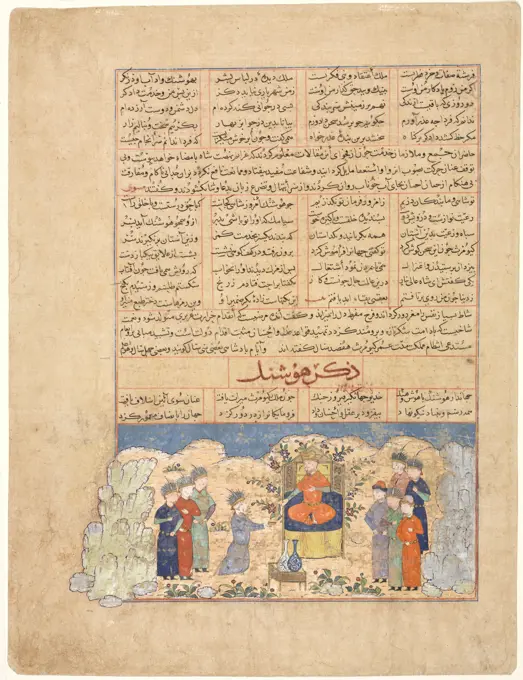
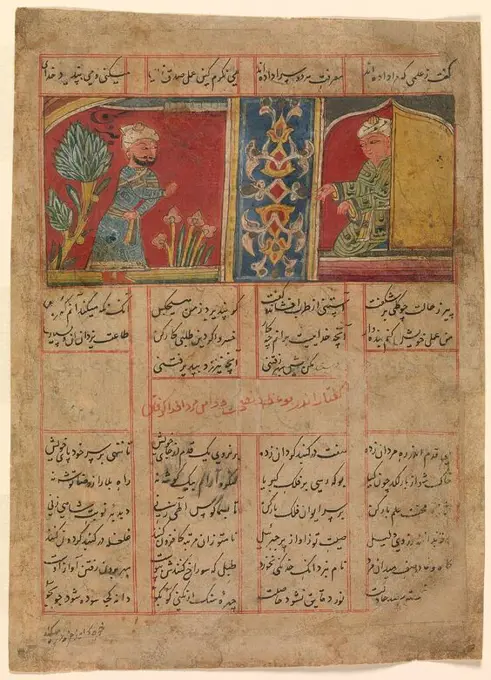
The Story of Hushang, from a Majma al-tavarikh (A Compendium of Histories) of Hafiz-i Abru (recto), 1425-50. Afghanistan, Herat, Timurid period (1370-1501). Opaque watercolor and ink on paper; image: 11 x 25.7 cm (4 5/16 x 10 1/8 in.); overall: 42 x 32 cm (16 9/16 x 12 5/8 in.); text area: 22.6 x 22.8 cm (8 7/8 x 9 in.).
4409-17433378
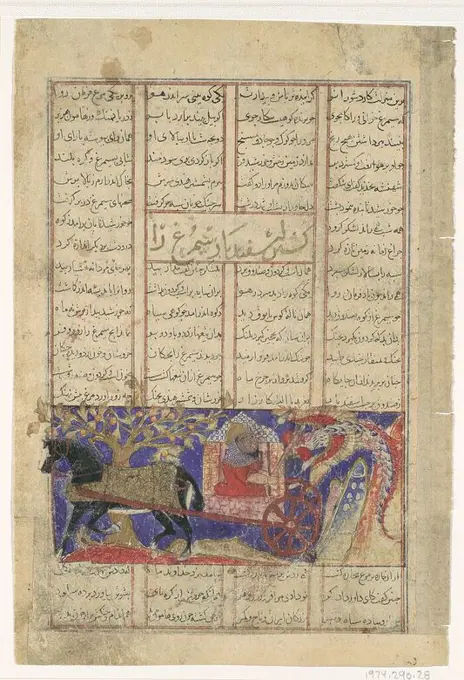
"Isfandiyar's Fifth Course: He Slays the Simurgh", Folio from a Shahnama (Book of Kings). Author: Abu'l Qasim Firdausi (935-1020). Dimensions: Page: 7 13/16 x 5 3/8 in. (19.8 x 13.6 cm)Painting: 1 7/8 x 4 1/8 in. (4.8 x 10.4 cm). Date: ca. 1330-40.The Simurgh in this miniature is not the benevolent guardian of the family of Zal and Rustam, but is based on the tradition of the Rukh - a creature of great strength and ferocity. This Simurgh is not yet fully patterned on the Chinese phoenix of some thirty-five years earlier, which comes from a more sophisticated cultural center, but is far more graceful than the rooster/parrot type of Simurgh found elsewhere in the present manuscript. Museum: Metropolitan Museum of Art, New York, USA.
6145-29137688
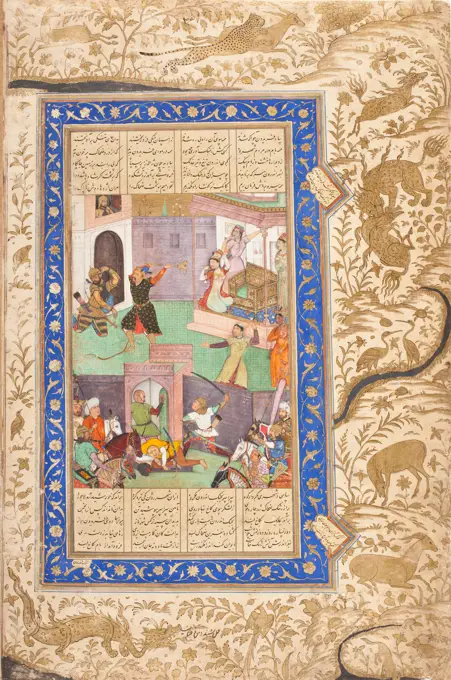
Faridun Strikes Zahhak, Folio from a Shahnama (Book of Kings). Bishandas (India, active circa 1590-1640)Inayd Inayat (active circa 1590-1615 ()). India, Mughal empire, circa 1610. Drawings; watercolors. Opaque watercolor, gold, and ink on paper
4409-17403758
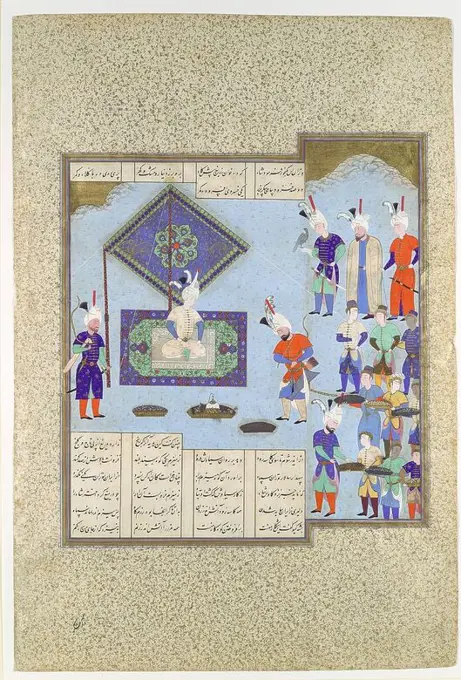
"Kai Khusrau's War Prizes Are Pledged", Folio 225v from the Shahnama (Book of Kings) of Shah Tahmasp. Artist: Painting attributed to Aqa Mirak (active ca. 1525-60). Author: Abu'l Qasim Firdausi (935-1020). Dimensions: Painting: H. 9 5/16 in. (23.7 cm) W. 10 7/16 in. (26.5 cm)Page: H. 18 5/8 in. (47.3 cm) W. 12 1/2 in. (31.8 cm)Mat: H. 22 in. (55.9 cm)W. 16 in. (40.6 cm). Date: ca. 1530.In preparation for war with the Turanians, Kai Khusrau ordered treasures and armor to be brought forth from the royal treasury and promised as prizes to the winners of six feats of prowess in the coming hostilities. Trays of gems and armor sit on the ground before the king. The style of this painting is characteristic of the third director of the Shahnama project, Aqa Mirak. The harmony of the composition is achieved not only by balancing solids and voids but also through the distribution of ultramarine blue, orange-red, and light green across the image against a ground of light blue. Museum: Metro
6145-51834178
Mi`raj (Ascension) of the Prophet Muhammad, Folio from an Illustrated Manuscript of the Khamsa (Quintet) of Nizami Nizami. , mid-16th century. Ink, opaque watercolors and gold on paper, full page: 13 1/8 x 8 3/8 in. (33.4 x 21.2 cm); miniature: 9 1/4 x 8 1/2 in. (23.5 x 21.6 cm).   Arts of the Islamic World mid-16th century
6145-29064008
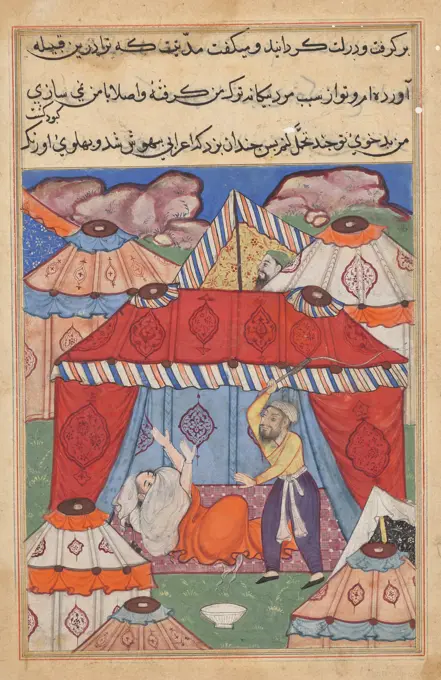
The disguised Arab, substituting for Habbaza, is whipped by her husband for refusing a bowl of milk, from a Tuti-nama (Tales of a Parrot): Twenty-fourth Night, c. 1560. Mughal India, court of Akbar (reigned 1556-1605). Gum tempera, ink, and gold on paper; overall: 20.3 x 14 cm (8 x 5 1/2 in.); painting only: 12.5 x 10.1 cm (4 15/16 x 4 in.). While Habbaza is away carrying on an affair with her lover Bashir, Bashirs friend dresses in Habbazas clothes and waits in her tent. Each night, Habbazas husband offers her milk and when she refuses, leaves her in peace. This time, however, he becomes enraged at her silence and lashes out.
6145-59274915
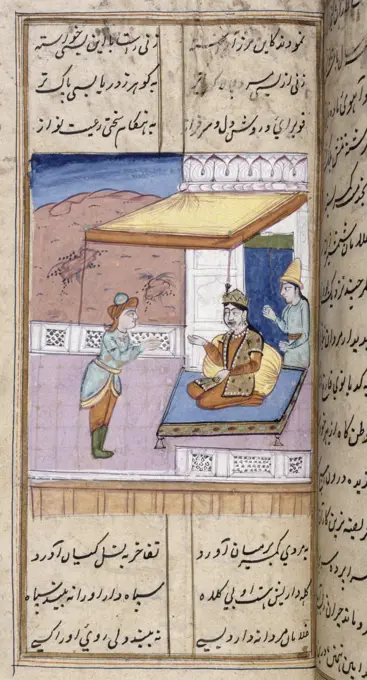
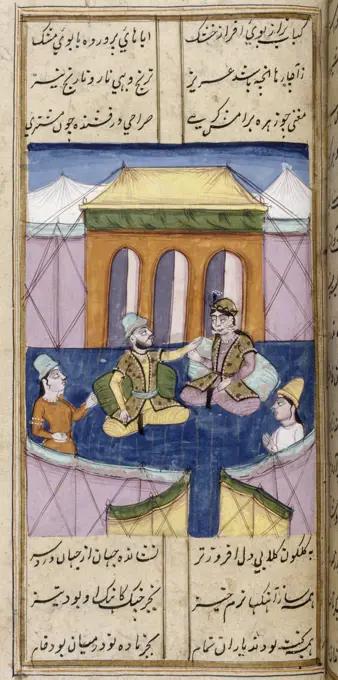
Two Eastern figures on a carpet for a palace, Anonymous, 1790 - 1810 Indian miniature. drawing In the middle of the show is an old man with a white beard, on the left opposite him a young man in purple robe, on his knees, in the background a piece of palace with a wall against which a flowering bush is standing; The show runs over the width of two columns of text. The performance is in the middle of the leaf and covers the width of two columns of text that are located above and below the performance and also on the back of the leaf. Cashmir paper brush / brush
4409-17434838
"Khizr Comes to the Ascetic's Cell", Folio from a Khamsa (Quintet) of Amir Khusrau Dihlavi. Author: Amir Khusrau Dihlavi (1253-1325). Dimensions: Page: H. 13 1/2 in. (34.3 cm)W. 10 1/4 in. (26 cm)Painting: H. 3 3/4 in. (9.5 cm)W. 8 1/16 in. (20.5 cm). Date: ca. 1450.This painting illustrates an episode from a five-part poem written by Amir Khusrau Dihlavi between 1298 and 1302. In the painting, a young man named Khizr is admonished by an ascetic to be faithful and disregard the opinion of others. The page comes from a book attributed to northern India in the fifteenth century, although it displays many features of contemporary Iranian painting, such as large-scale plants and a single-color background. Museum: Metropolitan Museum of Art, New York, USA.
6145-29118307
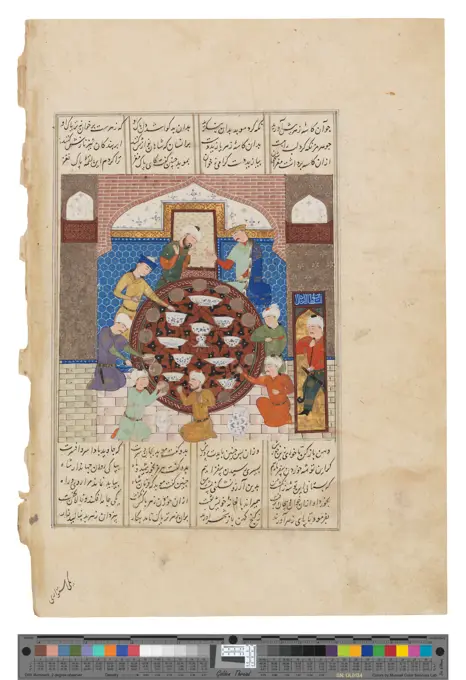
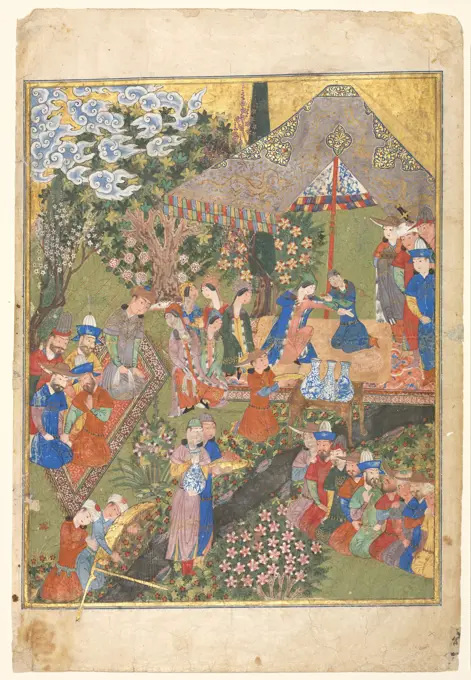
A Banquet Scene with Hormuz, Page from a Manuscript of the Shahnama (Book of Kings) of Firdawsi. Iran, Shiraz, circa 1485-1495. Manuscripts; folios. Ink, opaque watercolor, and gold on paper
6145-29067045
The kings handmaiden takes the prince away to the harem, from a Tuti-nama (Tales of a Parrot): Eighth Night, c. 1560. Mughal India, court of Akbar (reigned 1556-1605). Gum tempera, ink, and gold on paper; overall: 20.3 x 14 cm (8 x 5 1/2 in.); painting only: 9.2 x 10 cm (3 5/8 x 3 15/16 in.).
4409-17391872
"Rustam Captures the Shah of Sham and the Shah of Berber", Folio from a Shahnama (Book of Kings) of Firdausi. Author: Abu'l Qasim Firdausi (935-1020). Dimensions: Page: 8 1/16 x 5 1/4 in. (20.5 x 13.3 cm)Painting: 1 7/8 x 4 1/4 in. (4.7 x 10.8 cm). Date: ca. 1330-40.Rustam, heading the Persian forces, was called upon to defeat the combined armies of the shah of Hamavaran - who through treachery had captured the Persian shah, Kai Kavus - and his allies, the shahs of Sham and Berber. After fierce fighting, Rustam captured the allied kings and the shah of Hamavaran asked for peace. In this battle scene, depicted with liveliness and verve, Rustam, identifiable by his tiger-skin cuirass (right foreground) appears to be lassoing the shah of Sham though the lasso is missing. The shah of Sham (left) is bending forward on his horse as though pulled by the lasso.d. Museum: Metropolitan Museum of Art, New York, USA.
6145-51818479
Folio from a Manuscript of the Khamsa of Nizami Nizami. Folio from a Manuscript of the Khamsa of Nizami, 1447. Opaque watercolor, ink, and gold on paper, 11 1/4 x 7 1/4 in. (28.6 x 18.4 cm).   Asian Art 1447
4409-17533351
Death of Rustam and Shaghad, an episode from Firdausi's Shahnama (completed in 1010). Draughtsman: anonymous. Dating: 1417 - 1447. Place: Shiraz. Measurements: h 335 mm × w 225 mm. Museum: Rijksmuseum, Amsterdam.
4409-17505585
A Virtuous Woman Placates the King by Plucking Out Her Eyes. Date/Period: 1597-1598 (Mughal). Illuminated manuscripts; folios (leaves). Ink and pigments on laid paper ink and pigments on laid paper. Height: 28.50 mm (1.12 in); Width: 19 mm (0.74 in). Author: Amir Khosrow.
4409-17401609
"Amr has the Infidels Thrown into the Sea", Folio from a Khavarannama (The Book of the East) of ibn Husam al-Din. Author: Maulana Muhammad Ibn Husam ad Din (Persian, died 1470). Dimensions: 15 11/16 x 11 1/4in. (39.8 x 28.6cm). Date: ca. 1476-86.This painting, with its vibrant color palette and lively action, is taken from a manuscript of the Khavarannama (Book of the East), a gathering of tales relating the adventures of 'Ali ibn Abi Talib, son-in-law of the Prophet Muhammad. These mostly imaginary accounts of the exploits of 'Ali and his companions against demons, dragons, and kings were composed in emulation of the great Persian poet Firdausi's Shahnama, but have the important religious figure of 'Ali as their main protagonist. Museum: Metropolitan Museum of Art, New York, USA.
6145-29067966
Kaiwan, Latif, and Sharif arrive at a house of worship, where they seek help from Khurshid who has become a mystical healer, from a Tuti-Nama (Tales of a Parrot): Thirty-second Night, c. 1560. Mughal India, court of Akbar (reigned 1556-1605). Gum tempera, ink, and gold on paper; overall: 20.3 x 14 cm (8 x 5 1/2 in.); painting only: 14.3 x 10.1 cm (5 5/8 x 4 in.).
4443-28732505
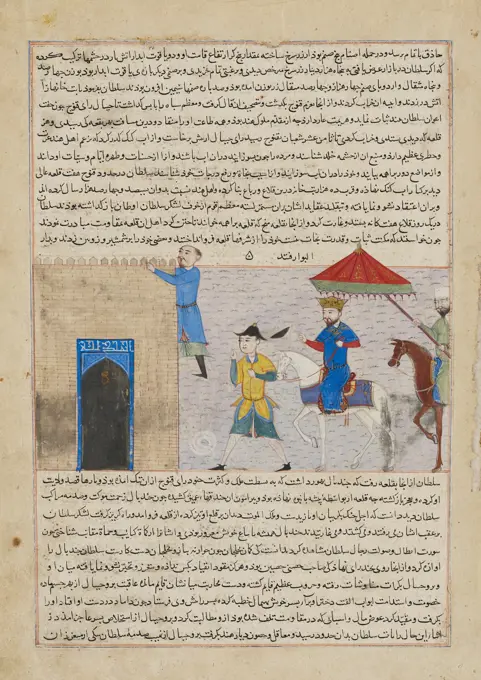
The Arrival of King Mahmud's Envoy at Gananj, 1425-30, Ḥāfi-i Abrū, died 1430, 16 7/8 × 13 1/8 in. (42.8 × 33.4 cm) (sheet)14 5/8 × 10 in. (37.1 × 25.4 cm) (image), Ink, opaque watercolor, and gold on paper, Afghanistan, 15th century, Sultan Mahmud, one of the most important patrons of Persian art and literature, arrives at the city gates of Gananj on horseback with his entourage in 1017. Mahmud had commissioned Ferdowsi to write the 50,000 verse Shah Nama (Book of Kings), and journeyed to Gananj to pay Ferdowsi the gold due him for his thirty-five year effort. Unfortunately, the great poet had just died and was thus denied the honor the Sultan intended to bestow on him
6145-29714383
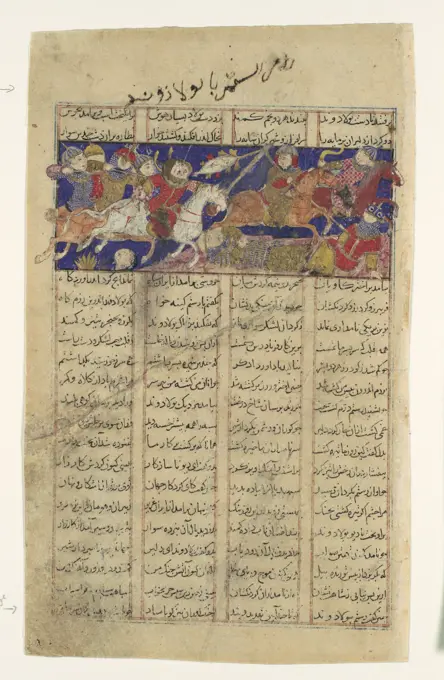
"The Combat of Rustam and Puladvand", Folio from a Shahnama (Book of Kings) ca. 1330-40 Abu'l Qasim Firdausi Generally, Shahnama illustrations of the single combat between the Iranian hero Rustam and the numerous div-like allies of the Turanians, who were prodigiously strong, show the final wrestling match when the victor is about to dash his enemy to the ground. Here, instead, the earlier episode of the horse fight between the two characters is depicted. The most unusual aspect of the present miniature is the strange flail-like weapon, presumably of Central Asian origin, dominating the center of the composition.. "The Combat of Rustam and Puladvand", Folio from a Shahnama (Book of Kings) 452640
6145-29122579
Fire Ordeal of Siyavush, Folio from a Shahnama (Book of Kings). India (), 1475-1500. Drawings; watercolors. Opaque watercolor, gold, and black and red ink on paper
6145-29067565
The parrot brings a fruit from the Tree of Life to the king of Syria, from a Tuti-nama (Tales of a Parrot): Ninth Night, c. 1560. Lalu. Gum tempera, ink, and gold on paper; painting only: 7.6 x 10.2 cm (3 x 4 in.); overall: 20 x 14.4 cm (7 7/8 x 5 11/16 in.).
1848-49391255
The cheating woman persuades her man to sleep in the same place where she slept with her lover in front of, from a Tuti-nama, Tales of a Parrot. Tutinama, Tales of a Parrot, is a series of 52 stories in Persian dating from the 14th century, in the 16th century Mughal Emperor Agbar commissioned an illustrated version, Eighth Night, c. 1560. Mughal India, Court of Akbar (r. 1556-1605) ., Historical, digitally restored reproduction from an original from the then
4409-17501915
"Timur before Battle", Folio from a Dispersed Copy of the Zafarnama (Book of Victories) of Sharaf al-din 'Ali Yazdi. Author: Sharaf al-din 'Ali Yazdi (1424-54). Calligrapher: Ya'qub ibn Hasan, known as Siraj al-Husaini. Dimensions: 11 1/2 x 8in. (29.2 x 20.3cm). Date: A.H. 839/A.D. 1436.This folio once illustrated a manuscript of the Zafarnama, a biography of the ruler Timur commissioned by his grandson Ibrahim Sultan (1394-1435). The painting, from a manuscript completed a year after Ibrahim Sultan's death, depicts the arrival of the Timurid army before the castle of Gortin in Georgia on Friday, 14th of Muharram, 806 A.H. (August 3, 1403 A.D.). This date, which appears on the other side of the folio, has made it possible for scholars to identify the scene. Museum: Metropolitan Museum of Art, New York, USA.
6145-29067075
Rustam meets the challenge of Ashkabus, from a Shah-nama (Book of Kings) of Firdausi (Persian, about 934-1020), c. 1590-1600. Iran, Shiraz, Safavid Period, 16th century. Opaque watercolor and gold on paper; overall: 31 x 20.1 cm (12 3/16 x 7 15/16 in.); text area: 25.4 x 15.7 cm (10 x 6 3/16 in.).
6145-29067939
The lovers son makes an elephant of the pastry dough carried by the unfaithful wife and puts it in her basket, from a Tuti-nama (Tales of a Parrot): Eighth Night, c. 1560. Mughal India, court of Akbar (reigned 1556-1605). Gum tempera, ink, and gold on paper; painting only: 8.9 x 9.9 cm (3 1/2 x 3 7/8 in.); overall: 20 x 14.4 cm (7 7/8 x 5 11/16 in.).
6145-59274918
Number of figures on a terrace for a red brick building, Anonymous, 1790 - 1810 Indian miniature. drawing On a terrace for a red brick wall with three gates are four figures in the background in front of the gates, on a white tiled piece there are three men, in meager clothing and a half bare; The show is placed halfway through the sheet in two columns of text in Persian handwriting. The performance is in the middle of the leaf and covers the width of two columns of text that are located above and below the performance and also on the back of the leaf. Cashmir paper brush / brush
6145-29067947
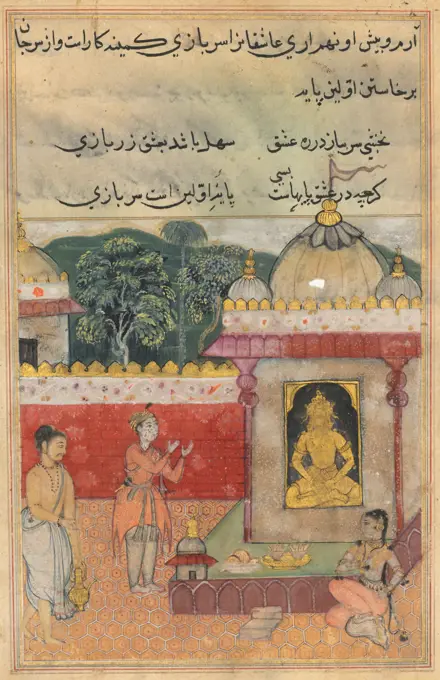
The Rajas son vows to sever his head and offer it to the image if he is united with the princess he has seen in the temple, from a Tuti-nama (Tales of a Parrot): Thirty-fourth Night, c. 1560. Mughal India, court of Akbar (reigned 1556-1605). Gum tempera, ink, and gold on paper; overall: 20.3 x 14 cm (8 x 5 1/2 in.); painting only: 12.5 x 10 cm (4 15/16 x 3 15/16 in.).
4409-17384134
"Faramarz Encircled While Battling Bahman", Folio 475r from the Shahnama (Book of Kings) of Shah Tahmasp. Artist: Painting attributed to Aqa Mirak (active ca. 1525-60). Author: Abu'l Qasim Firdausi (935-1020). Dimensions: Painting: H. 10 1/16 x W. 9 7/16 in. (H. 25.5 x W. 24 cm)Entire Page: H. 18 5/8 x W. 12 5/8 in. (H. 47.3 x W. 32.1 cm). Date: ca. 1530-35.Bahman, the son of Isfandiyar, wished to avenge his father's death by destroying Zabulistan (Sistan) and the remaining family of Rustam. Faramarz, Rustam's son, is shown here valiantly defending his homeland, but in the end he lost the battle, his land, and his life. The artist Aqa Mirak painted in the mature Safavid style, characterized here by large-scale figures set close to the foreground. This style anticipates that of illustrated manuscripts and single-figure studies of the 1540s and '50s. Museum: Metropolitan Museum of Art, New York, USA.
6145-29068264
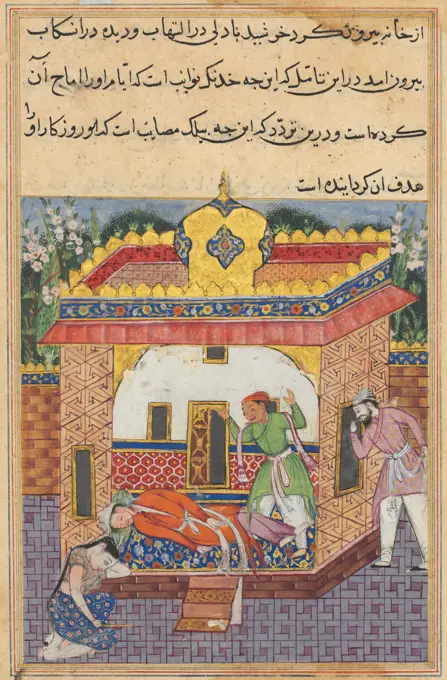
Latif, who has murdered his brother, falsely accuses Khurshid of the deed, from a Tuti-nama (Tales of a Parrot): Thirty-second Night, c. 1560. Mughal India, court of Akbar (reigned 1556-1605). Gum tempera, ink, and gold on paper; overall: 20.3 x 14 cm (8 x 5 1/2 in.); painting only: 12.5 x 10.1 cm (4 15/16 x 4 in.).
6145-29127381
35mm original
4443-28728457
Courtyard Scene, early 17th century, Ink and colors on paper, Iran, 17th century, This painting depicts an enclosed terrace at the edge of a royal garden in which servants are preparing drinks and fruit for a prince. The scene, based on a famous composition by the Persian artist Bihzad, dated 1488 and now in the Royal Egyptian Library in Cairo, is linked to one of the greatest Timurid painters. It demonstrates the conservative nature of book illustration, which often perpetuated standard themes and pictorial styles across several generations. The intense geometric ornamentation of the building in this work suggests the decorative wall tiles also exhibited here.
4443-21770528
White calligraphic text on sky blue clouds against a background of a golden field with colored floral motifs, vertically bordered in dark blue with golden tendrils, the upper part of the calligraphy has been pasted separately and largely disappeared. Along the (damaged) text sheet narrow strips of framed lines have been pasted and along them the rest of the leaf with floral motifs in gold surrounded by light brown tendrils against a background of sky blue, White calligraphic text on sky blue clouds., draughtsman: anonymous, Iran, 1570 - 1590, paper, brush, h 139 mm × w 77 mm, h 268 mm × w 155 mm
1899-18788012
Khwaja Shamsu d-Din Muhammad Hafez-e Shirazi, known by his pen name Hafez (1325/1326-1389/1390),was a Persian lyric poet. His collected works composed of series of Persian poetry (Divan) are to be found in the homes of most Persian speakers in Iran and Afghanistan, as well as elsewhere in the world, who learn his poems by heart and use them as proverbs and sayings to this day. His life and poems have been the subject of much analysis, commentary and interpretation, influencing post-fourteenth century Persian writing more than any other author. Themes of his ghazals are the beloved, faith, and exposing hypocrisy. His influence in the lives of Iranians can be found in 'Hafez readings', frequent use of his poems in Persian traditional music, visual art and Persian calligraphy. His tomb in Shiraz is visited often. Adaptations, imitations and translations of Hafez' poems exist in all major languages.
1848-49391277
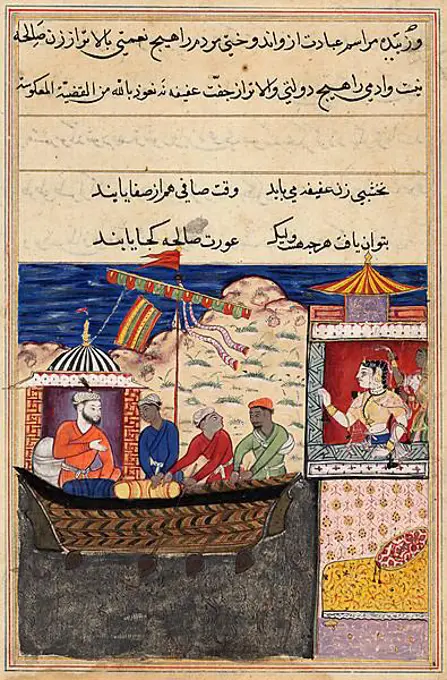
The merchant Mansur embarks on a sea voyage and leaves his woman behind, from a Tuti-nama, Tales of a Parrot. Tutinama, Tales of a Parrot, is a series of 52 stories in Persian from the 14th century, in the 16th century Mughal Emperor Agbar commissioned an illustrated version, Seventeenth Night, c. 1560. Mughal India, Court of Akbar (ruled 1556-1605) ., Historical, digitally restored reproduction from an original of the period
1889-60412106
Rajasthani miniature painting from Rajasthan, India.  Probably late 19th century or early 20th century.  A man courts a woman in a boudoir scene.
6145-29080814
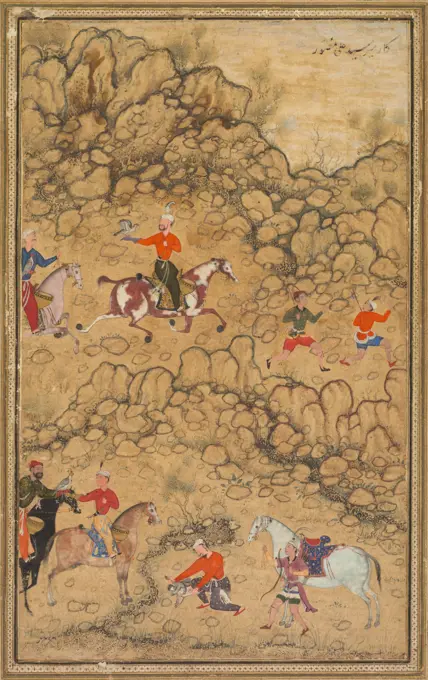
Hunting with falcons in a landscape; Verso: Calligraphy of Chaghatai Turkish poems in praise of wine, Sultan Muhammad Nur (Persian, c. 1472-1536) and Mirza Muhammad (probably Persian, active c. 1520s), c. 1558-60; borders added probably 1700s. Attributed to Abd al-Samad (Persian, c. 1510-1600). Opaque watercolor on paper (recto); ink on paper (verso); page: 35.7 x 24.3 cm (14 1/16 x 9 9/16 in.); painting: 21.5 x 13 cm (8 7/16 x 5 1/8 in.). The Mughals hunted on horseback with falcons. The hunting party would ride out into the wild and flush the prey. Then, its hood removed, the falcon would chase the prey and bring it down. From childhood Akbar loved hunting, and this painting may be a rare depiction of Akbar as a youth at the lower left, with the black feather in his white turban. The falcon that has caught a duck has been hooded and is being passed between the young man and his bearded companion. This important work was painted by one of the Persian artists Akbars father brought to
6145-29134418
Painting from Manuscript of The Diwan of Hafiz. Iran, Safavid, 16th century. Manuscripts; folios. Ink, colors, and gold on paper
6145-29168633
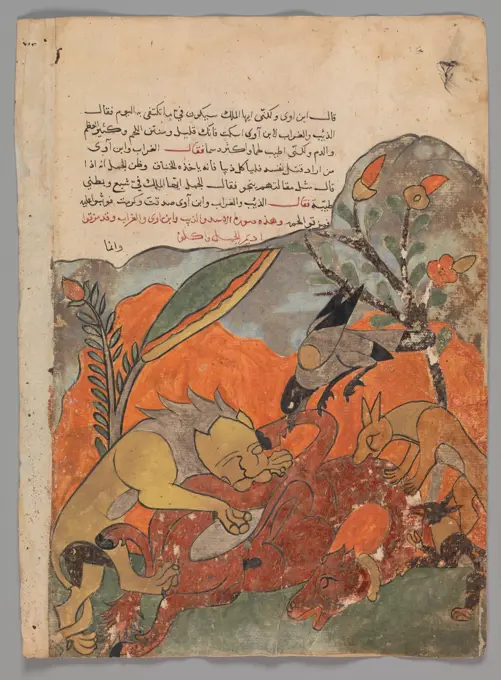
"The Attack on the Camel by the Lion, Crow, Wolf, and Jackal", Folio from a Kalila wa Dimna second quarter 16th century This manuscript contains seventy-eight paintings and many text folios telling the famous tales of the jackals Kalila and Dimna. Based on the book of ancient Indian animal fables, the Panchatantra written by Vidyapati (Bidpai), the stories spread all over the Middle East where they became wildly popular. This manuscript has a strong flavor of Mamluk Egypt in the figure styles and bold drawings, with hints of Ottoman tulips and Safavid turbans. However, the burnt orange palette and darkly-inked lines have led to an attribution to Sultanate Gujarat where it is suggested this manuscript was copied from an Egyptian original. Its life in India is also attested by a Devanagari inscription at the end, although the rest of the Arabic text is written in a strong, left-leaning naskh-like script.. "The Attack on the Camel by the Lion, Crow, Wolf, and Jackal", Folio from a Kalila
6145-29070666
Persian Quatrains (Rubayi) and Calligraphic Exercises (recto), c. 1509-59. Sultan Muhammad Khandan (Iranian, died after 1550). Ink, gold, and opaque watercolor on paper; sheet: 27.4 x 20 cm (10 13/16 x 7 7/8 in.); text area: 18.7 x 10.9 cm (7 3/8 x 4 5/16 in.).
4409-17543308
Calligraphy in Nastaliq script in a frame of colored spatulas. Draughtsman: anonymous. Dating: c. 1600 - c. 1699. Place: Iran. Measurements: h 42.5 cm × w 60 cm; h 191 mm × w 117 mm; h 354 mm × w 235 mm. Museum: Rijksmuseum, Amsterdam.
6145-29073782
King Luhrasp Ascends the Throne: a Processon Arrives at Court (recto); the Story of King Luhrasp (verso) from a Shahnama (Book of Kings) of Firdausi (940-1019 or 1025), c. 1560-90. Iran, Shiraz, Safavid period (1501-1722). Opaque watercolor, ink and gold on paper; sheet: 47 x 29.7 cm (18 1/2 x 11 11/16 in.); image: 43.9 x 26.6 cm (17 5/16 x 10 1/2 in.). This scene of a procession arriving at court was surely completed by the court scene itself. The subject of the frontispiece had nothing to do with the text that it accompanied, and the text has not been identified.
6145-29063616
Royal Reception in a Landscape, right folio from a double-page frontispiece of a Shahnama (Book of Kings) of Firdausi (940-1019 or 1025), 1444. Iran, Shiraz, Timurid period (1370-1501). Opaque watercolor, gold, and silver on paper; overall: 32.5 x 22.1 cm (12 13/16 x 8 11/16 in.); recto image: 27.7 x 10.3 cm (10 7/8 x 4 1/16 in.); verso image: 26.3 x 20.7 cm (10 3/8 x 8 1/8 in.). The painting on the verso of this folio is the first half of a double-page frontispiece now detached from a Shah-nama manuscript (see CMA 1956.10 for the second half of the frontispiece). The scene does not illustrate a narrative from the Shah-nama, but is likely a representation of the courtly audience for whose entertainment the manuscript was created. The date and style of the painting indicate that it was made during the reign of the Timurid dynasty in Shiraz, Iran.
1746-29012782
Persian (Iranian) Islamic style, manuscript, Illustrated 12th century: The poet Nezami recounts the tales of Alexander the great
4409-17403902
Bustan (Orchard) of Sa'di. Author: Sa'di (1213/19-92). Dimensions: 10.87 in. high 6.62 in. wide (27.6 cm high 16.8 cm wide). Date: 1529 or later. Museum: Metropolitan Museum of Art, New York, USA.
6145-29067740
The three young men present themselves as suitors for the hand of Zuhra, the daughter of the merchant of Kabul, from a Tuti-nama (Tales of a Parrot): Thirty-fourth Night, c. 1560. Mughal India, court of Akbar (reigned 1556-1605). Gum tempera, ink, and gold on paper; overall: 20.3 x 14 cm (8 x 5 1/2 in.); painting only: 16 x 10 cm (6 5/16 x 3 15/16 in.).
4409-17422844
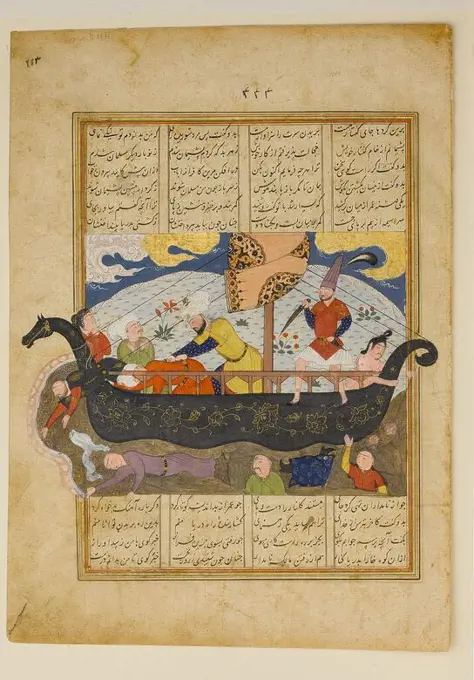
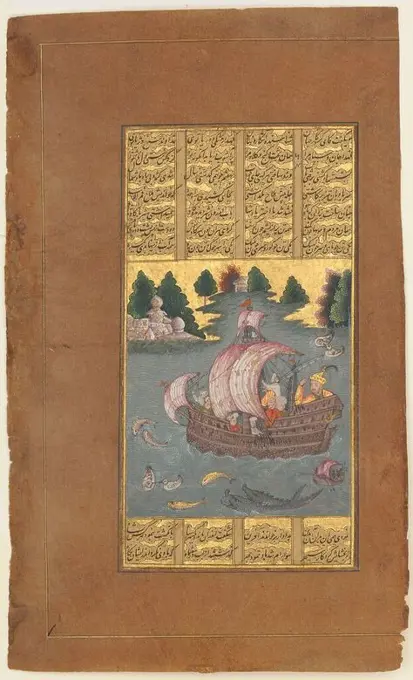
"Kai Khusrau Crosses the Sea", Folio from a Shahnama (Book of Kings) of Firdausi. Author: Abu'l Qasim Firdausi (935-1020). Dimensions: Page: 8 x 4 7/8 in. (20.3 x 12.4 cm)Painting: 5 3/8 x 2 3/4 in. (13.6 x 7 cm). Date: ca. 1610.These leaves come from a small-format manuscript of high quality, judging from the exquisite detail and lavish use of gold. The pastel palette and details like fantastic rock formations and small groupings of white buildings suggest the manuscript was made in Bijapur. This painting shows the ship of Kai Khusrau, which, when pursuing his enemy Afrasiyab, was blown off course by a fearful storm to a place with all manner of weird sea creatures. Museum: Metropolitan Museum of Art, New York, USA.
4430-3859
fine arts, islamic art, Persia, miniature, King Lohrasp on the throne surrounded by musicians and servants, ""Book of Kings"" (""Shahnameh"") of Ferdowsi (circa 1000), 1st half 16th century, Munich State Museum of Ethnology,
4409-17373194
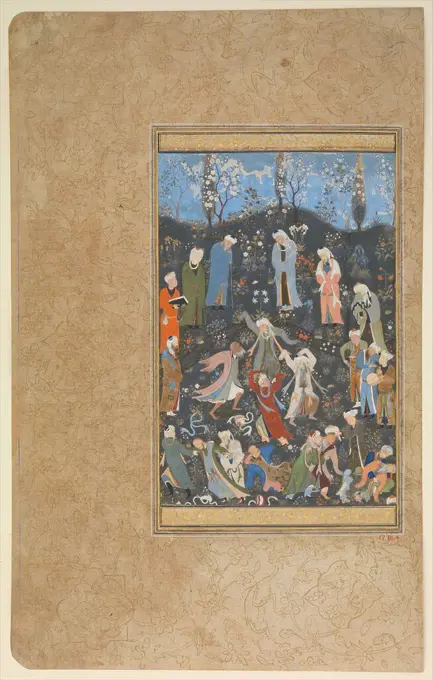
"Dancing Dervishes", Folio from a Divan of Hafiz. Artist: Painting attributed to Bihzad (ca. 1450-1535/36). Dimensions: Painting: H. 6 5/16 in. (16 cm) W. 4 1/4 in. (10.8 cm)Page: H. 11 3/4 in. (29.9 cm) W. 7 7/16 in. (18.9 cm)Mat: H. 19 1/4 in. (48.9 cm) W. 14 1/4 in. (36.2 cm). Poet: Hafiz (probably 1325/6-90). Date: ca. 1480.This miniature from a dispersed manuscript of the poems of Hafiz depicts Sufis or mystics dancing. In the court style of Herat, the rhythm set up by the whirling of the dancers contrasts with the meditative figures encircling them. Those overcome by the movement of the dance seen in the foreground exemplify the naturalism of this period, while the scene is set against a verdant landscape resembling an earthly paradise. Museum: Metropolitan Museum of Art, New York, USA. Author: Painting attributed to Bihzad.
1788-33071
Scene of battle between knights, miniature from the Persian tragic romance of Khosrow and Shirin, manuscript 362 folio 24 verso, 15th Century.
4409-17508927
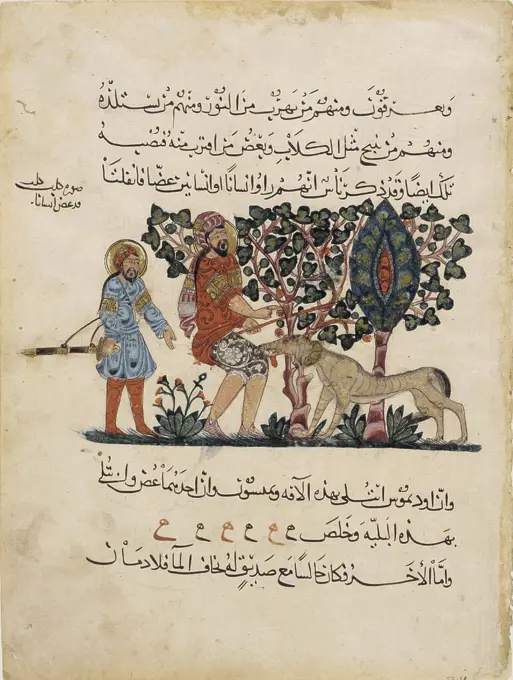
Folio from an Arabic translation of the Materia Medica by Dioscorides. Date/Period: 1224. Watercolor painting / manuscript. Opaque watercolor, ink and gold on paper. Height: 33.2 cm (13 in); Width: 25 cm (9.8 in). Author: PEDANIUS DIOSCORIDES.
6145-45956537
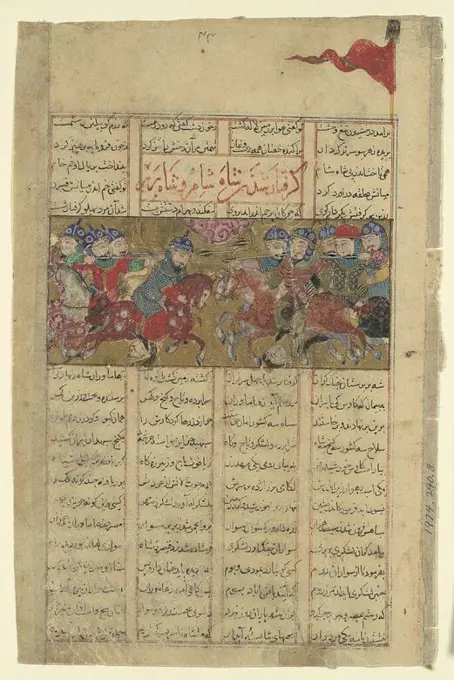
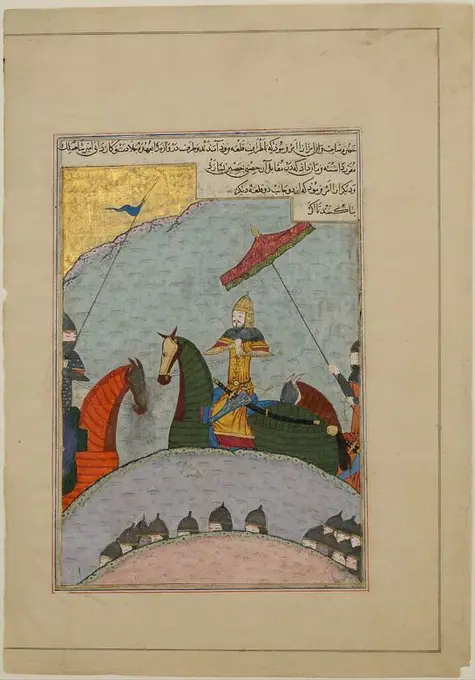
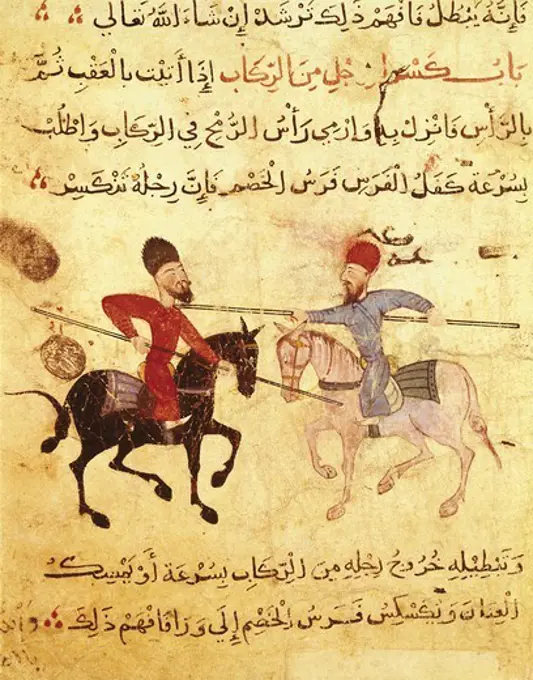
Remainder of a miniature with two riders and warriors. Two horsemen opposite each other keep a red whip, in the background behind the hills of warriors (). Remainder of a leaf, lower half disappeared, left half damaged and partly disappeared. On verso two columns text in former Persian script.
4409-8201
MINIATURA TURCA-ASCENSION DE MAHOMA. Location: NATIONAL LIBRARY. France. Mahoma. SAN GABRIEL ARCANGEL / ARCANGEL SAN GABRIEL.
4409-17382296
"Ceasar Captive Before Shapur II", Folio 543r from the Shahnama (Book of Kings) of Shah Tahmasp. Artist: Painting attributed to Aqa Mirak (active ca. 1525-60). Author: Abu'l Qasim Firdausi (935-1020). Dimensions: Painting: H. 8 5/8 x W. 8 7/16 in. (H. 21.9 x W. 21.4 cm)Entire Page: H. 18 5/8 x W. 12 1/2 in. (H. 47.3 x W. 31.8 cm). Date: 1530-35.Shah Shapur went to Rum disguised as a merchant, but was recognized at Caesar's court and thrown into prison. Caesar then invaded Iran, causing havoc. A sympathetic young man helped Shapur to escape to Iran, where he gathered an army to take revenge. He captured Caesar but spared his life, castigating him for his evil actions. Aqa Mirak, the last director of the Shahnama project, has minimized the number of figures to heighten the dramatic tension between the protagonists. Museum: Metropolitan Museum of Art, New York, USA.
6145-29081314
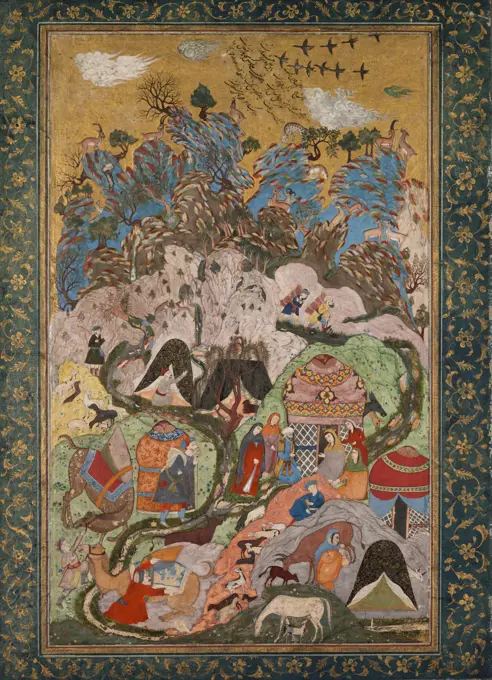
Encampment in the Mountains, c. 1650. India, Kashmir, 17th century. Color on paper; image: 34 x 21.1 cm (13 3/8 x 8 5/16 in.); overall: 40.2 x 27.7 cm (15 13/16 x 10 7/8 in.).
6145-29168585
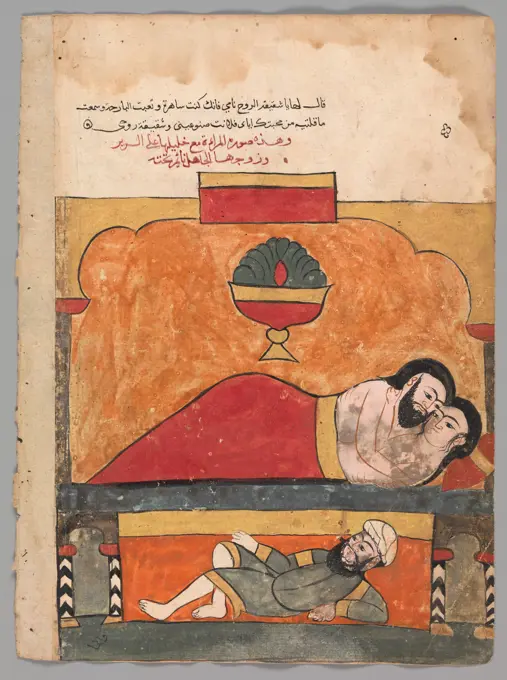
"The Cuckold Carpenter Under the Bed of his Wife and her Lover", Folio from a Kalila wa Dimna second quarter 16th century This manuscript contains seventy-eight paintings and many text folios telling the famous tales of the jackals Kalila and Dimna. Based on the book of ancient Indian animal fables, the Panchatantra written by Vidyapati (Bidpai), the stories spread all over the Middle East where they became wildly popular. This manuscript has a strong flavor of Mamluk Egypt in the figure styles and bold drawings, with hints of Ottoman tulips and Safavid turbans. However, the burnt orange palette and darkly-inked lines have led to an attribution to Sultanate Gujarat where it is suggested this manuscript was copied from an Egyptian original. Its life in India is also attested by a Devanagari inscription at the end, although the rest of the Arabic text is written in a strong, left-leaning naskh-like script.. "The Cuckold Carpenter Under the Bed of his Wife and her Lover", Folio from a Kal
6145-29748737
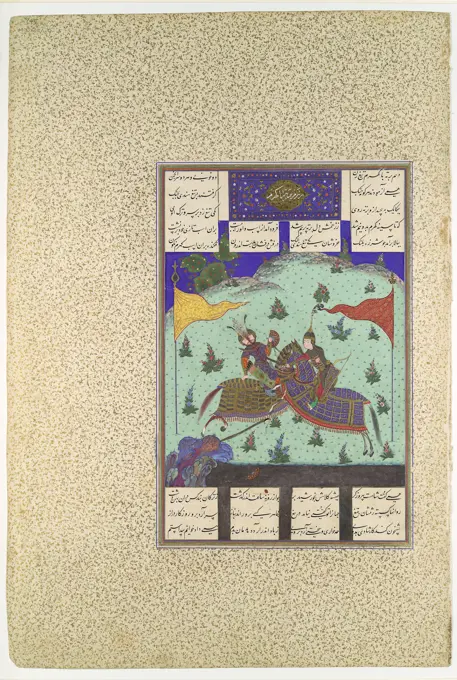
"The Tenth Joust of the Rooks: Barta versus Kuhram," Folio 345r from the Shahnama (Book of Kings) of Shah Tahmasp ca. 1525-30 Abu'l Qasim Firdausi With the eighth and ninth jousts the results are the same: more dead Turanians and more banners on the Iranian mound. In the tenth contest Barta of Iran and Kuhram of Turan confront one another, swords in hand. With a nimble shift of his horse, Barta cleaves Kuhram in two with his Indian scimitar.. "The Tenth Joust of the Rooks: Barta versus Kuhram," Folio 345r from the Shahnama (Book of Kings) of Shah Tahmasp 452154
6145-29738734
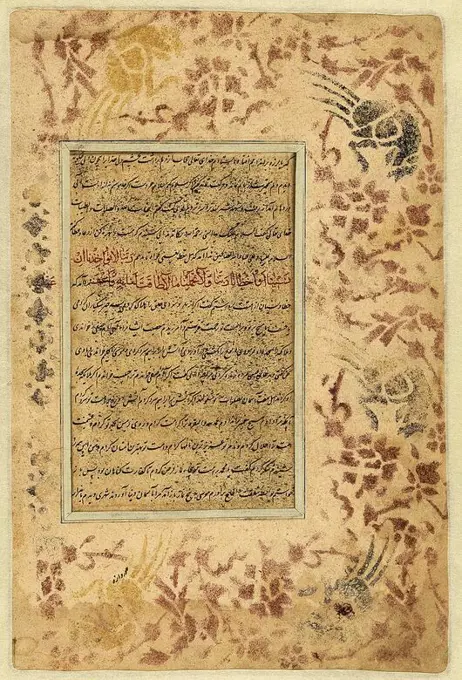
Calligraphic Folio with Persian Verses 17th century Six lines of Persian poetry in nastaliq appear in the central panel. The borders of this folio are executed with stenciling and marbling, through which figures of seated animals appear against a speckled ground.. Calligraphic Folio with Persian Verses 455048
1899-18787911
Yahya ibn Mahmod al-Wasiti was a 13th-century Arab Islamic artist. Al-Wasiti was born in Wasit in southern Iraq. He was noted for his illustrations of the Maqam of al-Hariri. Maqama (literally 'assemblies') are an (originally) Arabic literary genre of rhymed prose with intervals of poetry in which rhetorical extravagance is conspicuous. The 10th century author Badi' al-Zaman al-Hamadhani is said to have invented the form, which was extended by al-Hariri of Basra in the next century. Both authors' maqamat center on trickster figures whose wanderings and exploits in speaking to assemblies of the powerful are conveyed by a narrator. Manuscripts of al-Hariri's Maqamat, anecdotes of a roguish wanderer Abu Zayd from Saruj, were frequently illustrated with miniatures.
6145-29127353
35mm original
4409-17434298
"Bahram Recovers the Crown of Rivniz", Folio 245r from the Shahnama (Book of Kings) of of Abu'l Qasim Firdausi, commissioned by Shah Tahmasp. Artist: Painting attributed to Qadimi (active ca. 1525-65). Author: Abu'l Qasim Firdausi (935-1020). Dimensions: Painting: H. 9 1/4 x W. 10 3/8 in. (H. 23.5 x W. 26.4 cm)Entire Page: H. 18 3/4 x W. 12 5/8 in. (H. 47.6 x W. 32.1 cm). Date: ca. 1525-30.As the battle of Pashan continues, the Iranians start to gain control, but then Prince Rivniz, one of the sons of Kai Kavus, is killed, and his crown falls to the ground of the battlefield. Both the Iranians and the Turanians turn their focus to retrieving the crown until Bahram, son of Gudarz, rushes into the fray and scoops up the crown with the tip of his lance. Although both sides suffer many losses, the Turanians finish victorious. Museum: Metropolitan Museum of Art, New York, USA.
6145-51818694
The Mature Unrestrained Heroine Indian. The Mature Unrestrained Heroine, ca. 1660-1690. Opaque watercolor and gold on paper, sheet: 9 1/4 x 6 3/4 in. (23.5 x 17.1 cm).   Asian Art ca. 1660-1690
6145-55951921
Farâmarz slays Mihârk.. 1616. Firdawsî. text. illuminated manuscripts, Illuminations, Manuscripts. Spencer Collection. Manuscripts, Persian
1746-29012781
Persian (Iranian) Islamic style, manuscript, Illustrated 12th century: The poet Nezami recounts the tales of Alexander the great
6145-52333352
Georgie. Portrait de Chota Roustaveli, poete geogien du XII siecle.. Gagarin, Grigorii Grigorevich, kniaz (1810-1893). Prints, Illustrations. 1847. General Research Division. Caucasus
6145-29790009
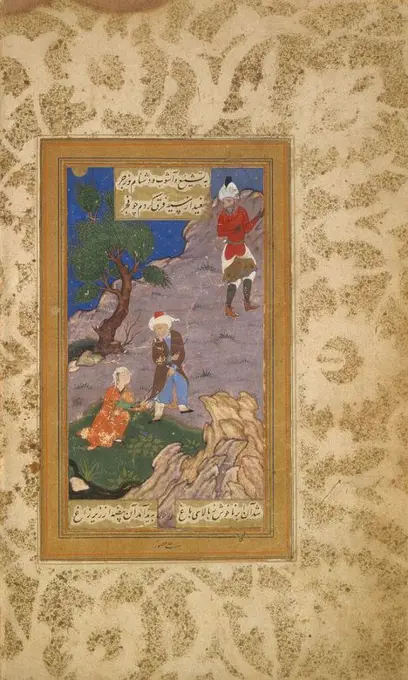
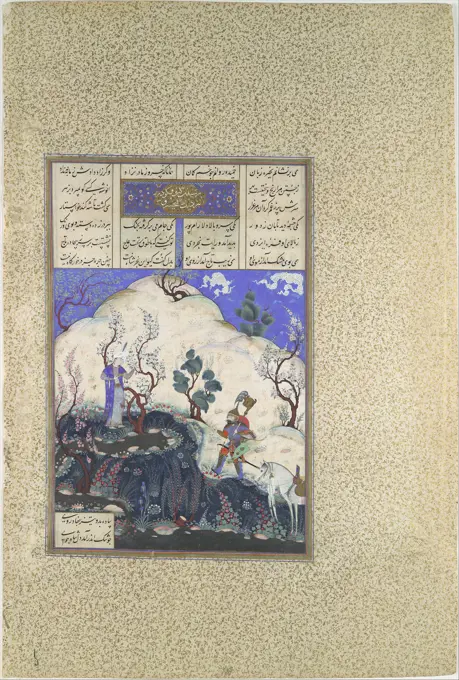
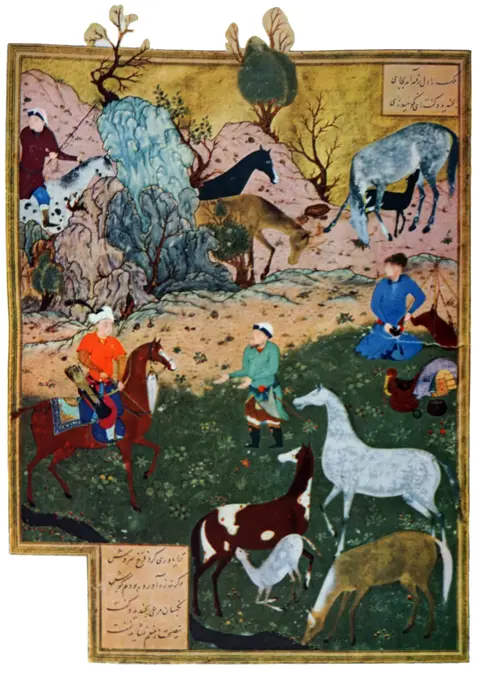
"Kai Khusrau is Discovered by Giv", Folio 210v from the Shahnama (Book of Kings) of Shah Tahmasp ca. 1525-30 Abu'l Qasim Firdausi After a sevenyear search for the future shah, the persistent Iranian knight Giv finally discovered the prince Kai Khusrau. Faithful to the story, the painting features an idyllic spring landscape, the remoteness of which is indicated by the barren hill in the background. The black pool next to Kai Khusrau and the stream flowing from it would have originally been silver, which has now tarnished.. "Kai Khusrau is Discovered by Giv", Folio 210v from the Shahnama (Book of Kings) of Shah Tahmasp 452141
4435-5826
Shahnameh. The Book of Kings. 16th c. Scene depicting a harem. Miniature Painting. EGYPT. CAIRO. Cairo. National Library.
4409-28962817
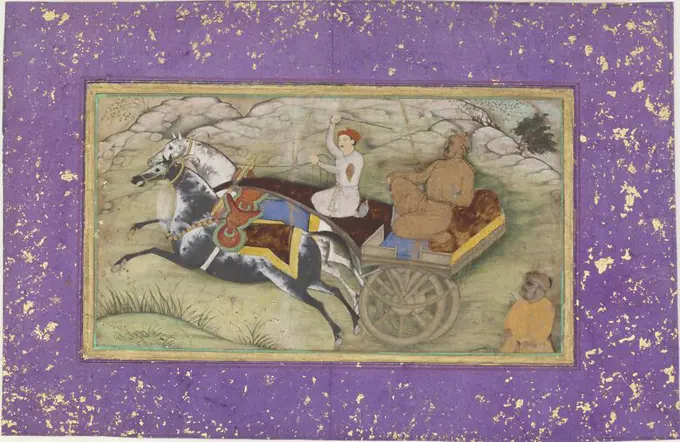
Sultan Salim in a Carriage. Period: Mughal dynasty. Opaque watercolor and gold on paper. Origin: Allahabad, Uttar Pradesh state, India. Date: ca. 1603. Museum: Freer Gallery of Art and Arthur M. Sackler Gallery.
1746-30020133
Persian painting. Colour plates
6145-29132586
Reunion of Vessantara and Maddi with Their Children and Parents. Thailand, Bangkok, 1820-1840. Drawings; watercolors. Opaque watercolor and gold on cloth
6145-55951884
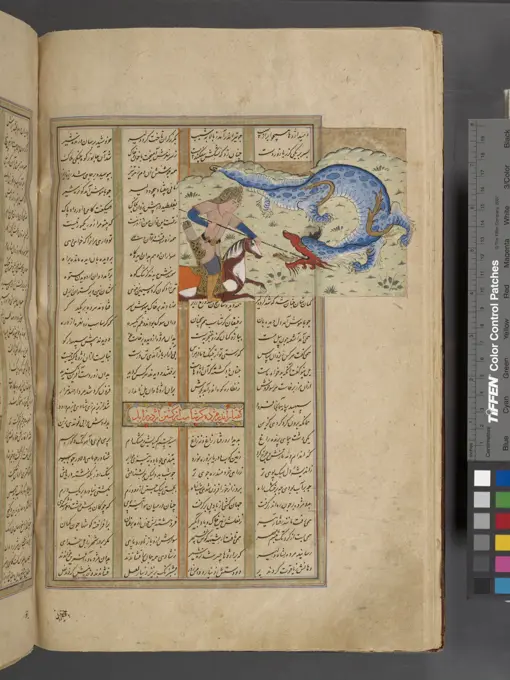
Garshâsp, an ancestor of Rustam, kills a dragon with a lance.. 1616. Firdawsî. text. illuminated manuscripts, Illuminations, Manuscripts. Spencer Collection. Manuscripts, Persian
6145-48527951
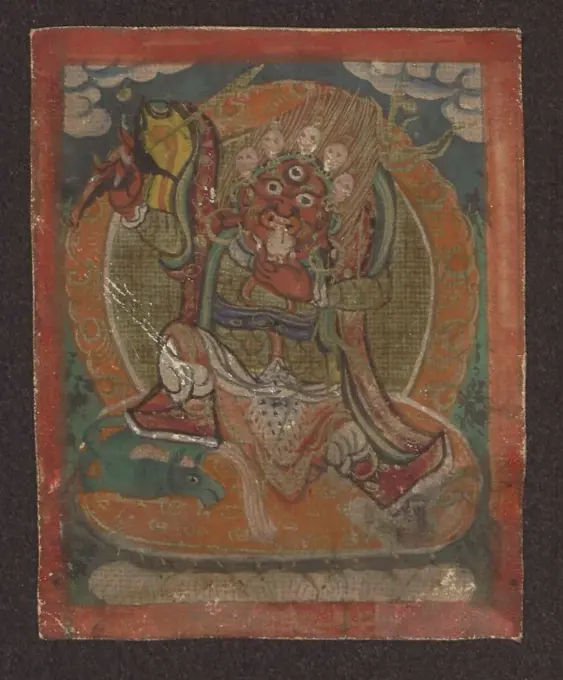
Miniatura rytualna tsakali z wyobrażeniem bóstwa - strażnika Begtse. unknown, painter
6145-55951952
The sîmurgh aids the wounded Rustam and Rakhsh.. 1616. Firdawsî. text. illuminated manuscripts, Illuminations, Manuscripts. Spencer Collection. Manuscripts, Persian
4443-75473789
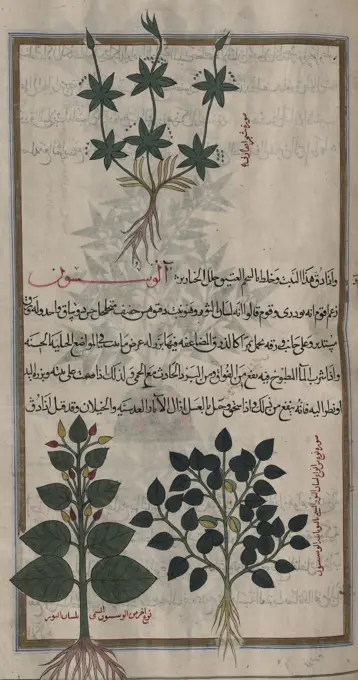
The illustration features two types of aquatic plants depicted as growing on the bottom of a pool. The top image shows Mouse ear (Auricula muris), also referred to as alsînî or âdhân al-fâr, while the bottom image depicts Duckweed (Lemna sp.), known as 'adas al-mâ' or 'water lentil'. The work is attributed to Mîrzâ Bâqir, created between 1889 and 1890, potentially in Tehran or Mashhad. The dimensions of the illustration are 17.2 x 11.2 cm for the top image and 5 x 9.3 cm for the bottom image, all presented on one page
4443-21770530
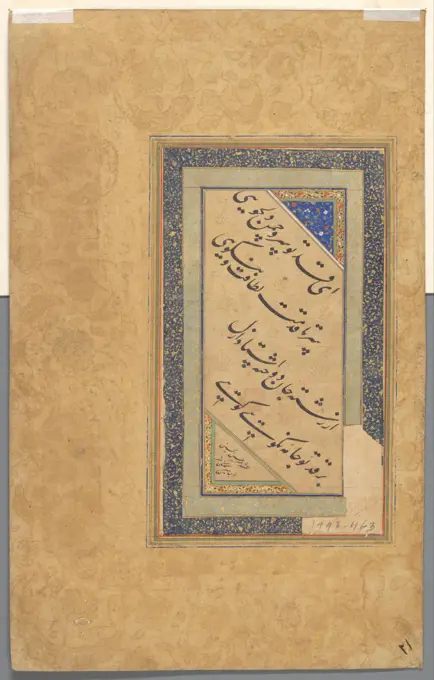
In a frame of two narrow ornamental borders in sky blue and dark blue speckled with gold, four diagonal lines of Persian calligraphy are placed, bottom left and top right two triangles with a narrow golden ornamental border form a closing, in the upper right corner an inscription is also placed, the leaf with the calligraphy is placed on the left side of a leaf veined with gold and separated from it by lines filled in with colors, Four diagonal lines of Persian calligraphy, draughtsman: anonymous, Iran, 1500 - 1700, paper, brush, h 164 mm × w 95 mm
4443-75470383
The image features three botanical illustrations on one page, showcasing two varieties of Goosegrass and lady's bedstraw (Galium verum; Galium aparine) at the top, along with Alyssum (Fibigia clypeata) at the bottom. The page dimensions are 16.3 x 11 cm for the top image and 16.1 x 12.1 cm and 18.5 x 10 cm for the bottom images. The work is attributed to Mîrzâ Bâqir, dating from 1889 to 1890, and may have been created in Tehran or Mashhad
6145-59271281
Design for illustration (fol. 1): Van den Vos Reinaerde, in the middle the writer Willem, Bernard Willem Wierink, 1866 - 1939 drawing Design for a print.  paper. cardboard. ink. pencil pen / brush fable of Reynard the Fox
6145-55950441
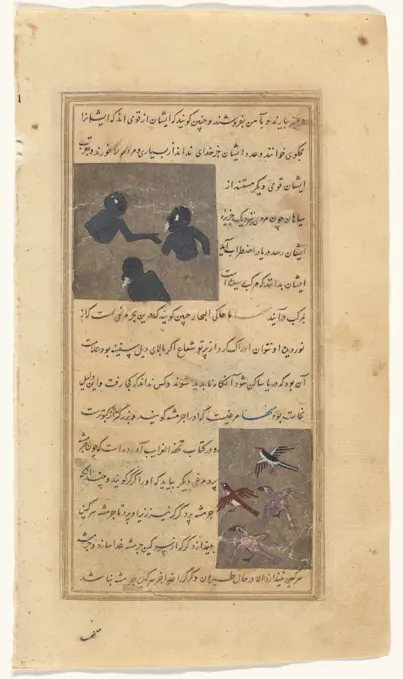
Three black cannibals swimming in a silver sea top; Four flying birds against a silver background bottom, f. 77v. 1540 - 1545. Qazwīnī, Zakarīyā ibn Muammad, approximately 1203-1283. text. Illuminations, Manuscripts, Miniatures (Illuminations). Spencer Collection. Mountains, Birds, Animals, Manuscripts, Persian
475-2330
Portrait of Sultan Selim II (1524-74) Firing a Bow and Arrow Nakkep Reis Haydar (1494-1572 Turkish) Gouache on Paper Topkapi Museum, Istanbul, Turkey
6145-29116605
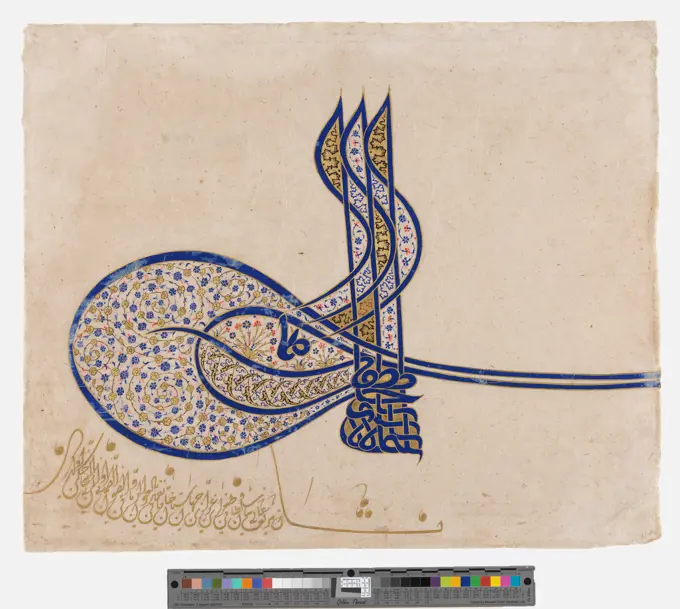
Tugra (Calligraphic Monogram) of Sulayman the Magnificent. Turkey, circa 1550-1565. Manuscripts; folios. Ink, opaque watercolor, and gold on paper
4435-5308
Fatimid period (10th-12th c.). Islamic art. Miniature Painting. EGYPT. CAIRO. Cairo. Museum of Islamic Arts.
6145-29725298
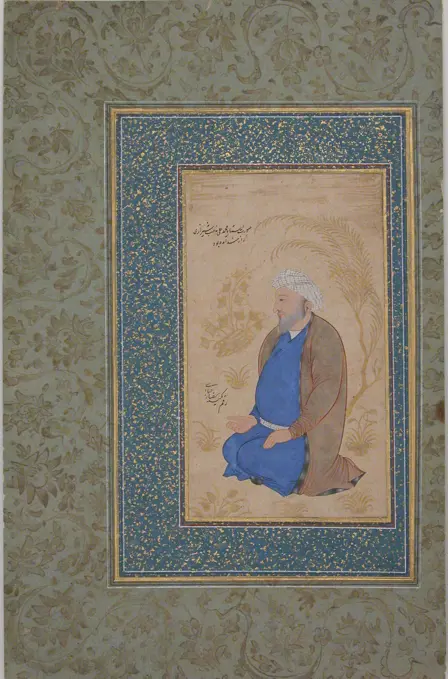
Portrait of Ustad Muhammad Ali 17th century. Portrait of Ustad Muhammad Ali. 17th century. Opaque watercolor and gold on paper. Attributed to Iran. Codices
6145-54583267
Mahavira Rides in His Initiation Palanquin, Folio 36 (recto), from a Kalpa-sutra, c. 1475-1500. Western India, Gujarat, last quarter of the 15th century. Gum tempera, ink, and gold on paper; overall: 12.5 x 25.7 cm (4 15/16 x 10 1/8 in.).
6145-51830500
Album Folio with Calligraphy Muhammad Rafi`. Album Folio with Calligraphy, 17th century. Ink, opaque watercolor, and gold on vellum; marbleized paper border, 4 7/16 x 7 7/8 in. (11.2 x 20 cm).   Arts of the Islamic World 17th century
PREVIOUS
of 1
NEXT
2401 S. Ervay, Suite 206
Dallas, Texas 75215
United States
Browse
CategoriesGalleriesFree Research
For Creators
License Your ContentSuperStock For StudentsFrame of Mind BlogContributor PortalNew Image SpotlightLicense AI Imagery
Resources
About UsLicensingTerms & ConditionsAPI AccessPrivacyPricing
Contact
+1 866 236 0087help@superstock.com Contact form
©2026 SuperStock. All Rights Reserved. -A
This site is protected by reCAPTCHA and Google Privacy Policy and Terms of Service apply.