Fine ArtVintageFootageSubscriptionBoardsFree ResearchPricing
  • Fine Art
  • Vintage
  • Footage
  • Subscription
  • Boards
  • Free Research
  • Pricing

Space Shuttle Maintenance

Images showcasing the intricate process of maintaining and decommissioning space shuttles at a NASA facility, featuring technicians and specialized equipment in action.

STS-133 DISCOVERY ENGINE-1 INSTALLATION
213 assets in this story
6145-44675935
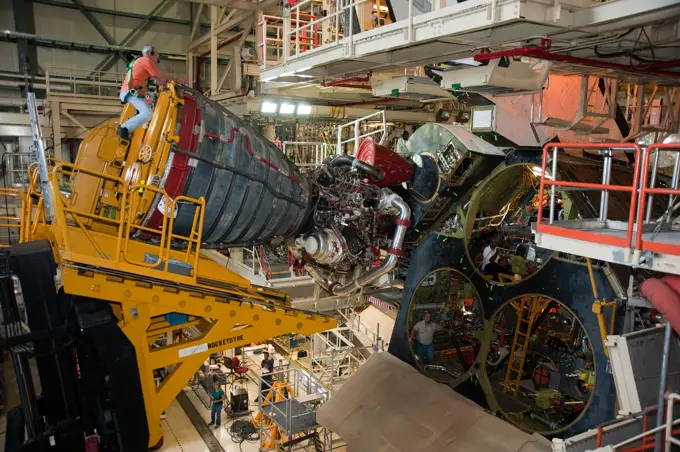
KENNEDY SPACE CENTER, FLA. --   In the Space Shuttle Maine Engine Shop, workers check the installation of an engine controller in one of the three main engines of the orbiter Discovery.  The controller is an electronics package mounted on each space shuttle main engine. It contains two digital computers and the associated electronics to control all main engine components and operations. The controller is attached to the main combustion chamber by shock-mounted fittings.  Discovery is the designated orbiter for mission STS-120 to the International Space Station.  It will carry a payload that includes the Node 2 module, named Harmony. Launch is targeted for no earlier than Oct. 20.
6145-58959760
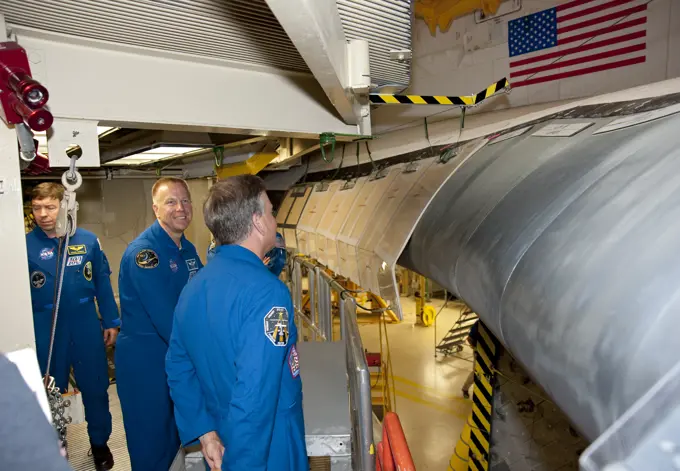
CAPE CANAVERAL, Fla. -- In Orbiter Processing Facility-3 at NASA's Kennedy Space Center in Florida, STS-133 Commander examines the shuttle's wing leading edge while Mission Specialist Tim Kopra and Michael Barratt look on. The astronauts are at Kennedy for the Crew Equipment Interface Test, or CEIT, which provides the crew with hands-on training and observation of shuttle and flight hardware for their mission to the International Space Station. Launch of the STS-133 mission on space shuttle Discovery is targeted for Nov. 1 at 4 33 p.m. EDT.
6145-58963851
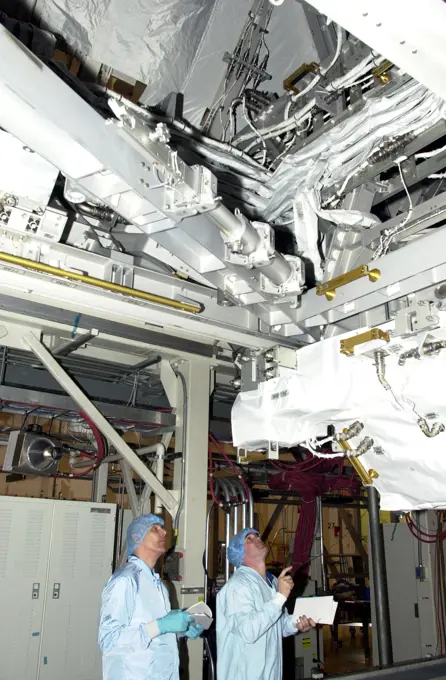
KENNEDY SPACE CENTER, FLA. - STS-110 Mission Specialists Lee Morin and Rex Walheim look up at the S0 Integrated Truss Structure, part of the payload on their mission to the International Space Station. Crew members are at KSC for Terminal Countdown Demonstration Test activities that include the payload familiarization and a simulated launch countdown. Mission STS-110 is scheduled for launch April 4.
6145-45107804
Inside Building 1555 at Vandenberg Air Force Base in California, technicians and engineers offload the first stage motor for the Orbital ATK Pegasus XL rocket which will launch eight NASA Cyclone Global Navigation Satellite System, or CYGNSS, spacecraft. When preparations are completed at Vandenberg, the rocket, with CYGNSS in its payload fairing, will be attached to the Orbital ATK L-1011 carrier aircraft and transported to NASAs Kennedy Space Center in Florida. On Dec. 12, 2016, the carrier aircraft is scheduled to take off from the Skid Strip at Cape Canaveral Air Force Station and CYGNSS will launch on the Pegasus XL rocket with the L-1011 flying off shore. CYGNSS will make frequent and accurate measurements of ocean surface winds throughout the life cycle of tropical storms and hurricanes. The data that CYGNSS provides will enable scientists to probe key air-sea interaction processes that take place near the core of storms, which are rapidly changing and play a critical role in t
6145-58971226
NASA Astronauts Stephanie Wilson, Jonny Kim, and Randy Bresnik take a look at the Orion spacecraft simulator that recently arrived at the agencys Johnson Space Center in Houston on Dec. 8, 2020. The simulator provides the ability for astronauts, engineers, and flight controllers to train and practice for scenarios during Artemis missions to the Moon. The interior of the simulator is being outfitted with Orions display and control system and crew seats to mimic what astronaut will experience during liftoff to the lunar vicinity and on their way back home to Earth...Kim and Wilson are among the 18 astronauts recently named to the Artemis Team of astronauts eligible to be selected for Artemis missions to the Moon. Bresnik is currently the assistant to the chief of the astronaut office for exploration. NASA is targeting 2023 for Artemis II, the first mission with crew, with the Orion Spacecraft set to launch atop the agencys Space Launch System rocket. The mission will send astronauts arou
6145-44609933
KENNEDY SPACE CENTER, FLA. -  In the SRB Assembly and Refurbishment Facility, STS-114 Mission Specialist Stephen Robinson looks at part of the thrust vector control system in a segment of a solid rocket booster. The crew is at KSC for familiarization with Shuttle and mission equipment. The STS-114 mission is Logistics Flight 1, which is scheduled to deliver supplies and equipment, plus the external stowage platform, to the International Space Station.
6145-58958342
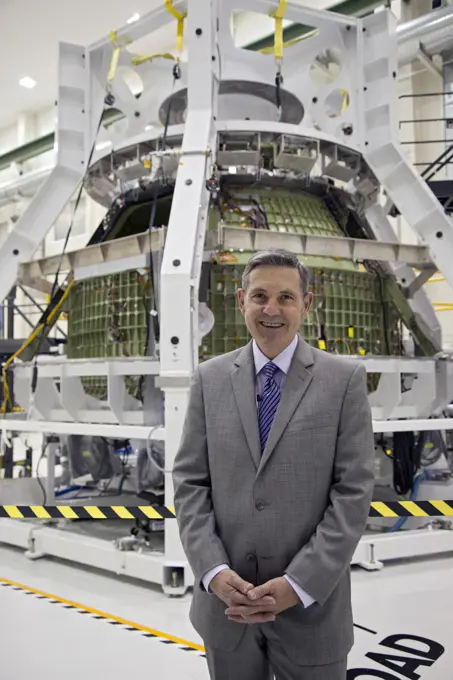
CAPE CANAVERAL, Fla. - Inside the high bay of Kennedy Space Center's Operations and Checkout Building, Kennedy Director Bob Cabana, stands in front of the Orion spacecraft which is surrounded by a special pre-launch processing access fixture. Orion is the exploration spacecraft designed to carry crews to space beyond low Earth orbit. It will provide emergency abort capability, sustain the crew during the space travel and provide safe re-entry from deep space return velocities. The first unpiloted test flight of the Orion is scheduled to launch in 2014 atop a Delta IV rocket and in 2017 on a Space Launch System rocket.
6145-44918165
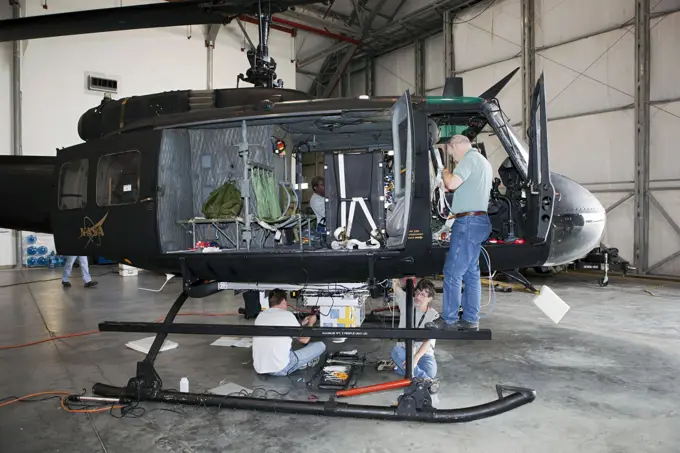
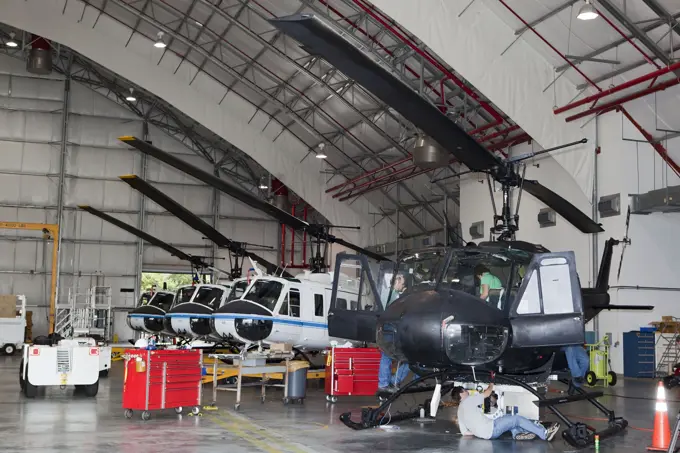
CAPE CANAVERAL, Fla. - Near the Shuttle Landing Facility at NASA's Kennedy Space Center in Florida, a space agency team installed and tested hazard avoidance instrumentation on a Huey helicopter. Led by the Johnson Space Center and supported by Jet Propulsion Laboratory and Langley Research Center, the Autonomous Landing Hazard Avoidance Technology, or ALHAT, laser system provides a planetary lander the ability to precisely land safely on a surface while detecting any dangerous obstacles such as rocks, holes and slopes. Just north of Kennedy's Shuttle Landing Facility runway, a rock- and crater-filled planetary scape has been built so engineers can test the ability to negotiate away from risks.
6145-44550247
KENNEDY SPACE CENTER, FLA. -- Some of the former Apollo program astronauts admire an Apollo Command and Service Module during a tour the new Apollo/Saturn V Center (ASVC) at KSC prior to the gala grand opening ceremony for the facility that was held Jan. 8, 1997. The astronauts were invited to participate in the event, which also featured NASA Administrator Dan Goldin and KSC Director Jay Honeycutt. The astronauts are (from left): Apollo 10 Command Module Pilot and Apollo 16 Commander John W. Young;. Apollo 11 Lunar Module Pilot Edwin E. "Buzz" Aldrin, Jr.; Apollo 17 Commander Eugene A. Cernan; and Apollo 10 Commander Thomas P. Stafford. The ASVC also features several other Apollo program spacecraft components, multimedia presentations and a simulated Apollo/Saturn V liftoff. The facility will be a part of the KSC bus tour that embarks from the KSC Visitor Center
6145-44776908
CAPE CANAVERAL, Fla. - On a tour of NASA's Kennedy Space Center in Florida, NASA Administrator Charles Bolden stops in the Operations and Checkout Building to view the high bay planned for the assembly of the Constellation Program's Orion crew vehicle.  At left are Chief of Staff in the Office of the Administrator George Whitesides, Center Director Bob Cabana (back to camera) and Bolden.  Facing Bolden is Lockheed Martin Space Systems Company Deputy Program Manager Richard F. Harris. Bolden is touring several facilities at Kennedy involved with NASA's  Constellation Program. Bolden also was at Kennedy for several events, including the landing of space shuttle Endeavour's STS-127 mission and the signing of the joint NASA-Japan Aerospace Exploration Agency agreement defining the terms of cooperation between the agencies on the Global Precipitation Measurement, or GPM, mission.
6145-45071475
CAPE CANAVERAL, Fla. - Inside the Neil Armstrong Operations and Checkout Building high bay at NASA's Kennedy Space Center in Florida, members of the Brevard Police and Fire Pipes and Drums lead NASA and Lockheed Martin workers out of the high bay after a ceremony to turn over the Orion spacecraft for Exploration Flight Test-1 to Lockheed Martin Ground Operations from Orion Assembly, Integration and Production.   Orion is the exploration spacecraft designed to carry astronauts to destinations not yet explored by humans, including an asteroid and Mars. It will have emergency abort capability, sustain the crew during space travel and provide safe re-entry from deep space return velocities. The first unpiloted test flight of the Orion is scheduled to launch atop a United Launch Alliance Delta IV Heavy rocket from Cape Canaveral Air Force Station in Florida in December to an altitude of 3,600 miles above the Earth's surface. The two-orbit, four-hour flight test will help engineers evaluat
6145-44918161
CAPE CANAVERAL, Fla. - Near the Shuttle Landing Facility at NASA's Kennedy Space Center in Florida, a space agency team installed and tested hazard avoidance instrumentation on a Huey helicopter. Led by the Johnson Space Center and supported by Jet Propulsion Laboratory and Langley Research Center, the Autonomous Landing Hazard Avoidance Technology, or ALHAT, laser system provides a planetary lander the ability to precisely land safely on a surface while detecting any dangerous obstacles such as rocks, holes and slopes. Just north of Kennedy's Shuttle Landing Facility runway, a rock- and crater-filled planetary scape has been built so engineers can test the ability to negotiate away from risks.
6145-44639903
KENNEDY SPACE CENTER, FLA. - In NASA Kennedy Space Centers Orbiter Processing Facility bay 3, a fuel cell removed from the orbiter Discovery is lowered toward the floor.  Fuel cells are located under the forward portion of the payload bay.  They make power for the orbiter by mixing hydrogen and oxygen to produce electricity.  Fuel cells also create potable water that is pumped into storage tanks for the crew to use in orbit.  Discovery is the designated orbiter for the second return-to-flight mission, STS-121, scheduled for launch in May.
PREVIOUS
of 3
NEXT
2401 S. Ervay, Suite 206
Dallas, Texas 75215
United States
Browse
CategoriesGalleriesFree Research
For Creators
License Your ContentSuperStock For StudentsFrame of Mind BlogContributor PortalNew Image SpotlightLicense AI Imagery
Resources
About UsLicensingTerms & ConditionsAPI AccessPrivacyPricing
Contact
+1 866 236 0087help@superstock.com Contact form
©2026 SuperStock. All Rights Reserved. -A
This site is protected by reCAPTCHA and Google Privacy Policy and Terms of Service apply.